The world is graying at a break-neck pace and that’s bad news for the global economy.
By 2020, 13 countries will be “super-aged” — with more than 20% of the population over 65 — according to a report by Moody’s Investor Service.
That number will rise to 34 nations by 2030. Only three qualify now: Germany, Italy and Japan.
“Demographic transition … is now upon us,” warn Elena Duggar and Madhavi Bokil, the authors of the Moody’s report.
“The unprecedented pace of aging will have a significant negative effect on economic growth over the next two decades across all regions.”
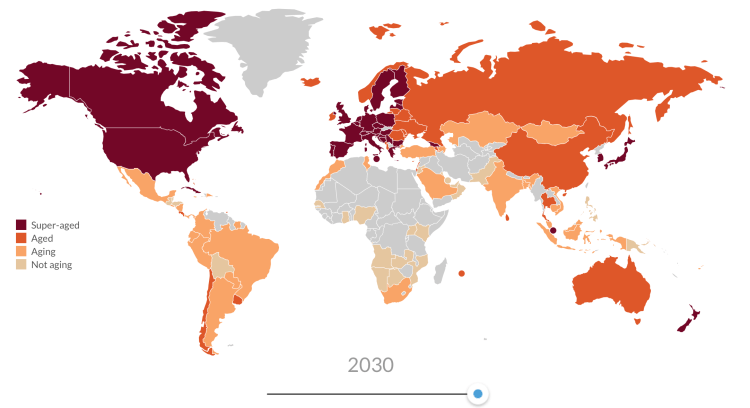
v
Chosen excerpts by Job Market Monitor. Read the whole story at World will have 13 ‘super-aged’ nations by 2020 – Aug. 21, 2014.
Related Posts
The Ageing Population: no historical evidence of impact on productivity or creativity
Complaints about the graying of the population sometimes imply an inevitable loss of economic dynamism. But I know of no historical evidence that either the productivity or the creativity of a society is determined by the age structure of its population. The interaction between demographic and economic change is so much more complex than the … Continue reading
The “graying” of the planet – The case of 30 of the world’s capitals
What do urban people care about most?What do talented professionals in their most productive working years care about most? What are the qualities that cities need in order to continue building prosperity? What about the increasing proportion of older citizens as we live longer or slow our rate of natural population growth? Does a rising … Continue reading
The Demography of Largest Countries 2010–50 in a Figure
Source: THE UNITED STATES AFTER THE GREAT RECESSION: THE CHALLENGE OF SUSTAINABLE GROWTH
China | Demography | Aging : the long-term implications
Canada and Europe are not alone in dealing with important demographic shifts. And worries about increasing recruitment problems, workforce shortages and skills gap are widespread. But there might be more critical situations. For instance, China is just beginning its huge demographic transition. In an article published on brookings.edu, Wan Feng qualifies China as a “demographic overachiever” and analyses … Continue reading
The Ageing Workforce in Europe – A report from The Economist Intelligence Unit
Historically low birth rates and increasing life expectancy mean that Europe’s working population is ageing fast. In 2012, the continent reached an inevitable demographic tipping point. The percentage of the population at working age fell for the first time in 40 years. It is now forecast to fall every year until 2060. This inescapable trend … Continue reading
US – Birthrate fell to “another record low” in 2012
Last September, the U.S. government announced that our birthrate fell to “another record low” in 2012, following a long, steady slide since the Baby Boom after World War II. It goes without saying that, morally speaking, there’s nothing wrong with this. It’s natural, in a way. All over the world, birthrates tend to fall along with … Continue reading
Korea / Ageing faster than any other country in the OECD
South Korea is ageing faster than any other country in the OECD. Last year almost 12% of the population were aged 65 or over. By 2030 that proportion will double Continue reading
Taiwan / From ‘aging’ to ‘aged’
Official statistics showing an increase in Taiwan’s 65-and-over population indicate that the nation is on course to go from being an “aging society” to an “aged society” Continue reading
The Talent War / The implications of the demographic outlook and immigration flows are substantial says a report
The implications for policymakers are substantial. First of all, receiving countries will have to invest more in developing smart migration, integration, and nondiscrimination policies Continue reading
China / Working-age population shrank in 2012
China’s working-age population shrank in 2012, marking the beginning of a trend that will accelerate over the next two decades and have profound implications for the world’s second-largest economy. By the end of December China’s population aged between 15 and 59 was 937.27 m, a decrease of 3.45m from 2011, according to figures released by … Continue reading
Canada – Aging population could have a positive effect on the labour market outcomes of youth research finds
Post-recession it is common to hear concerns that youth, facing high unemployment rates, are unable to find good job opportunities. Historically, youth have experienced higher unemployment rates than older workers. In the context of an aging workforce dominated by the baby boom generation and delayed retirement, there appears a general concern that older workers are … Continue reading
America’s Aging Workforce
More older Americans want to work than ever before. There is no question that economic stresses have delayed retirement and driven older people to keep working. But there are other forces at work, and they’re part of a sustained change that’s been going on for more than 20 years. Last week’s strong employment report showed … Continue reading
Employer Strategies for an aging workforce
There are a number of reasons why employers should ensure that workers over the age of 50 remain actively employed with their organization. Nobody wants to lose good workers, and most in this age group have a wealth of experience within both their industry and their company. Many of them enjoy what they do and … Continue reading
The effect of population growth on per capita GDP growth is negative in developing countries | Minh Quang Dao
Based on data from the World Bank and using a sample of forty-three developing economies, the author finds that the growth rate of per capita GDP is linearly dependent upon population growth, both the young and old dependency ratios, the mortality rate. Continue reading



 Job Market Monitor
Discussion
Trackbacks/Pingbacks
Pingback: Canada – Aging population expected to go west | Job Market Monitor - September 18, 2014
Pingback: The long-term employment challenge – The productivity solution | Job Market Monitor - January 16, 2015
Pingback: Job Market Monitor - May 25, 2017