Governments sometimes promote reforms that increase access to education for a large share of the population. These reforms may lower the returns to education by altering returns to skills, education quality, and peer effects. This column examines a 1961 Italian reform that increased enrolment in university STEM majors among students who had previously been denied access. The reform ultimately failed to raise their incomes.
Several findings suggest that the enrolment expansion following the policy implementation lowered the returns to a STEM degree. To analyze changes in the value of a university education, I focus on the students who were not directly affected by the reform – the graduates from university-prep high schools. Among these students, returns to STEM education declined after 1961 to the point of erasing the pre-reform income premium associated with a STEM degree.
This decline can be partially explained by a lower amount of skills acquired in STEM majors after 1961. I find that human capital (measured by absolute grades) decreased more in STEM courses in which resources became more crowded and in which the entry of technical students had greater disruptive potential. Overall, lower resources per student can explain 31% of the income decline, while the change in class composition can explain another 37.3%. The remaining share can be attributed to higher supply of workers with a university STEM education or possibly other minor channels of general equilibrium effects.
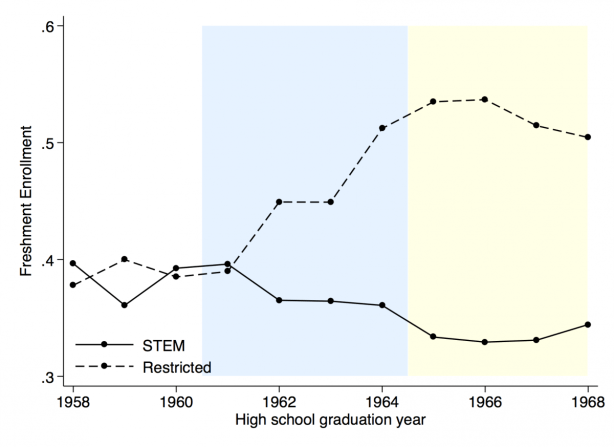
By decreasing the value of STEM education, the reform might have deprived STEM majors of talented students. After 1961, many more students with a university-prep diploma decided to enroll in university majors that were still not accessible to technical students (see Figure 2). This effect was concentrated among the students with higher high school grades.
Figure 2 Cohort shares of students from university-prep high schools enrolling in university STEM majors and programs with restricted access after 1961
Chosen excerpts by Job Market Monitor. Read the whole story at Access to higher education and the value of a university degree | VOX, CEPR’s Policy Portal.
Related Posts
US – 74 percent of STEM grads are not employed in STEM occupations finds Census Bureau
The U.S. Census Bureau reported today that 74 percent of those who have a bachelor’s degree in science, technology, engineering and math — commonly referred to as STEM — are not employed in STEM occupations. In addition, men continue to be overrepresented in STEM, especially in computer and engineering occupations. About 86 percent of engineers … Continue reading
Higher Education and Employability in Europe – Using labour market information systematically in policy planning is relatively rare report says
Besides a few exceptions (Bulgaria, Croatia, Portugal and Liechtenstein), labour market forecasting exists at national and/or regional levels in most European countries (14). As Figure 4.2 shows, labour market forecasts are conducted in an ad hoc manner in 10 countries, while there is a regular, established system in 13 countries. In Lithuania, a regular labour … Continue reading
STEM in US – The barriers to entry are also lower than most think.
With the expansion of advanced technologies and processes into more and more fields, the science, technology, engineering and math (STEM) economy is much bigger than many imagine and the barriers to entry are also lower than most think. Occupations like pipefitting and welding require only a high school diploma plus technical training to start. In … Continue reading
Careers Guidance in STEM in UK – More than half of 14 to 16-year-olds interested knew very little about these jobs
While enthusiasm for science, technology, engineering and maths, remains high among school pupils, lack of careers guidance means few young people continue into industry. Britain is facing a skills “crisis” as not enough is being done to encourage young people into STEM related careers, despite there being enthusiasm for the subjects, according to new research. … Continue reading
US – Employment and wages in STEM by the BLS
Employment Total May 2013 OES employment in all STEM occupations is 16,994,480. This is nearly 13 percent of total national employment (132,588,810). Across the four types of STEM subdomains, health occupations have the most employment (8,276,100) and architecture occupations have the least employment (156,650). Of the five types of STEM occupations, the largest by far … Continue reading



 Job Market Monitor
Discussion
Trackbacks/Pingbacks
Pingback: STEM workforce in Australia – 2.3 million people with qualifications | Job Market Monitor - April 1, 2016
Pingback: Italy – 85,000 people applied for 30 jobs at a bank | Job Market Monitor - July 3, 2017
Pingback: STEM Workforce in US – Has grown 79% since 1990 | Job Market Monitor - January 13, 2018
Pingback: STEM Workforce in US – Has grown 79% since 1990 | Job Market Monitor - January 13, 2018