A frequent question is: “I’ve heard the participation rate for older workers is increasing, yet you say one of the reasons the overall participation rate has fallen is because people are retiring. Is this a contradiction?”
Answer: This isn’t a contradiction. When we talk about an increasing participation rate for older workers, we are referring to people in a certain age group. As an example, for people in the “60 to 64” age group, the participation rate has increased over the last ten years from 51.1% in April 2004 to 55.7% in April 2014 (see table at bottom for changes in all 5 year age groups over the last 10 years).
However, when we talk about the overall participation rate, we also need to know how many people are in a particular age group at a given time. As an example, currently there is a large cohort that has recently moved into the “60 to 69” age group. To calculate the overall participation rate we need to multiple the participation rate for each age group by the number of people in the age group.
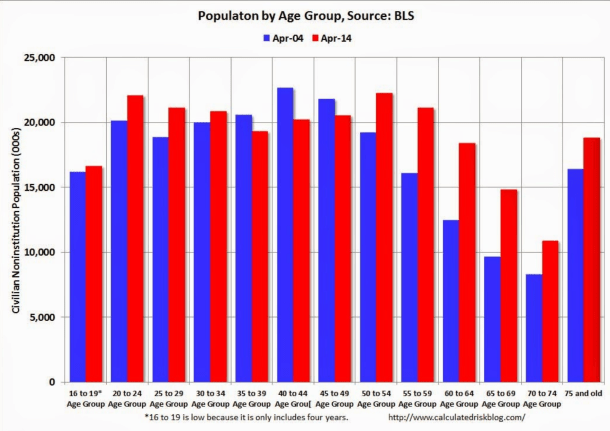
Chosen excerpts by Job Market Monitor. Read the whole story at Calculated Risk: Participation Rate: Trends and Cohorts.
Related articles
- US / Why Is Labor Force Participation Shrinking?
- US – Labor Force Participation Rate Update
- Baby Boomers and Participation in US – The aging effect accounts for more than 40 percent of the decline
- Discouraged workers in US / What if they were still in ?




 Job Market Monitor
Discussion
Trackbacks/Pingbacks
Pingback: Participation in the US – The decline | Job Market Monitor - August 19, 2014
Pingback: Participation in US – Ongoing structural influences with some crowding out of job opportunities for young workers research finds | Job Market Monitor - September 8, 2014
Pingback: Participation in US – Much, but not all, of the decline since 2007 is structural says FED research | Job Market Monitor - September 25, 2014
Pingback: Older Workers in UK – Although their number in employment is rising, employment rates still drop sizeably reports says | Job Market Monitor - April 6, 2017