Since easier access to a large supply of foreign labour might generate undesirable incentives on the part of both employers and prospective workers, a Temporary Foreign Worker (TFW) program requires careful design. Failure at any stage of the process – at time of hiring, during employment, or at the end of the contract – is likely to create significant negative effects on domestic workers and, in the medium term, on the temporary foreign workers themselves. 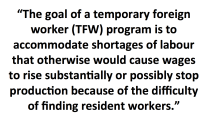
When choosing between domestic and foreign workers, employers are naturally concerned about labour costs and labour productivity. Therefore, a key design feature of any TFW program is the hiring conditions it imposes on employers – conditions that must deal with regional or occupational labour market shortages.
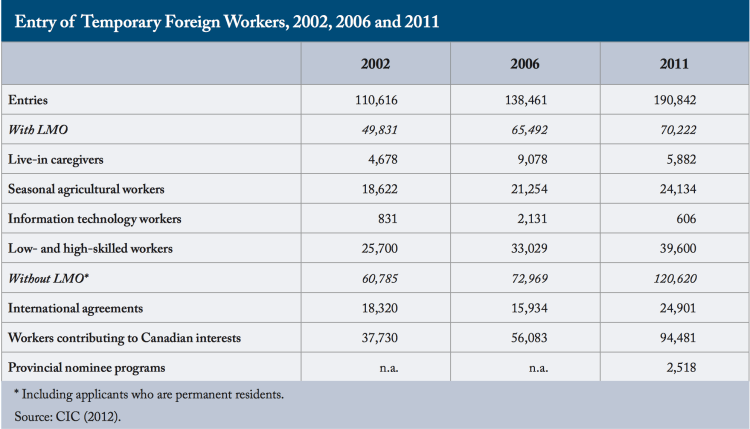
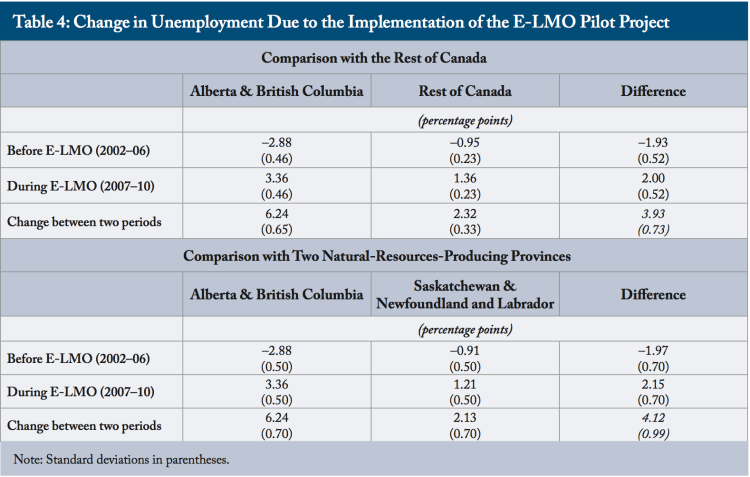
Between 2002 and 2013, Canada eased the hiring conditions of TFWs several times, supposedly because of a reported labour shortage in some occupations, especially in western Canada. By 2012, the number of employed TFWs was 338,000, up from 101,000 in 2002, yet the unemployment rate remained the same at 7.2 percent. Furthermore, these policy changes occurred even though there was little empirical evidence of shortages in many occupations. When controlling for differences across provinces, I find that changes to the TFWP that eased hiring conditions accelerated the rise in unemployment rates in Alberta and British Columbia.
In sum, there was no obvious shortage of labour, especially of workers with low skills levels, in the two western provinces during the course of the E-LMO pilot project, and making it easier for employers there to access TFWs did increase the unemployment rate among domestic workers. This suggests that relaxing labour market test conditions for some occupations was not a desirable policy, and by lowering employers’ constraints on hiring TFWs, the federal government reduced the incentives for employers to search for domestic workers to fill job vacancies. These findings, combined with other research that shows the contribution of the standard TFWP in maintaining interprovincial differences in
The reversal of some of these changes in 2013 is welcome but probably not sufficient, largely because adequate information is still lacking about the state of the labour market, and because the uniform application fee employers pay to hire TFWs does not adequately increase their incentive to search for domestic workers to fill job vacancies.
Chosen excerpts by Job Market Monitor. Read the whole story at Temporary Foreign Workers in Canada: Are They Really Filling Labour Shortages?
Related articles
- Canada / Are Temporary foreign workers filling gap or depressing wages?
- Canada’s Temporary Foreign Worker Program – Kenney banning restaurants
- McDonald’s in Canada – The federal investigation use of temporary foreign workers has widened
- Temporary Foreign Workers in Canada – Waitresses too
- Canada – Trade Union slams ‘mass importation’ of Chinese workers for B.C. coal mine
- Canada / Is the widespread assumption that Canada is suffering from a growing shortage of labour true?
- After the Gold Medal to Canada – Temporary foreign workers needed to coach hockey teams
- Alberta Coalition for Action on Labour Shortages | Calling on governments
- Canada / Mandarin: a requirement for jobs at B.C. mine
- Canada / The Controversy over Chinese miners is not over




 Job Market Monitor
Discussion
Trackbacks/Pingbacks
Pingback: Temporary Foreign Workers Program in Canada – The solution is to fine the offending firms, and not to curtail it | Job Market Monitor - June 23, 2014
Pingback: Canada – A company success with the Temporary Foreign Workers | Amrita Sandhu | Job Market Monitor - July 23, 2014