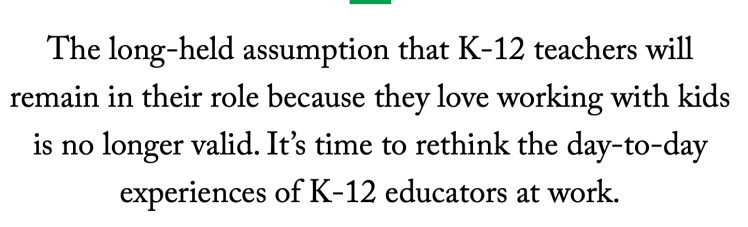
While K-12 teaching is, for many in the profession, inherently purposeful, some leaders in education mistakenly believe that the mission-rich nature of educators’ work alone is sufficient to keep K-12 teachers in the classroom.
Shifts in America’s K-12 education landscape have led to a significant decline in key elements of educators’ engagement, including knowing what’s expected of them, having the ability to use their strengths every day, and having a sense of purpose in their work.
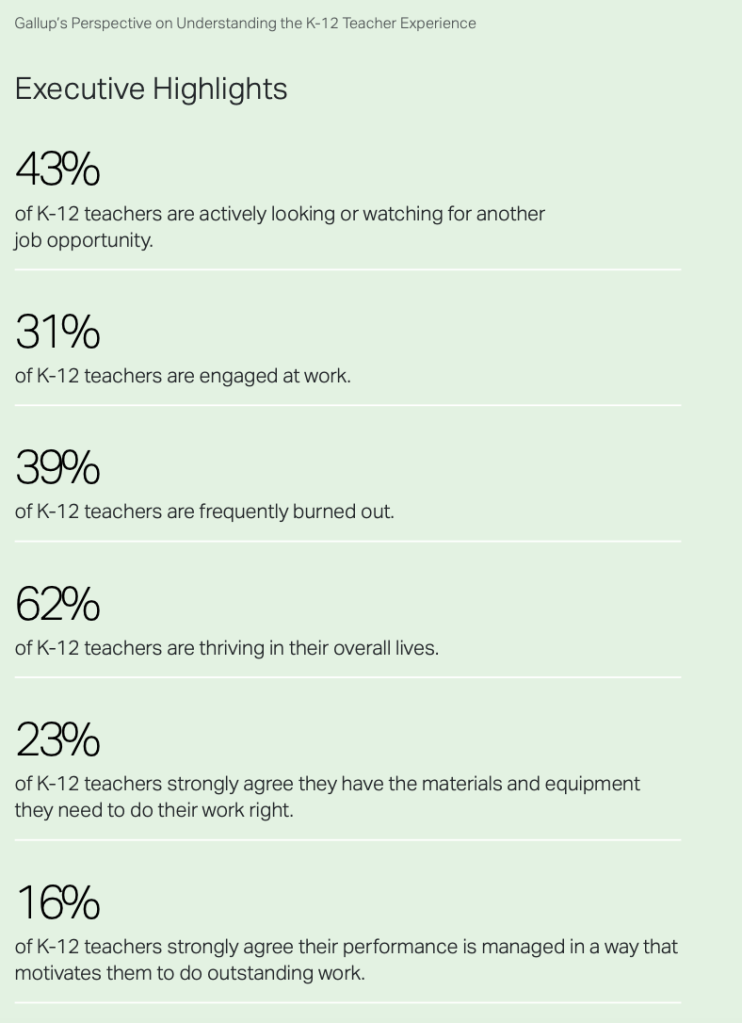
K-12 teachers also face unique challenges due to the nature of their role. On average, they are less likely to have the materials and equipment they need to do their work right, less likely to be treated with respect at work, and more likely to experience frequent burnout compared with workers in other occupations.
In Their Own Words
To better understand recent K-12 teacher turnover, Gallup conducted in-depth interviews with 10 former educators. These individuals, who have an average of 14 years of teaching experience, chose to leave K-12 teaching within the past five years to pursue another occupation.
Chosen excerpts by Job Market Monitor. Read the whole story @ New Perspective: Improving the K-12 Teacher Experience
Related posts
Teachers in US – Shortage shows small signs of improvement, but it remains widespread
The COVID-19 pandemic greatly exacerbated a long-standing and widespread teacher shortage in schools. By mid-2022, several indicators of teaching shortages and staffing stress were at record highs. Recent data from the School Pulse Panel (SPP) show that understaffing stress in schools has relented somewhat in the past year, though progress remains modest and uneven. The … Continue reading
Newly Arrived Teachers in Sweden – The Fast Track programme to answer the shortage
In 2016, the government-funded Fast Track for Newly Arrived Teachers and Preschool Teachers programme was introduced in Sweden. The initiative stemmed from a shortage of teachers and preschool teachers alongside a relatively large number of educated and experienced teachers among newly arrived immigrants. This study uses both qualitative and quantitative data to present the participants’ … Continue reading
New Foundational Skills in Middle and High Schools – The educational opportunity gap is large and grows larger the more teachers value them
Labor market data and previously reported research confirm that the skills required of the modern workforce have changed. The New Foundational Skills of the modern economy include greater digital savvy, increased business acumen, and more versatile human and team- centered workplace competencies. These skills generate substantial salary premiums for the students and workers who master … Continue reading
COVID, Library of Congress and Teachers – Classroom materials and professional development to help teachers
For Educators: Classroom Materials & Online Office Hours The Library of Congress offers classroom materials and professional development to help teachers effectively use primary sources from the Library’s vast digital collections in their teaching. https://loc.gov/teachers/
COVID-19 and Teachers – A temporary hub of information and tools by GOOGLE and UNESCO
A temporary hub of information and tools to help teachers during the coronavirus (COVID-19) crisis. Set up your home for video calling Find a location with strong WiFi signal, find a clear background and ensure plenty of natural light. When using webcam, turn your camera off to reduce lag. Start a video call with your … Continue reading
Preparing Children for the Future – The role of primary teachers and schools
This paper, commissioned by Teach First, provides evidence on the benefits of career development activities for children in the primary phase, and the range of teacher roles when delivering it. In doing so the research attempts to map what primary schools are doing to tackle the influence of socio-economic issues that affect children’s future transition … Continue reading
Stereotypes and Biases – Do teachers change when they become aware of them ?
Stereotypes are over-generalized representations of characteristics of certain groups. They allow for easier and efficient processing of information, but they may cause biased judgment or even discrimination against particular groups. In addition, discrimination may lead to self-fulfilling prophecies by influencing the behavior of discriminated groups in the direction of the stereotypes. If individuals become aware … Continue reading
Developing Real Employability Skills in Schools in UK – Over 90% of teachers believe that the top five skills and two of the four competencies are developed
There have been numerous studies asking employers ‘what they really want’ in terms of workforce skills. These often show that employers express concerns about students’ skills level in certain areas, for instance, communications. But there are two challenges – the number of overlapping studies and the broad definition of these skills. This report takes a … Continue reading
Teachers in US – 30 percent more likely to work a second job
You might not think of teachers as players in our growing “gig economy.” After all, a teaching job seems like the ultimate form of guaranteed employment. Turns out, a significant number of teachers do work second jobs. In fact, teachers are more likely than others to work a second job. It’s a summer thing, right? … Continue reading
Teacher in UK – What happens to teachers who leave the profession after they leave?
What happens to teachers who leave the profession after they leave? What can their destinations tell us about how schools and policymakers might better retain teachers? In this third Research Update, we use data from the Understanding Society survey to track teachers for several years after they leave. Our analysis shows that, on average, teachers’ … Continue reading
Literacy and Numeracy skills of Teachers – On average, they score better but the scope for improvement varies between countries
Teachers are essential for the development of human capital in society. Their skills are formed in teacher training programs, but are also highly influenced by the type and overall quality of the students who enter these programs and become teachers. Understanding which segment of the population is part of the teacher corps is important in … Continue reading
Teachers – What they do when they leave teaching
There’s a chart taken from data from the “Teacher Follow-up Survey” (TFS) of the School and Staffing Survey, which is administered to school teachers nationwide every four years by the U.S. Department of Education. We see in the chart that about 16 percent of teachers exited a school in recent years, combining both exits represented … Continue reading
The Happiest Jobs – Engineers closely followed by teachers and nurses the Guardian finds
Engineers have the happiest job in the world, closely followed by teachers and nurses, according to analysis carried out by the Guardian. We looked at nine different surveys conducted to find the occupations that make us happiest, and then did our own survey of these surveys, looking for the professions that appeared most often in … Continue reading
Teachers in US – Why do they quit?
Teaching, Ingersoll says, “was originally built as this temporary line of work for women before theygot their real job—which was raising families, or temporary for men until they moved out of the classroom and became administrators. That was sort of the historical set-up.” Ingersoll extrapolated and then later confirmed that anywhere between 40 and 50 … Continue reading
Newly qualified teachers in Canada / Heading abroad
Newly qualified Canadian teachers frustrated with the over-saturated teaching market in many major Canadian cities are setting their sights on international schools abroad, where they say professional and personal benefits far outweigh those back home Continue reading
US / Teachers for grades K-12 with less than one year of experience are the most engaged at work finds Gallup
U.S. teachers for grades K-12 with less than one year of experience are the most engaged at work, at 35.1% Continue reading



 Job Market Monitor
Discussion
Trackbacks/Pingbacks
Pingback: Teacher in US – Low job satisfaction and few are optimistic about the future | Job Market Monitor - April 15, 2024