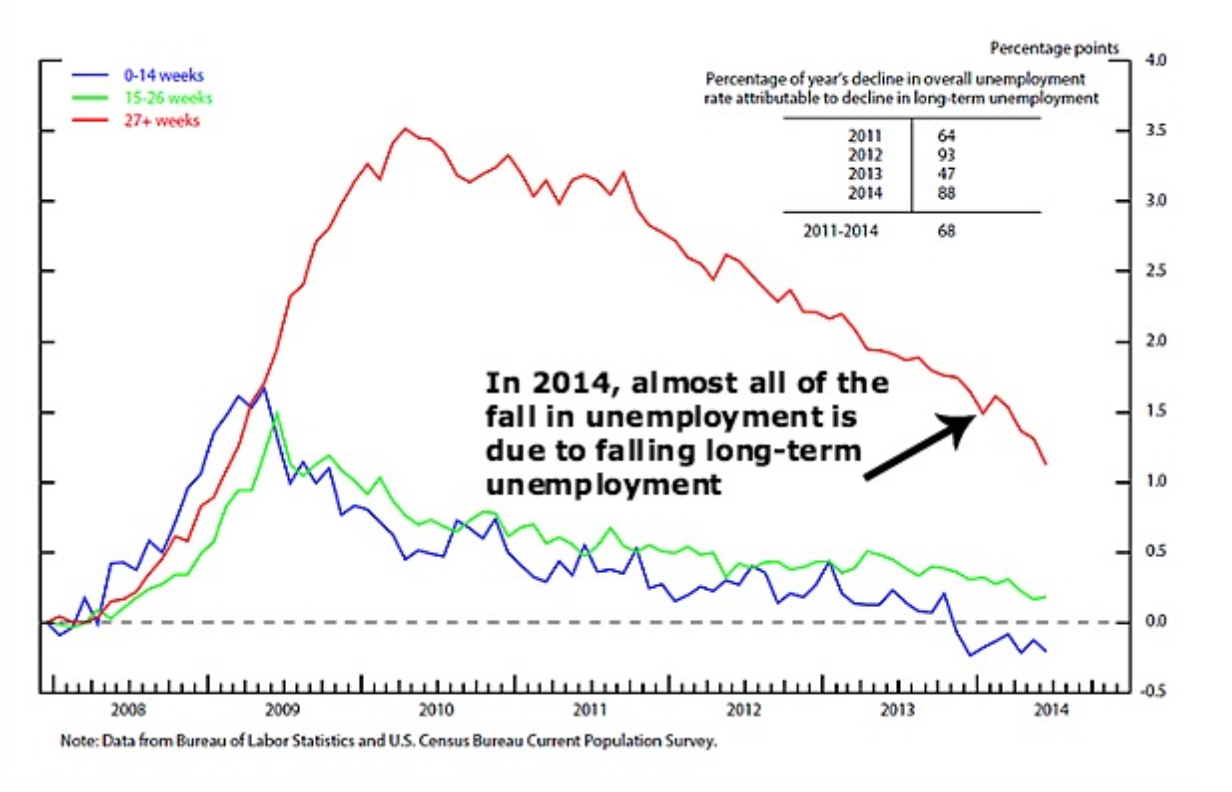
in the past six months, unemployment has fallen much faster than expected, from 6.7 to 6.1 percent. And as you can see above, 88 percent of that has been due to declining long-term unemployment.
Chosen excerpts by Job Market Monitor. Read the whole story at The long-term unemployed might finally be getting jobs – The Washington Post.
Related Posts
US Long-Term Unemployment / Why so many people have been out of work for so long
Democrats generally point to the anemic recovery, in which weak demand for goods and services results in less hiring. The cyclical nature of unemployment, they say, can be addressed with more government stimulus. Republicans tend to focus more on structural problems, in which the education and experience levels of the unemployed don’t match what employers … Continue reading
Long-term unemployment in US – Geography could be one reason
New research that examined joblessness in the early 2000s provides evidence that some of the problem might also be geography. A paper written by government and academic experts suggests that living near where the jobs are significantly reduces the amount of time it takes unemployed jobseekers to find work. The research found that to be especially true … Continue reading
US – Long-Term Unemployment is elevated across all education, age, occupation, industry, gender, and racial and ethnic groups
Long-term unemployment is elevated for workers at every education level. The table below provides additional breakdowns of long-term unemployment by age, gender, race/ethnicity, occupation, and industry. For each category, the table shows the long-term unemployment rate in 2007, the long-term unemployment rate in 2013, and ratio of the two. It demonstrates that while there is … Continue reading
Long-term unemployment in US since 1950 – A chart
This FRED graph divides unemployed (civilian) workers according to the duration of their unemployment spell. The number of those unemployed for 27 weeks or more is still very high, while the other categories have recovered to normal levels. This level of persistently elevated unemployment is different from that during previous recessions, and there may even … Continue reading
Long-Term Unemployed in US – Only 11 percent have returned to steady, full-time employment a year later
In “Are the Long-Term Unemployed on the Margins of the Labor Market?” Alan B. Krueger, Judd Cramer, and David Cho of Princeton University find that even after finding another job, reemployment does not fully reset the clock for the long-term unemployed, who are frequently jobless again soon after they gain reemployment: only 11 percent … Continue reading
US / The Unemployment Problem is a long-term unemployment problem
In a response to Friday’s jobs report, Jason Furman, the Chairman of the White House’s Council of Economic Advisors, included this graph that shows the share of unemployment benefits going to long-term unemployed workers (those out of work more than 27 weeks) and short-term unemployed workers. Check it out: Source: Council of Economic Advisers The … Continue reading



 Job Market Monitor
Discussion
Trackbacks/Pingbacks
Pingback: US – Misconceptions about long-term unemployment | Job Market Monitor - August 19, 2014
Pingback: US Labor Secretary on Long-Term Unemployed – It keeps me up at night because their stories are so compelling | Job Market Monitor - September 1, 2014