The 2012/13 Employment Insurance (EI) Monitoring and Assessment Report examines the EI program for the 2012/13 fiscal year. Unless otherwise indicated, these highlights are for 2012/13 or relate to changes from 2011/12 to 2012/13. 
The number of regular and Work-Sharing claims fell, as the result of ongoing economic growth.
The number of regular benefits claims decreased by 4.6% to 1.36 million in 2012/13. However, this figure is 4.8% higher than the figure recorded in 2007/08, prior to the onset of the late-2000s recession. Regular benefit payments decreased by 6.1% to $10.1 billion.
Work-Sharing benefits claims decreased by 41.5% to 13,890, as claims figures returned to pre-recession levels in 2007/08, while benefit payments decreased by 17.6% to $26.1 million.
As a result of an increase in 2012, the EI eligibility rate approached pre-recession levels.
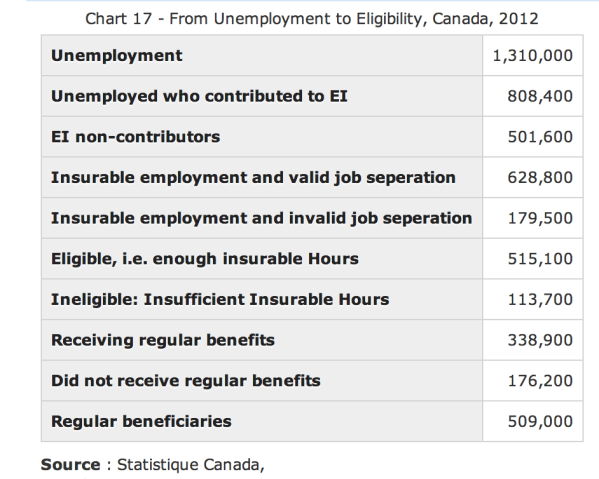
Among unemployed workers who had contributed EI premiums and then had a job separation that qualified under the EI program, 81.9% were eligible for EI regular benefits in 2012, an increase of 3.5 percentage points from 2011 (78.4%).
The increase was attributable mainly to a shift in the labour market characteristics of unemployed EI contributors toward permanent employment.
Before the recession, the rate was 82.3% in 2007 and 82.7% in 2006.
The number of EI special claims increased, while the number of fishing benefits claims decreased.
The number of special benefits claims increased by 0.3%, to 510,040 in 2012/13.
Among the special benefits claims in 2011/12, nearly one third (31.6%) combined more than one special benefit in a single claim.
The number of fishing benefits claims decreased by 4.1% to 28,290 in 2012/13, after increasing by 3.4% the previous year.
Participation in Employment Benefits and Support Measures shifted with the economy.
A total of 662,260 clients (+2.5%) participated in 1,076,271 interventions (+11.8%).
The use of Employment Assistance Services increased 14.2% to 901,063 as provinces and territories helped more job-ready clients with short-term interventions while case-managing more non-insured clients facing multiple barriers. Non-insured clients increased 12.7%.
Apprenticeships responded to a steady demand for skilled trades (-0.5%).
 Service Canada continued to respond to a higher than normal volume of EI claims.
Service Canada processed 2.76 million EI claims in 2012/13.
Through the click-call-visit model, in 2012/13, clients submitted 98.4% of EI applications electronically; EI specialized call centre agents handled 4.4 million client enquiries; resolving close to 85% of calls at the first point of contact and responded to over 4.2 million EI-related visits to an in-person point of service.
Significant progress has been made on the automation of claims, with 65.7% of EI initial and renewal claims now fully or partially automated.
The payment accuracy rate was 94.1% in 2012/13. Errors included overpayments and underpayments attributable to three sources: claimants, employers and Service Canada.

Chosen excerpts by Job Market Monitor. Read the whole story at Executive Highlights | ESDC.
Related articles
- Canada – Employment Insurance – EI recipients participating in employability measures should be exempted from the application of the proposed provisions on convenient job
- Employment Insurance ‘Reform’ in PEI / Far fewer unemployed getting it
- Update – Atlantic Canada and EI / Almost 80% of the unemployed receive benefits compare with 1 in 3 for the rest of Canada




 Job Market Monitor
Discussion
Trackbacks/Pingbacks
Pingback: Canada – Employment decreased by 29,000 in April | Job Market Monitor - May 9, 2014
Pingback: Canada – L’emploi a diminué de 29 000 en avril, de 32 000 au Québec | Moniteur de l'Emploi - May 9, 2014
Pingback: Canada – L’assurance-emploi doit se recentrer sur le remplacement du revenu des personnes ayant perdu leur emploi selon un rapport de l’IRPP | Job Market Monitor - July 24, 2015