“Reforms to the Employment Insurance (EI) program should focus on removing barriers to mobility by creating uniform, nationwide entrance requirements and benefit entitlement period” write Colin Busby and David Gray in Mending Canada’s Employment Insurance Quilt: The Case for Restoring Equity published at cdhowe.org.
“Under the current EI system, long-lasting EI benefits are more easily accessed in regions with high unemployment rates than in regions with low unemployment rates where workers face tighter restrictions to access short-lived benefits.”
The authors think that “Canada’s EI program, instead of providing clear and equitable access to benefits for all Canadian workers, supports the preservation of regional labour markets that are dominated by part-year employment. To the extent that variable entrance requirements support persistently high unemployment rates in a few Canadian regions, the program hinders the convergence of wages, prices and unemployment rates across the country.”
“Reforms are needed to better align the incentives of the EI program with the national interests of a more dynamic, flexible and buoyant labour market. Regionally based criteria for determining eligibility and the length of the benefit period should be replaced by uniform, countrywide EI entrance requirements and benefit entitlement periods. An improved screening mechanism would allow EI parameters to be tightened as the economy recovers and loosened when it enters a downturn.”
They remark : “The recent recession led to public concerns that too few laid-off workers – particularly those in low-unemployment regions facing relatively stringent entrance requirements – are eligible for EI benefits. Across Canada, the range of EI participation is wide and, not surprisingly, varies substantially according to the strictness of the entrance requirements determined by the regional unemployment rate”.
.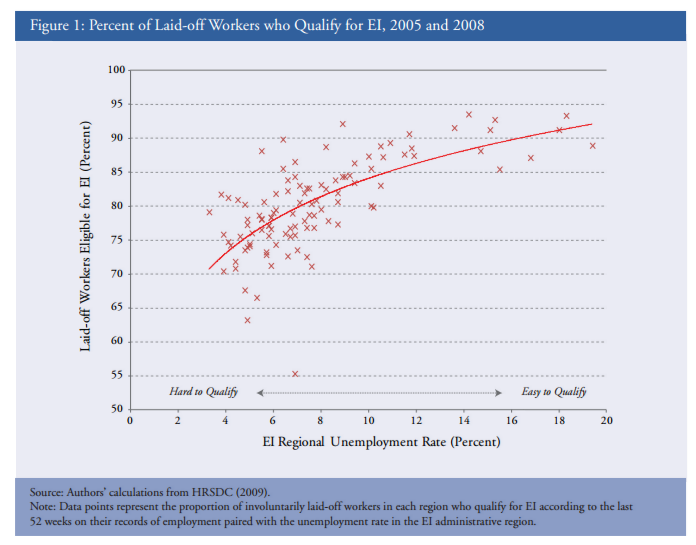
They also found that, statistically, “local unemployment rate variable explains only 43 percent of the fluctuations in the EI coverage rate across regions and, therefore, other unspecified (and currently unknown) factors generate 57 percent of those variations… This finding suggests that the local unemployment rate is a blunt indicator for measuring local labour market conditions.”
“In addition to raising equity issues, these differences in eligibility criteria also lead to more troubling long-term labour market problems, particularly the way in which regional eligibility and benefit entitlement variations increase economic barriers to geographical mobility.”
,
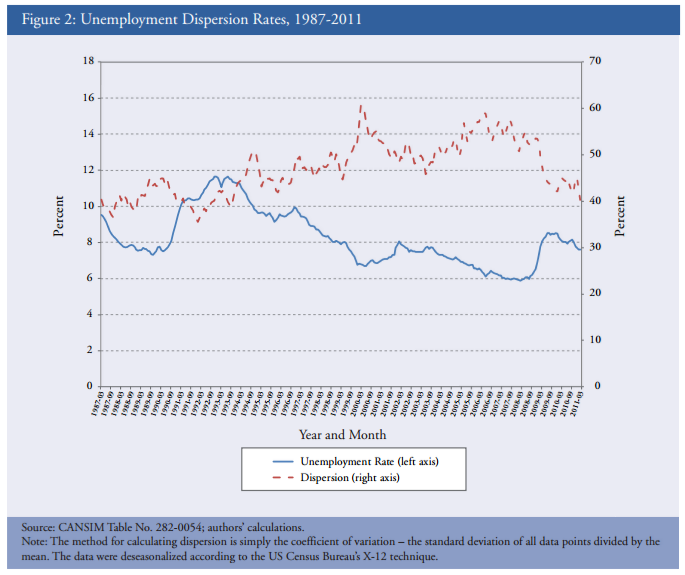
.
“In an efficient, flexible labour market where economic conditions in one region are stronger than those in another, some workers in the worse off region would migrate to the better-off region where the prospects for employment are brighter. This process would continue until the degree of opportunity for employment in each region was roughly the same. In other words, a sort of arbitrage process would occur that would at least reduce, but certainly not eliminate, the imbalance.’
“Canada’s recent labour market history, however, shows that the opposite is true: as the national labour market improves and the aggregate unemployment rate falls, the degree of unemployment dispersion tends to rise.”
Their “… preliminary empirical investigation does not imply that the EI regime is the sole causal factor of labour market rigidity.” Write the authors. “Given the current state of data availability, few researchers have been able to rely on solid, rigorous techniques to link labour mobility with the workings of an EI regime. We do suggest, however, that the level of unemployment prevailing in high-entitlement areas has remained persistently high in the context of a 10-year-plus recovery in the aggregate labour market in Canada, and that the EI program incentives work against labour mobility rather than encourage it.”
“Reforms to the EI program should remove incentives that deter workers moving from a highto a low-unemployment region, thus keeping the financial costs of moving as low as possible. As the Canadian economy recovers from the current recession and western Canadian businesses create jobs at pre-recession levels, the need for worker mobility will be of critical importance” theyconclude.
Source & details @ :




 Job Market Monitor
Discussion
Trackbacks/Pingbacks
Pingback: Canada | Assurance-emploi | Un critère d’admissibilité et une période de prestations uniformes à l’échelle nationale | Le Blog d'InfoCompétences - November 8, 2011
Pingback: Atlantic Canada / EI stats drop in after changes aimed at seasonal work: economist | 680News | Job Market Monitor - October 2, 2013
Pingback: Update – Atlantic Canada and EI / Almost 80% of the unemployed receive benefits compare with 1 in 3 for the rest of Canada | Job Market Monitor - October 4, 2013
Pingback: Employment Insurance in Canada / Legal Coverage at 81.9% in 2012, up from 78.4% finds Stat Can | Job Market Monitor - November 15, 2013
Pingback: Employment Insurance in Canada / More beneficiaries in Quebec and Manitoba, as well as in the Atlantic provinces. | Job Market Monitor - November 24, 2013
Pingback: Employment Insurance ‘Reform’ in PEI / Far fewer unemployed getting it | Job Market Monitor - January 7, 2014
Pingback: Canada – L’assurance-emploi doit se recentrer sur le remplacement du revenu des personnes ayant perdu leur emploi selon un rapport de l’IRPP | Job Market Monitor - July 24, 2015
Pingback: Employment Insurance in Canada – Five key changes | Job Market Monitor - April 21, 2016