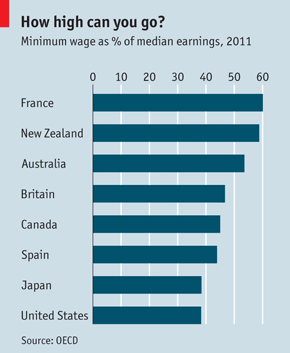
MINIMUM-WAGE laws have a long history and enduring political appeal. New Zealand pioneered the first national pay floor in 1894. America’s federal minimum wage dates from 1938. Most countries now have a statutory pay floor—and the ranks are still swelling. Even Germany, one of the few big countries without, may at last introduce a national one. And in an era of budget austerity and widening inequality, the political temptation to prop up wages at the bottom by fiat may well grow.
Economists have tended to oppose minimum wages on the grounds that they reduce employment, hurting many of those they are supposed to help. Milton Friedman called them a form of discrimination against low-skilled workers. In standard models of competitive markets, anything that artificially raises the price of labour will curb demand for it, and the first to lose their jobs will be the least-skilled workers.
Yet economic theory allows for the possibility that wage floors can boost both employment and pay. If employers have monopsony power as buyers of labour and are able to set wages, for instance, they can keep pay below its competitive rate. Academic supporters of wage floors, mainly economists on the left, appealed to this logic. But most of their colleagues disagreed; and until about 1990, most empirical studies found that higher minimum wages cost jobs, particularly among young workers.
Then a pioneering case study by two noted labour economists, David Card and Alan Krueger, examined the response of fast-food restaurants to a rise in New Jersey’s state minimum wage. It found that this had actually increased employment. The paper spawned a flood of similar “case-study” research, a flurry of revisionist thinking and a heated academic debate. The most prominent critics of the new research were David Neumark of the University of California at Irvine and William Wascher of the Federal Reserve. They disputed Messrs Card and Krueger’s findings for New Jersey and argued that a comparison of different states over time showed that higher minimum wages hurt jobs…

Choosen excerpts by Job Market Monitor from
via Free exchange: The argument in the floor | The Economist.



 Job Market Monitor
Reblogged this on cashzilla.
Posted by cashzilla | November 23, 2012, 10:23 am