Artificial intelligence (AI) is set to profoundly change the global economy, with some commentators seeing it as akin to a new industrial revolution. Its consequences for economies and societies remain hard to foresee. This is especially evident in the context of labor markets, where AI promises to increase productivity while threatening to replace humans in some jobs and to complement them in others.
Almost 40 percent of global employment is exposed to AI, with advanced economies at greater risk but also better poised to exploit AI benefits than emerging market and developing economies. In advanced economies, about 60 percent of jobs are exposed to AI, due to prevalence of cognitive-task-oriented jobs. A new measure of potential AI complementarity suggests that, of these, about half may be negatively affected by AI, while the rest could benefit from enhanced productivity through AI integration. Overall exposure is 40 percent in emerging market economies and 26 percent in low-income countries. Although many emerging market and developing economies may experience less immediate AI-related disruptions, they are also less ready to seize AI’s advantages. This could exacerbate the digital divide and cross-country income disparity.
AI will affect income and wealth inequality. Unlike previous waves of automation, which had the strongest effect on middle-skilled workers, AI displacement risks extend to higher-wage earners. However, potential AI complementarity is positively correlated with income. Hence, the effect on labor income inequality depends largely on the extent to which AI displaces or complements high-income workers. Model simulations suggest that, with high complementarity, higher-wage earners can expect a more-than-proportional increase in their labor income, leading to an increase in labor income inequality. This would amplify the increase in income and wealth inequality that results from enhanced capital returns that accrue to high earners. Countries’ choices regarding the definition of AI property rights, as well as redistributive and other fiscal policies, will ultimately shape its impact on income and wealth distribution.
The gains in productivity, if strong, could result in higher growth and higher incomes for most workers. Owing to capital deepening and a productivity surge, AI adoption is expected to boost total income. If AI strongly complements human labor in certain occupations and the productivity gains are sufficiently large, higher growth and labor demand could more than compensate for the partial replacement of labor tasks by AI, and incomes could increase along most of the income distribution.
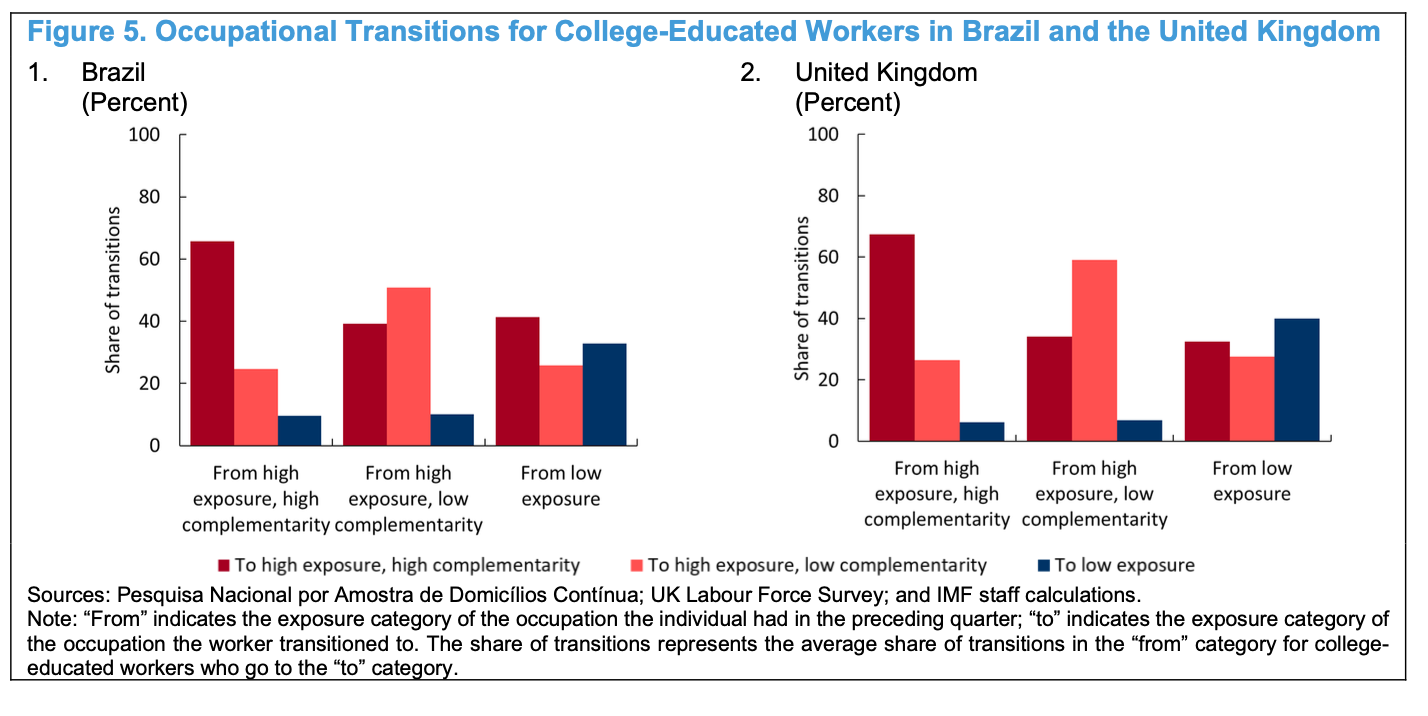
College-educated workers are better prepared to move from jobs at risk of displacement to high- complementarity jobs; older workers may be more vulnerable to the AI-driven transformation. In the UK and Brazil, for instance, college-educated individuals historically moved more easily from jobs now assessed to have high displacement potential to those with high complementarity. In contrast, workers without postsecondary education show reduced mobility. Younger workers who are adaptable and familiar with new technologies may also be better able to leverage the new opportunities. In contrast, older workers may struggle with reemployment, adapting to technology, mobility, and training for new job skills.
To harness AI’s potential fully, priorities depend on countries’ development levels. A novel AI preparedness index shows that advanced and more developed emerging market economies should invest in AI innovation and integration, while advancing adequate regulatory frameworks to optimize benefits from increased AI use. For less prepared emerging market and developing economies, foundational infrastructural development and building a digitally skilled labor force are paramount. For all economies, social safety nets and retraining for AI-susceptible workers are crucial to ensure inclusivity.


Chosen excerpts by Job Market Monitor. Read the whole story @ Gen-AI: Artificial Intelligence and the Future of Work
Related Posts
AI and the Future of Skills – Healthy human adults share some basic skills that AI systems do not have
Artificial intelligence (AI) and robotics are major breakthrough technologies that are transforming the economy and society. To understand and anticipate this transformation, policy makers must first understand what these technologies can and cannot do. The OECD launched the Artificial Intelligence and the Future of Skills project to develop a programme that could assess the capabilities … Continue reading
Skills and AI – Millions of workers may need to be not just upskilled but reskilled
In the coming decades, as the pace of technological change continues to increase, millions of workers may need to be not just upskilled but reskilled—a profoundly complex societal challenge that will sometimes require workers to both acquire new skills and change occupations entirely. Companies have a critical role to play in addressing this challenge, but … Continue reading
Artificial Intelligence (AI) – Tasks will be augmented, not automated
Despite technological strides forward, this year’s Future of Jobs report suggests that businesses are becoming more sceptical about the potential for artificial intelligence to fully automate work tasks. Executives estimate that 34% of tasks are already automated – just one percentage point ahead of the figure reported in the Future of Jobs Report 2020. Future … Continue reading
The Future of Work – Artificial Intelligence (AI) won’t replace most jobs but people using it are starting to replace people who don’t
As AI is increasingly applied to knowledge work, a significant shift will likely take place in the workplace, affecting many jobs in the Western middle class. Contrary to recent dire predictions about AI’s effect on employment, our survey suggests cautious optimism. Most respondents, for example, do not expect that AI will lead to a reduction … Continue reading
New Technologies and Artificial intelligence – How they are transforming tasks : analyzing 170 million online job postings
Technology has long brought change to the nature of work, and to the skills required for the most desirable, best-paying jobs. But until recently, new technology – even robotics – has tended to mean automating repetitive or arduous tasks, while often leading to new types of tasks for workers. The emergence of artificial intelligence (AI) … Continue reading
AI and Jobs? Workers seem more hopeful than concerned about the impact of AI
Which U.S. workers are more exposed to AI on their jobs? In 2022, 19% of U.S. workers were in jobs in which the most important activities may be replaced or assisted by artificial intelligence tools. Higher-paid workers, as well as those who are women, Asian or college-educated, are more exposed to AI than other groups. … Continue reading
AI – Has rapidly become a part of the cultural and business zeitgeist LinkedIn finds
The Future of Work Report: AI at Work, November 2023 uncovers the latest real-time trends we see around how AI is ushering a new world of work, grounded in LinkedIn’s unique labor market insights, based on one billion professionals and 67 million companies. Explore our latest findings and insights around: Professionals’ conversations and sentiments towards … Continue reading
GenAI and Upskilling – Look at how employee roles and skills must evolve
Generative AI presents both benefits and challenges to organizations. BCG’s GenAI Workforce Productivity Diagnostic helps companies define a clear path to successfully implement this transformative technology. Key Takeaways While the value and transformation potential of GenAI are real, so too are the technical, implementation, and change management challenges. BCG’s GenAI Workforce Productivity Diagnostic helps companies … Continue reading
AI and Ageing Revolutions – The extent to which they alter our societies for good or for ill will very much depend on how we choose to respond
The world of work is getting older in advanced economies and increasingly in many emerging ones. Today, people between theages of 45 and 64 account for some 40 percent of the working-age population in OECD countries, up from 28 percent in 1990. Two powerful and persistent trends – longer lifespans and lower birth rates – … Continue reading
AI in the Workplace – What do workers and employers think and what to do about it
In 2022, the OECD gathered data on the impact of AI on people and their workplaces, in the manufacturing and finance sectors of seven countries. The findings show that AI use at work can lead to positive outcomes for workers around job satisfaction, health and wages. Yet there are also risks around privacy, work intensity … Continue reading
Employment Outlook – OECD countries may be on the brink of an AI revolution while wages have not kept up with inflation
While firms’ adoption of AI is still relatively low, rapid progress including with generative AI (e.g. ChatGPT), falling costs and the increasing availability of workers with AI skills suggest that OECD countries may be on the brink of an AI revolution. It is vital to gather new and better data on AI uptake and use … Continue reading
Artificial Intelligence (AI) – It will challenge economists in coming years
After a number of AI-winters, AI is back with a boom. There are concerns that it will disrupt society. The immediate concern is whether labor can win a ‘race against the robots’ and the longer-term concern is whether an artificial general intelligence (super-intelligence) can be controlled. This paper describes the nature and context of these … Continue reading
The Future of Work – Artificial Intelligence (AI) impacts on learning, teaching, and education
At the November 2017 Gothenburg Summit, the Commission presented the Communication ‘Strengthening European Identity through Education and Culture’, that set out a vision for a European Education Area and announced a dedicated Digital Education Action Plan, which aims to foster digital skills and competences for all citizens. The Action Plan focuses on implementation and the … Continue reading
Artificial Intelligence – Creating both fear and hope among workers
What will be the effects of artificial intelligence on the workplace? Our survey respondents expect AI will have a large impact on the skills employees will need on the job. At the same time, they remain cautiously optimistic about AI’s overall effect on the workforce. Another year of AI experimentation and learning has left opinions … Continue reading
Future of Jobs – Views about robots and artificial intelligence, Sweden vs US
Eighty percent of Swedes express positive views about robots and artificial intelligence, according to a survey this year by the European Commission. By contrast, a survey by the Pew Research Center found that 72 percent of Americans were “worried” about a future in which robots and computers substitute for humans. In the United States, where … Continue reading
Artificial Intelligence (AI) – The three new categories of AI-driven business and technology jobs
The threat that automation will eliminate a broad swath of jobs, across the world economy is now well established. As artificial intelligence (AI) systems become ever more sophisticated, another wave of job displacement will almost certainly occur. It can be a distressing picture. But here’s what we’ve been overlooking: Many new jobs will also be … Continue reading
Artificial Intelligence (AI) and Jobs – Far from killing the jobs of knowledge workers, this tends to free them up to do what they are paid for
“Knowledge work, for the first time, can be produced at volume from NLG-AI systems,” Gould says. “Far from killing the jobs of knowledge workers, this tends to free them up to do what they are paid to do—innovate, model, refine, and improve on the expertise of their business.” “Far from killing the jobs of knowledge … Continue reading
HR / Artificial intelligence scans for recruitment data
ARTIFICAL intelligence technology is being used to deliver recruitment data that offers a more complete picture of the job market. Recruitment industry veteran Robert Olivier, who founded the former Olivier Internet Job Index, is using the United States-developed technology to analyse the Australian job market. “The thing that bothered me about my old approach was … Continue reading



 Job Market Monitor
Discussion
Trackbacks/Pingbacks
Pingback: Artificial intelligence (AI) and Skills – High-exposure occupations comprise a third of all vacancies in OECD countries in the sample | Job Market Monitor - April 30, 2024