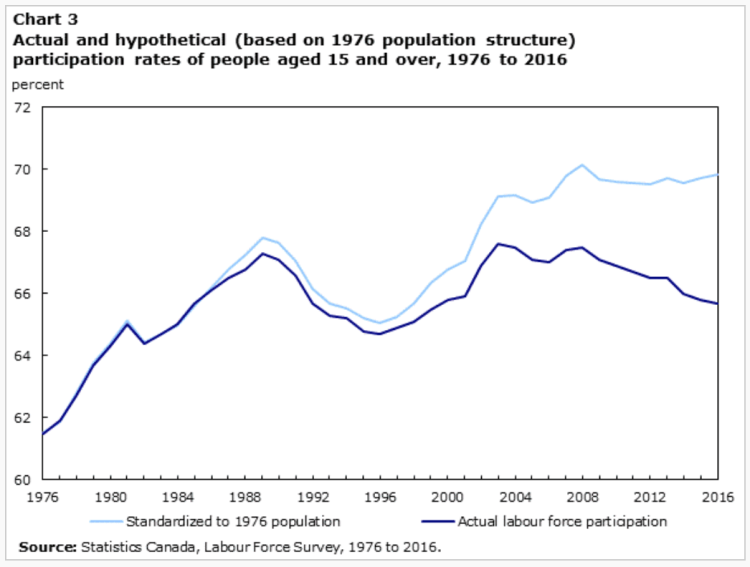
Since 2007—prior to the economic downturn of 2008/2009—the overall labour force participation of Canadians declined by about two percentage points. The first part of the study investigates the extent to which aging affected changes in labour market participation rates since 2007, based on data from the Labour Force Survey (LFS). In the second part, the reasons behind the increase in the participation rates of Canadians aged 55 and over, which have been trending upwards since 1996, are explored.
- In 2016, individuals aged 55 and over accounted for 36% of the working-age population, the highest proportion on record (since the compilation of comparable statistics in 1976). By 2026, that proportion could reach 40%.
- Because labour market participation starts to decline after age 55, population aging was the main factor behind the decline in the overall participation rate in the years following the recession.
- At the same time, the labour market participation of older Canadians increased. From 1996 to 2016, the labour force participation rate of individuals aged 55 and over increased from 24% to 38%, reaching a record high in 2016.
- The participation rate of individuals aged 55 and over increased for all levels of education. For instance, the participation rate of those with a high school diploma or less increased from 19% in 1996 to 29% in 2016.
- Changes in age, family structure and educational factors explained 44% of the increase in the labour market participation of older Canadians from 1996 to 2016.
Chosen excerpts by Job Market Monitor. Read the whole story at The impact of aging on labour market participation rates
Related Posts
Aging Canada – No choice but to adapt to slower domestic growth David K. Foot says
The entry of the massive baby boomer generation into the Canadian work force over the 1960s and 1970s resulted in rapid work force and economic growth, rising unemployment and increasing inflation. Their exit over the next 20 years will have the opposite effects: slow work force and economic growth, falling unemployment and reduced inflation (possibly … Continue reading
Demographic change will have a profound effect on the UK labour market over the next two decades and beyond. Over 30% of people in employment in the UK are over the age of 50, and there are unlikely to be enough younger people entering the labour market to replace this group when they leave the … Continue reading
Aging Workforce in US – A 10% increase in the fraction of the population ages 60+ decreases the growth rate of GDP per capita by 5.5% research finds
Population aging is widely assumed to have detrimental effects on economic growth yet there is little empirical evidence about the magnitude of its effects. This paper starts from the observation that many U.S. states have already experienced substantial growth in the size of their older population and much of this growth was predetermined by historical … Continue reading
The Aging Challenge – Two solutions
Population aging—the increase of the share of older individuals in a society due to fertility declines and rising life expectancy—is an irreversible global trend with far-reaching economic and socio-political consequences. By 2050, the number of people aged 60 and older will more than double from its current levels, reaching around 2 billion. While Europe was … Continue reading
Aging Finland – 34,000 immigrants needed instead of the current 18,000 in order to stop the decrease working-age population
Finland does not apply quotas or a points-based system to labour migration. Instead, Finland applies the determination of the availability of labour when issuing a residence permit for an employed person. However, the proportion of labour subject to the determination of the availability of labour is relatively low and the majority of labour uses other … Continue reading
Aging – The picture looks a lot brighter using a series of new measures
The populations of most countries of the world are aging, prompting a deluge of news stories about slower economic growth, reduced labor force participation, looming pension crises, exploding health care costs and the reduced productivity and cognitive functioning of the elderly. These stories are dire, in part because the most widely used measure of aging … Continue reading
Aging and Shrinking Labor Forces in Europe – Economic long-term outlooks often too pessimistic
Demographic aging and accompanying shrinking labor forces are common phenomena throughout the developed world. There is a widespread notion that societal aging will put significant pressure on public budgets, a view supported by recent OECD projections. Expenditures for public health are expected to rise, old-age pension systems already are burdened by an imbalance of working … Continue reading
Self-employment in Canada – Aging and the shift of employment to older age groups led to an increase in the aggregate self-employment rate
Canada has a large group of unincorporated self-employed businesses that play a critical role in the early lifecycle of firms. This study presents summary statistics on the importance of a particular group of the self-employed: those whose primary source of income from employment comes from an unincorporated business. The unincorporated self-employed measured in this study … Continue reading



 Job Market Monitor
Discussion
No comments yet.