It’s an important question because the road to a successful career in science – as with technology, engineering and mathematics, the other STEM fields – can be challenging, often requiring a Ph.D. or other postgraduate training. And once in their fields, there can be political and economic pressures with which to contend. The Bureau of Labor Statistics projects workforce shortfalls for many science fields, though the projected needs differ across the life, physical and natural sciences.
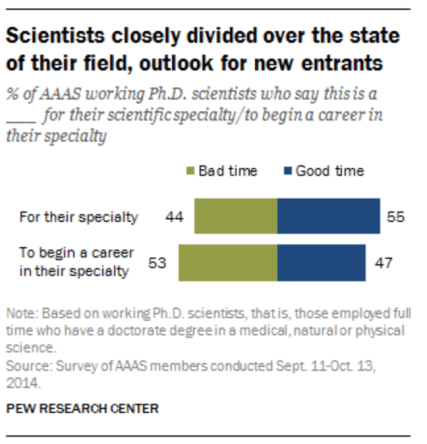
Some 55% of working Ph.D. scientists belonging to the American Association for the Advancement of Science (AAAS) who we surveyed in 2014 said this was generally a good time for their scientific specialty, while 44% said it was a bad time. And while nearly half (47%) said it was a good or very good time to begin a career in their field, 53% said it was a bad time to start out in their field.
Chosen excerpts by Job Market Monitor. Read the whole story at Why do people become scientists? What scientists told us | Pew Research Center



 Job Market Monitor
Discussion
Trackbacks/Pingbacks
Pingback: STEM Workforce in US – Has grown 79% since 1990 | Job Market Monitor - January 13, 2018