This report assesses how new immigrants to Sweden fare in the country’s labor market. The report is part of a series of six case studies on labor market outcomes among immigrants to European Union countries.
The report shows that employment rates during newcomers’ initial years in Sweden are relatively depressed for low-educated refugees and migrants who come based on family ties, in comparison to natives and labor migrants from EU countries. Since Sweden’s refugees and family arrivals are not selected through employment-related criteria, they are likely to lack locally in-demand skills and are often out of work in the years immediately after arrival. The obstacles these groups face can be exacerbated by certain features of Sweden’s labor market, such as high minimum wages, a relatively small pool of low-skilled jobs, and stringent employment protection for permanent work.
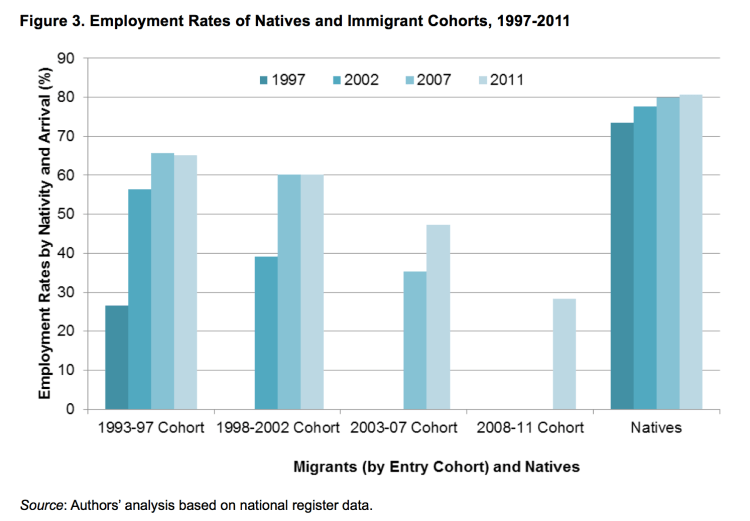
Non-EU labor migrants are also more concentrated in low-skilled jobs and have lower average annual earnings than both EU migrants and natives. Over time, however, all newcomers to Sweden have on the whole improved their employment rates, displayed income growth similar to natives, and moved into middle-skilled positions.
Chosen excerpts by Job Market Monitor. Read the whole story at Catching Up: The Labor Market Outcomes of New Immigrants in Sweden | migrationpolicy.org.
Related articles
- Immigrant Workers in the U.S. Labor Force in Charts
- Points-Based Immigration Systems in Australia, Canada, and the United Kingdom
- Germany / Immigrants struggle in job market – Arab immigrants most affected
- Sweden | Unemployment Drops | Steep hike in immigrant unemployment | The Local
- International migration / Labour migration decreased in 2010 finds OECD
- Immigrant workers | Boosting The Incomes Of Less-Educated Native Workers




 Job Market Monitor
Discussion
Trackbacks/Pingbacks
Pingback: New Immigrants in France – Fare badly in the first few years, but improvement over time finds research | Job Market Monitor - May 9, 2014
Pingback: Immigrants in UK – Countries of origin, level of education, and time since arrival all shaped their employment outcomes report finds | Job Market Monitor - May 29, 2014
Pingback: Immigration in Sweden – The next few years that will be the fastest recorded | Job Market Monitor - May 13, 2016