Income inequality has increased in both advanced and developing economies in recent decades.
Increasing inequality has been attributed to a range of factors, including the globalization and liberalization of factor and product markets; skill-biased technological change; increases in labor force participation by low-skilled workers; declining top marginal income tax rates; increasing bargaining power of high earners; and the growing share of high-income couples and single-parent households. Many of these developments have had beneficial effects on growth and poverty reduction both nationally and globally.
There is growing evidence that high income inequality can be detrimental to achieving macroeconomic stability and growth.
Recent empirical work finds that high levels of inequality are harmful for the pace and sustainability of growth. Others have argued that rising inequality may have been an important contributing factor to the global financial crisis. Moreover, evidence from public surveys in various countries indicates that widening income inequality has been accompanied by growing public demand for income redistribution, especially in countries most strongly affected by the crisis. This comes at a time when high public debt ratios in the advanced economies, and emerging vulnerabilities in the developing economies, have made fiscal restraint an important priority, and point to the importance of sensitivity to distributional concerns in designing consolidation packages. In this light, income inequality can be of macroeconomic concern for country authorities, and the Fund should accordingly seek to understand the macroeconomic effects of inequality. In addition, in its policy advice, the Fund should be mindful of how macroeconomic policies (including fiscal policies) affect income distribution and their consistency with the distributional goals of country authorities.
Inequality of Income – Over the last three decades, inequality in the personal distribution of income has increased in most economies.
Figure 1 presents trends in the average (unweighted) Gini coefficient for disposable incomes (i.e., market incomes minus direct taxes plus cash transfers) across regions over recent decades—which reflects both the inequality of market-determined incomes as well as the distributional impact of income taxes and public transfers. The Gini coefficient ranges between 0 (denoting complete equality) and 1 (denoting complete inequality). Between 1990 and 2010, the Gini for disposable income has increased in nearly all advanced and emerging European economies. Over one-third of advanced economies and half of emerging Europe experienced increases in their Ginis exceeding 3 percentage points, with most of the increases in emerging Europe occurring between 1990 and 1995 during the early years of their transition to market-based systems. Inequality also rose in most economies in Asia and the Pacific and in Middle East and North Africa. While average inequality fell in sub-Saharan Africa over this period, it still rose by more than 3 percentage points in more than one-fourth of these economies. Inequality also increased in over one-third of the economies in Latin America, although on average there was a slight decline. However, since 2000 there has been a substantial decline in the Gini in nearly all countries in this region.

Inequality of Wealth – In advanced economies, household net wealth—financial assets and real estate minus debt—has increased substantially over the last four decades.
Assessment of trends in this area requires caution, given the limited number of economies with comprehensive data. Internationally comparable data for eight large advanced economies show that the average ratio of net household wealth to national income grew by almost 80 percent between 1970 and 2010. The largest increase was observed in Italy (by 180 percent) and the smallest increase was in the United States (by 21 percent). Explanations for the rapid growth in wealth include asset-price booms and a significant increase in private savings.
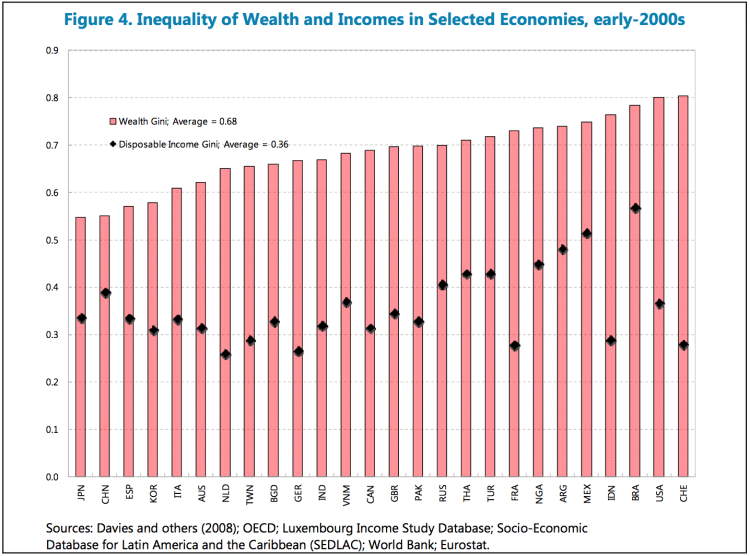
Wealth is more unequally distributed than income.
The Gini coefficient of wealth in a sample of 26 advanced and developing economies in the early 2000s was 0.68, compared to a Gini of 0.36 for disposable incomes (Figure 4).8 The share of wealth held by the top 10 percent ranges from slightly less than half in Chile, China, Italy, Japan, Spain, and the United Kingdom, to more than two-thirds in Indonesia, Norway, Sweden, Switzerland, and the United States. In Switzerland and the United States, where wealth is most unequally distributed, the top one-percent alone holds more than one-third of total household wealth.
The inequality of wealth has risen in recent decades in several advanced economies.
For instance, between the mid-1980s and early-2000s, the growth of wealth in Canada and Sweden was all concentrated in the two upper deciles of the wealth distribution. During the same period, the Gini coefficients of wealth distribution in Finland and Italy rose from around 0.55 to above 0.6. In the United States, the Gini coefficient of wealth distribution rose from 0.80 in the early-1980s to almost 0.84 in 2007.
Chosen excerpts by Job Market Monitor. Read the whole story at IMF POLICY PAPER – Fiscal Policy And Income Inequality
Related articles
- Measuring Income Inequality / The Standard Gini Coefficient : a ‘rightist’ measure
- The Top 1% / 39% Of The World’s Wealth
- Robert Shiller, Nobel prize for economics / Income Inequality Is ‘Most Important Problem’
- Asia / Gap between rich and poor widening finds the Asian Development Bank (ADB)
- Asia-Pacific / Economic growth is not generating sufficient decent and productive employment says the Asian Development Bank
- US / Addressing income inequality is not government’s job voters says to Fox Poll
- US / Income inequality is now near a record high reports a Senate Joint Economic Committee
- OECD / Countries with greater skills inequality have higher income inequality
- OECD / How Inequality in skills is associated with inequality in income
- Inequalities / The 85 richest people as wealthy as poorest half of the world




 Job Market Monitor
Discussion
Trackbacks/Pingbacks
Pingback: Growth in inequality for decades is likely | Job Market Monitor - March 19, 2014
Pingback: US – Back to early 20th century wealth concentration levels at the very top finds research | Job Market Monitor - April 14, 2014
Pingback: Inequality in US – the top 20% of earners accounted for more than 80% of the rise in household income from 2008-2012 | Job Market Monitor - April 18, 2014
Pingback: Great Britain – The wealthiest 10% of households owned 44% of total aggregate household wealth, the least wealthy half 9% | Job Market Monitor - May 16, 2014