Each month the Bureau of Labor Statistics (BLS) reports employment figures for the United States. These figures have served as a barometer of the country’s relative economic strength for the last seventy years and recently have highlighted unemployment’s rise throughout the Great Recession. Often overlooked, however, are figures related to the so-called “long-term” unemployed, those unemployed for longer than twenty-six weeks, roughly six months.
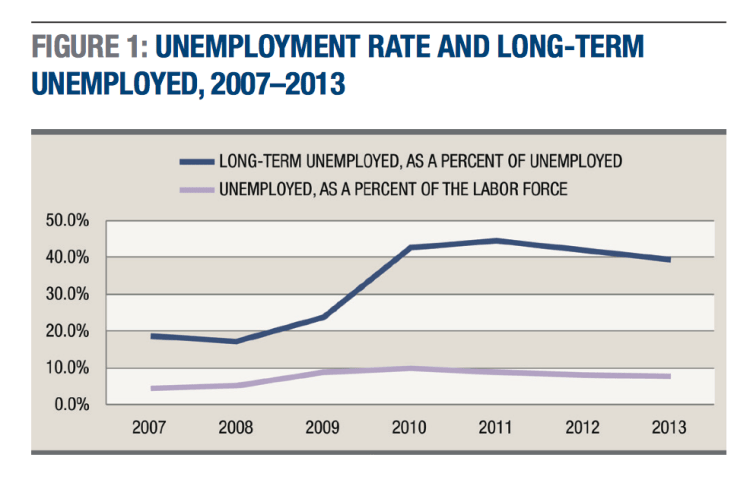
While the unemployment rate has slowly receded after a peak of about 10 percent during the Great Recession between december 2007 and June 2009, the long-term unemployment rate remains staggeringly high at more than a third (39 percent) of all unemployed. This is cause for concern given that workers in most states are eligible for a maximum twenty-six weeks of basic unemployment insurance, and the federal extension of unemployment benefits that would have provided, at most, thirty-eight weeks of benefits expired on January 1 of this year. Given the significant numbers of individuals involved, the long-term unemployed are an important group to monitor.
But what are the characteristics of the long-term unemployed? And how do these characteristics vary across place? We know surprisingly little about these questions.5 Using the Annual Social and Economic Supplement (ASEC) of the Current Population Survey (CPS), this brief outlines the demographic and economic characteristics of the long-term unem- ployed and compares them with their short-term unemployed counterparts.

Chosen excerpts by Job Market Monitor. Read the whole story at

via The Long-Term Unemployed in the Wake of the Great Recession
Related articles
- US / The Unemployment Problem is a long-term unemployment problem
- US / Why African-American unemployment is double that of Whites
- US / The share of unemployed receiving jobless aid will drop to its lowest level
- US Unemployment Rate / What if those who have left the labor force since the start of the Great Recession are counted ?
- Unemployed Older Workers in US / One’s past hard work and successes can become the very thing that keeps one from finding a new job




 Job Market Monitor
Discussion
Trackbacks/Pingbacks
Pingback: Food Stamp Recipients in US / The majority are now working-age americans | Job Market Monitor - January 30, 2014
Pingback: White House Meets Business / To discuss better job training and discrimination against long-term unemployed | Job Market Monitor - January 31, 2014
Pingback: US / Long- term unemployment spans all industries, education levels, age groups, and among blue- and white-collar workers | Job Market Monitor - February 5, 2014
Pingback: US / 10.4 million men, aged 25 to 54, don’t have jobs | Job Market Monitor - February 7, 2014
Pingback: Labor Force Participation in US / A Chart | Job Market Monitor - February 12, 2014
Pingback: US / Long-term unemployment has less impact on the behavior of wages study says | Job Market Monitor - February 13, 2014
Pingback: The FED / Inflation wins over Unemployment | Job Market Monitor - February 26, 2014
Pingback: 6 facts Kelly Blazek had to learn the hard way | Millennial Survival Guide - March 2, 2014
Pingback: Unemployment Extension in US – A bipartisan compromise agreement on the table | Job Market Monitor - March 17, 2014
Pingback: Long-Term Unemployed in US – Only 11 percent have returned to steady, full-time employment a year later | Job Market Monitor - March 20, 2014
Pingback: Unemployment Benefits Cuts in North Carolina – The largest drop in its labor force in its history | Job Market Monitor - March 26, 2014
Pingback: Unemployment Benefits Extension in US – Senate Advances Bill but it is unlikely the legislation can get through | Job Market Monitor - March 28, 2014
Pingback: Long-term unemployment – Why does it matters | Job Market Monitor - April 7, 2014
Pingback: Unemployed Mothers in US – Staying at home | Job Market Monitor - April 10, 2014
Pingback: Parenting and “secure attachment” – 40% of children would miss it out says a report | Job Market Monitor - April 12, 2014
Pingback: How Long You’ll Be Unemployed – Look at the Unemployment Rate | Job Market Monitor - April 19, 2014
Pingback: US – 9.6 Percent of families included an unemployed person in 2013 finds the BLS | Job Market Monitor - April 30, 2014
Pingback: Unemployment Insurance Extension in US – Update | Job Market Monitor - May 30, 2014
Pingback: Fathers in US – 2 million stay-at-home in 2012 | Job Market Monitor - June 8, 2014