The Top 10
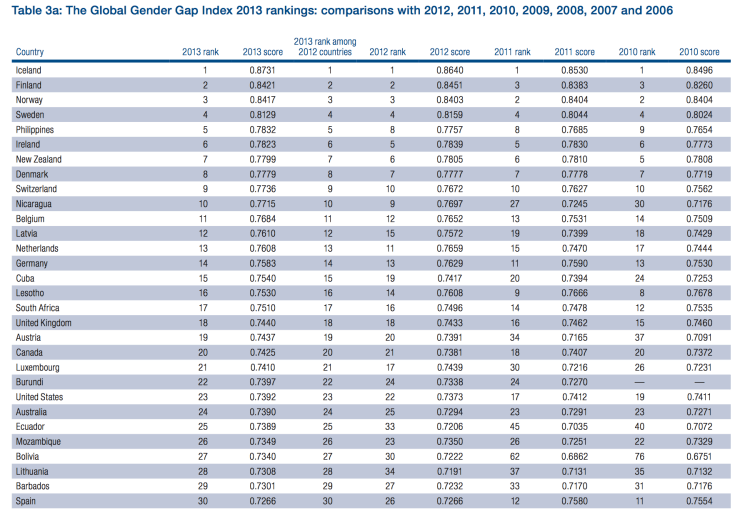
The four Nordic countries that have consistently held the highest positions in previous editions of the Global Gender Gap Index continue to hold privileged positions. Iceland (1) holds the top spot for the fifth consecutive year and therefore continues to be the country with the narrowest gender gap in the world. Iceland’s overall score moves up due to improvements in the Economic Participation and Opportunity and the Political Empowerment subindexes. Finland (2) continues to hold the second position despite slight losses in its overall score because of a decrease of its Economic Participation and Opportunity score. Norway (3) follows next, with a small increase in its overall score. Sweden (4) continues to hold the fourth position.
The Rankings (click on the image for full ranking)
-*-
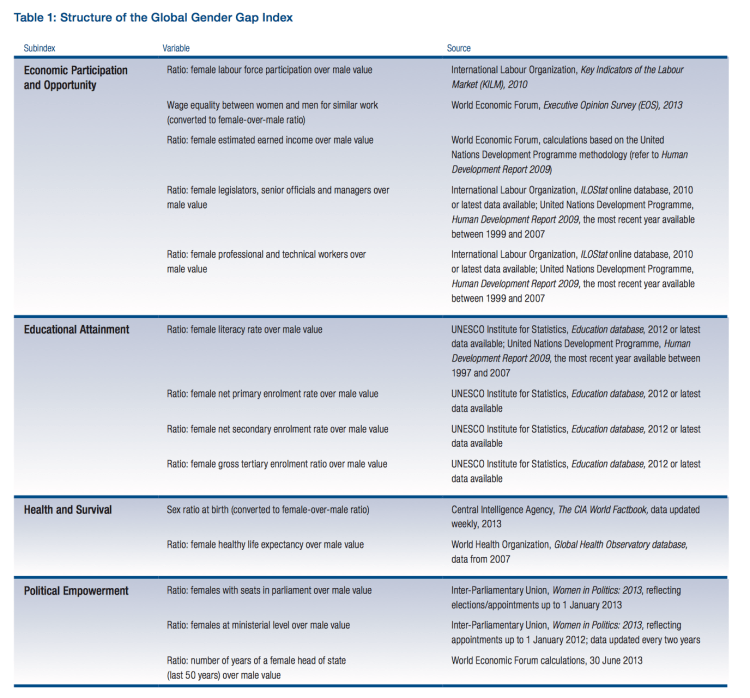
The Global Gender Gap Index introduced by the World Economic Forum in 2006, is a framework for capturing the magnitude and scope of gender-based disparities and tracking their progress. The Index benchmarks national gender gaps on economic, political, education- and health-based criteria, and provides country rankings that allow for effective comparisons across regions and income groups, and over time. The rankings are designed to create greater awareness among a global audience of the challenges posed by gender gaps and the opportunities created by reducing them. The methodology and quantitative analysis behind the rankings are intended to serve as a basis for designing effective measures for reducing gender gaps.
The Index is designed to measure gender-based gaps in access to resources and opportunities in individual countries rather than the actual levels of the available resources and opportunities in those countries. We do this in order to make the Global Gender Gap Index independent from countries’ the levels of development. In other words, the Index is constructed to rank countries on their gender gaps not on their development level. For example, rich countries have more education and health opportunities for all members of society and measures of education levels thus mainly reflect this well-known fact, although it is quite independent of the gender-related issues faced by each country at its own level of income. The Global Gender Gap Index, however, rewards countries for smaller gaps in access to these resources, regardless of the overall level of resources. Thus the Index penalizes or rewards countries based on the size of the gap between male and female enrolment rates, but not for the overall levels of education in the country.
Chosen excerpts by Job Market Monitor. Read the whole story at
via The Global Gender Gap Report 2013 | World Economic Forum – The Global Gender Gap Report 2013.



 Job Market Monitor
Discussion
Trackbacks/Pingbacks
Pingback: Japan – Addressing the Gender Gap | Job Market Monitor - August 14, 2014
Pingback: Hiring Gender Gap for Business Grads in US – 5 percentage-point in job offer finds BW | Job Market Monitor - August 28, 2014