A new paper, from EPI economist Monique Morrissey and research assistant Natalie Sabadish, demonstrates that the current retirement system has left the vast majority of Americans unprepared for retirement. Retirement Inequality Chartbook: How the 401(k) revolution created a few big winners and many losers uses 46 charts to demonstrate the impact of the shift from pensions to individual savings accounts. The chartbook examines disparities in retirement preparedness and outcomes by income, race and ethnicity, education, gender, and marital status.
While high-income Americans have benefitted enormously from the rise of 401(k)s, most Americans are being left behind. These findings underscore the importance of preserving and strengthening Social Security, defending defined-benefit pensions for workers who have them, and seeking solutions for those who do not.
“401(k)s were never designed to replace pensions for most workers. They serve primarily as a tax shelter for high earners,” said Morrissey. “The 401(k) revolution has been a disaster, yet some policymakers are calling for cuts to Social Security, which will be the only significant source of retirement income for most Americans—if they are able to retire in the first place.”
The easy-to-read interactive charts make it clear that America’s retirement system is broken for most Americans:
- Households in the top income-fifth accounted for 72 percent of total savings in retirement accounts in 2010 and were the only income group that had more than their annual income saved in these accounts.
- Participation in employer-based retirement plans by workers age 25-61 declined over the past decade, from 52% in 2000 to 45% in 2010;
- For many demographic groups, including black and Hispanic households, households headed by someone without a college degree, and single people, the typical (median) household has no savings at all in retirement accounts;
- On average, white households have more than six times as much saved in retirement accounts as Hispanic or black households;
- Similarly, college-educated households have nearly six times as much saved on average as high school-educated households.
Some Charts
The recent decline in worker participation in employer-based retirement plans is generally steeper when focusing on narrower age groups rather than all prime-age workers, because an aging workforce partly offsets declines within age groups as workers in their 50s and early 60s are more likely to participate.

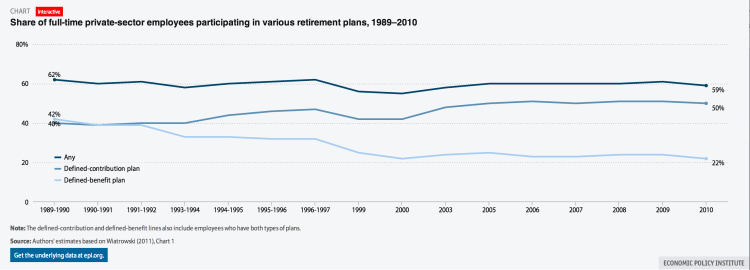
Participation trends show a shift from defined-benefit pensions to defined-contribution plans
While overall participation in employer-based plans has been flat or declining, there has been a shift from defined-benefit pensions to defined contribution plans in the private sector. In 1989, full-time private-sector workers with retirement benefits were divided roughly equally between those with defined benefit pensions and those with defined-contribution plans (including roughly 20 percent who had both—not shown). By 2010, 50 percent of these workers had a defined-contribution plan and 22 percent had a defined-benefit plan (including roughly 13 percent who had both).
Seniors’ pension benefits have peaked while earnings have increased
Older households received an average of $7,545 in defined-benefit pension benefits in 2010, slightly less than in 2004. Though older households’ incomes have grown over the past two decades, most of the growth has come from higher earnings. This reflects both a trend toward later retirement and the fact that since 2008 the large baby boomer generation has begun to age into the 62–79 age group, and many of these younger seniors are still working.

Chosen excerpts by Job Market Monitor. Read the whole story at




 Job Market Monitor
Discussion
Trackbacks/Pingbacks
Pingback: US / 47 per cent of working now expect to retire later survey finds | Job Market Monitor - October 15, 2013
Pingback: Older Workers in US / Attitudes on work and retirement | Job Market Monitor - October 16, 2013
Pingback: Chart shows who’s saving for retirement, who’s not – Encore – MarketWatch | Job Market Monitor - March 22, 2014
Pingback: Saving for Retirement in US – Who’s not ? | Job Market Monitor - March 22, 2014
Pingback: US – What can be done about the rampant underfunding of public pension systems? | Job Market Monitor - March 27, 2014
Pingback: US – Only 19 percent of lower-Income Individuals individuals aged 50-58 participated in a pension of any kind at their current jobs | Job Market Monitor - April 13, 2014
Pingback: US – 59%, are worried about not having enough money for retirement finds Gallup | Job Market Monitor - April 23, 2014
Pingback: US – 71 percent are adequately prepared for retirement RAND finds | Job Market Monitor - August 12, 2014