Rick Miner, Ph.D. produced the report People Without Jobs, Jobs Without People in February 2010. Job Market Monitor chooses to present some excerpts given its relevancy in the debate about the extend of the Skills Gap in Canada.
-*-
While much of the world is understandably focused on the current recession, there is a looming demographic and labour market crisis which has the potential to shake the very foundations of our society and economy.
THIS CRISIS ARISES FROM THE INTERSECTION OF TWO MEGA-TRENDS: AN AGING POPULATION AND AN EMERGING KNOWLEDGE ECONOMY.
Ontario population is aging; as the baby boomer generation advances into the age of normal retirement, there will be a significant in the proportion of our population in the prime working years (15 to 64). Using Ontario Ministry of Finance data, the projected shortfall in the availability of workers is shown to rise to at least 200,000, and to as high as 1.8 million by 2031, depending on our levels of population growth. Even in the midst of a recession, we have to understand that a labour shortage looms.

Unfortunately, this is only half of the bad news. At the same time as our population is aging, the requirements of the labour market are changing. With the emergence of our knowledge economy, the proportion of the labour force requiring some form of education or training beyond high school will increase dramatically. Using a variety of Canadian and U. S. estimates, it is concluded that by 2031 we will need 77% of our workforce to have post-secondary credentials (apprenticeship, university, college, industry, professional). Overall, we now stand at about 60%, with our younger population (25 to 34 years of age) at just over 66%.
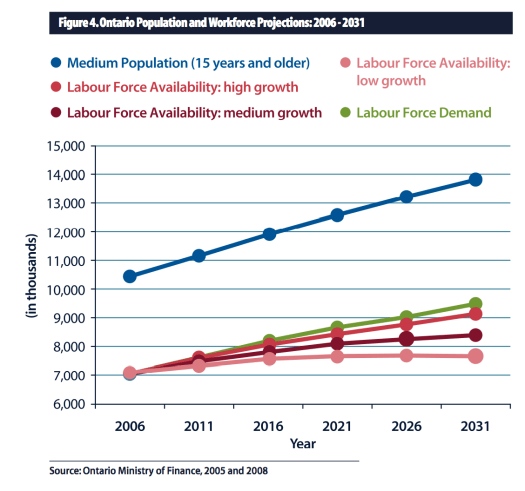
So, we will need both a larger workforce and increased skills. For potential solutions, increasing the size of the population (immigration) with more skilled workers could help, but it will not solve the problem. Increasing the participation rates of those currently under-represented in the labour force is another option that needs to be explored, as do ways of accelerating graduations, increasing employer-provided training, improving literacy rates,and creating a more unified educational system. But what is most clearly needed is a change in our society’s attitude towards post-secondary education. We have to accept attainment of post-secondary education or training as the expectation for all but a small minority of Ontarians.

Without effective action, we face a future with large numbers of unskilled workers looking for jobs that require skills they do not possess, and a large number of jobs that will go unfilled. The time for action is now. It will take planning, hard work, cooperation, and difficult decisions to secure our future. An alternative outcome is simply unacceptable.
Full Report @:



 Job Market Monitor
Discussion
No comments yet.