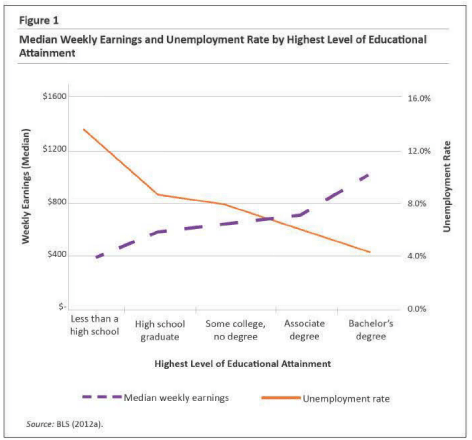
The “jobs gap”—or number of jobs needed to return to pre–Great Recession levels—stood at 11.3 million in late 2012, while 12.8 million Americans were unemployed. Carnevale, Smith, and Strohl (2010), however, estimated 46.8 million new jobs will need to be filled by 2018, of which 13.8 million will be new jobs and 33 million will be jobs open due to retirement. The types of industries expected to grow will shift in occupational expectations toward those needing abilities associated with greater levels of educational attainment, so these jobs will require college-educated workers. Factors contributing to the need for college-educated workers include creative destruction leading to a churn of skills needed by the workforce, a continuing increase in the wage premium associated with differences in educational attainment, the increasingly tough road to economic stability for low-income students, and the training provided in internal labor markets for workers that are more educated. Together these trends suggest that access to not only a job, but also to the training to keep that job, is augmented by higher levels of educational attainment.
Simply put, America’s community colleges are the brokers of opportunity for a stronger middle class and more prosperous nation. The value of community colleges has repeatedly been detailed in broad brushstrokes. Belfield and Bailey (2012) reviewed twenty studies on the earnings effects of a community college, concluding, “[T]his review affirms that there are strong positive earnings gains from community college attendance and completion, as well as progression to a 4-year college” (p. 60). In addition, the latest national estimate of the return on investment to state and local governments from investing in community colleges in 2007 was 16.1%.
While these broad-brush pictures of the community college contribution are important, the community college is an intricate institution offering pathways to credentials, degrees, and retraining opportunities for those with and without college credentials; they operate as engines of economic development. To date, the multifunctional nature of the community college mission has limited our ability to understand these colleges’ role in sustaining the nation’s general welfare. This brief provides a better opportunity to understand community colleges’ role, and frames private and public economic returns of the community college movement in three ways:
1. The community college as a launching pad. Community colleges serve as a starting point for students in terms of educational progression—the lockstep mentality that dominates considerations of educational attainment. They also accelerate learning through early college experiences and transfer opportunities.
2. The community college as a (re)launching pad. Community colleges serve as providers of knowledge and skills to members of the community when they need them, and in ways that they need them, often for those who have already been successful in college.
3. The community college as a local commitment. Community colleges serve local purposes, focusing on the needs and demands of the communities they serve.
As mentioned above, the workforce of the future will increasingly rely on occupations that require college-educated workers, and many of those workers will need the education and training provided at the subbaccalaureate level to enter a field, and in some cases to maintain job tenure. Given that there are numerous public and private returns associated with educational attainment, it is therefore prudent to align fiscal resources with the workforce of the future.
Full report @

via Community College Contributions
Related Posts
US / College Degrees Matter
How Much Protection Does a College Degree Afford? Past research from Pew’s Economic Mobility Project has shown the power of a college education to both promote upward mobility and prevent downward mobility. In the wake of the Great Recession, however, many have questioned whether the advantageous market situation of college graduates has suffered under the pressure …Continue reading »
The Grand Disconnect – Employers, education providers, and youth
“Around the world, governments and businesses face a conundrum: high levels of youth unemployment and a shortage of job seekers with critical skills” writes Mona Mourshed, Diana Farrell, and Dominic Barton in a McKinsey in Its report Education to Employment Designing a system that works. (Adapted choosen excerpts by Job Market Monitor to follow) How can a country successfully move … Continue reading »
US / 2013 job market for College graduates, construction workers and Government workers
Amid another blah year, a few workers that bore the brunt of the Great Recession stand to gain in 2013. Here are three: College graduates Congrats class of 2013! You have a better chance landing your dream job than the poor grads before you working as baristas. The years following the Great Recession hit workers … Continue reading »
Community Colleges / Job Retraining Programs: Getting back into the workforce
Community colleges have long played a key role as an entryway to better career opportunities for adults in the workforce. But with the job market more competitive than ever and the unemployment rate stubbornly stuck near 8%, community colleges across the country are launching new initiatives that are more aggressive in helping unemployed Americans find … Continue reading »
California / College Grads Taking Low Paying Jobs rose by 60,000 from 2006 to 2011
The number of California college graduates working in low-paying jobs rose by 60,000 from 2006 to 2011 according to the U.S. Census Bureau. Throughout the state, 260,000 recent college grads under the age of 30 are working on the front lines of food service and retail industries where historically those jobs have gone to workers … Continue reading »
Closing the Skills Gap / Connecting College Students and Employers
There are two major factors we need to address to close this gap and bring students and young professionals closer together with employers. The first factor is empowering students to make informed decisions about their degree and courses they take. It takes 120 credits to graduate with a Bachelor’s Degree, yet the national average is … Continue reading »
US | Colleges and Universities | Only 29 pc of students have received career and job help
Millennial Branding, a Gen Y research and consulting firm and StudentAdvisor.com, a Washington Post Company and the leading free learning resource for students, today announced a new report on how students are developing their careers while in college. The report, The Student Career Development Study, shows that students are not aggressively preparing for their post-college …Continue reading »



 Job Market Monitor
Reblogged this on This Got My Attention and commented:
Good information.
Posted by Mike | January 31, 2013, 8:59 am