“The length of time the jobless spent searching for work before finding a job increased from 5.2 to 10.4 weeks between 2007 and 2010, edging down to 10.0 in 2011; for the unemployed who eventually quit lookingand left the labor force, duration also increased sharply between 2007 and 2011, from 8.7 to 21.4 weeks” write Randy E. Ilg and Eleni Theodossiou in Job search of the unemployed by duration of unemployment published in the Monthly Labor Review.
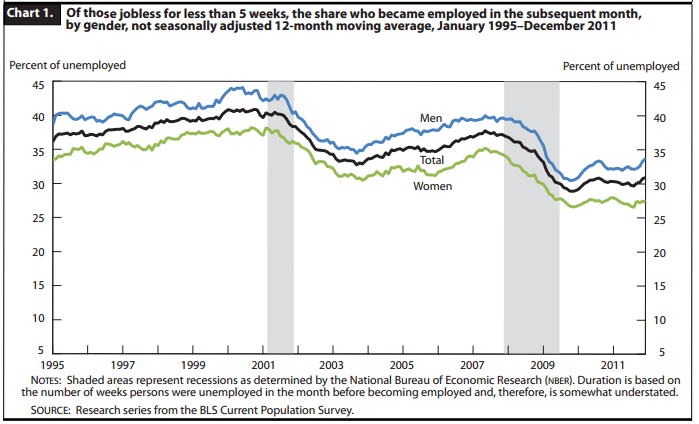
From 1994 through 2008, roughly half of successful jobseekers found work within 5 weeks of beginning their search. Prior to the start of the recent recession in December 2007, for example, 49 percent of those who were unemployed in one month but employed in a subsequent month had been jobless for less than 5 weeks. In 2011, a little more than one-third of jobseekers found work in less than 5 weeks. As the share of shortterm successful job searches declined, the share of longterm successful job searches (those lasting 6 months or longer) increased dramatically. By 2011, more than a quarter (26.7 percent) of successful job searches lasted 6 months or longer, with about half of those taking more than a year. In comparison, about 10 percent of successful job searches lasted 6 months or longer in 2007.
.
 .
.
.
The chance of becoming employed decreases the longer one is unemployed. This relationship holds regardless of expansions or contractions in the business cycle. However, the chance of finding a job has been substantially lower in the aftermath of the 2007–2009 economic downturn. In 2011, an individual who had been unemployed for less than 5 weeks had a 31-percent chance of becoming employed in a subsequent month, whereas an individual who had been jobless for a half year or longer had only a 10-percent chance. In comparison, during the tight labor market of 2000, the proportions were higher, 40 percent and 20 percent, respectively.
.
.
Overall, the unemployed (both men and women) took to find work in 2011 was nearly twice as long as prior to the beginning of the recession in 2007, 10.0 weeks versus 5.2 weeks. Although men were somewhat more persistent in their job search than women, among the jobless who found work in 2011, roughly a quarter of each gender spent over a half year searching. Among the jobless who were unsuccessful in their job search and left the labor force in 2011, more than 4 in 10 spent a half year or longer searching before giving up. Undoubtedly, one of the most profound effects of the 2007–2009 recession was the shrinking likelihood of the unemployed finding jobs; even more dramatic was that the likelihood of finding work decreased substantially as the length of time spent searching increased.
Source:
Read More @ Job search of the unemployed by duration of unemployment



 Job Market Monitor
Thanks for providing this info. The hardest thing for most job seekers is to stay motivated the longer a job search goes on. Sticking with a solid plan, creating a clear, consistent message across both traditional and social media, and not letting bitterness take over are some of the hardest obstacles to overcome. Also, sometimes you have to stop and reassess. If your original plan is not working out, what can be adjusted, how can you think more out of the box? I heard a job seeker say the other day that he was frustrated because the job search process itself required a different set of skill sets than the job he was actually going for. So although he was prepared for the job, he was less sure of how to conduct the search. It was a good reminder on how careers today do require solid job search skills in order to maintain them.
Posted by @Rezlady & @ITtechExec: Career Pros for Technical Candidates | April 6, 2012, 9:09 am