Each year, the Congressional Budget Office publishes a report presenting its projections of what the federal budget and the economy would look like over the next 30 years if current laws generally remained unchanged. This report is the latest in that series.
The federal budget deficit increases significantly in relation to gross domestic product over the next 30 years, in CBO’s projections, pushing federal debt held by the public far beyond any previously recorded level.

The Long-Term Budget Outlook
Deficits
In CBO’s projections, the total federal budget deficit increases significantly in relation to gross domestic product (GDP) over the next 30 years, reaching 8.5 percent of GDP in 2054. Since the Great Depression, that level has been exceeded only during and shortly after World War II and during the 2007–2009 financial crisis and the coronavirus pandemic. That growth results from rising interest costs and large and sustained primary deficits, which exclude net outlays for interest. Those deficits average 2.2 percent of GDP over the 30-year period; over the past 50 years, they averaged 1.6 percent of GDP. Projected primary deficits are especially large given the forecast of low unemployment rates.
Debt
Federal debt held by the public, measured as a percentage of GDP, increases in every year of the 2024–2054 period. By 2029, that debt climbs to 107 percent of GDP, exceeding the historical peak it reached immediately after World War II. In 2054, it reaches 166 percent
of GDP and remains on track to increase thereafter. Such large and growing debt would slow economic growth, push up interest payments to foreign holders of U.S. debt, and pose significant risks to the fiscal and economic outlook; it could also cause lawmakers to feel more constrained in their policy choices.
Outlays and Revenues
Measured as a percentage of GDP, federal outlays are large by historical standards and, beginning in 2028, increase in each year, 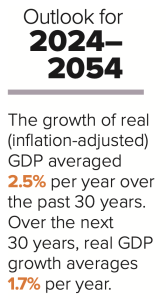 reaching 27.3 percent of GDP in 2054. Growth in net interest costs and in spending for federal health care programs, particularly Medicare, drives those increases. Revenues, also measured as a percentage of GDP, fluctuate over the next decade and increase thereafter, reaching 18.8 percent of GDP in 2054. That later growth in revenues occurs mainly because growth in income boosts receipts from the individual income tax.
Population Growth
Demographic trends are a key determinant of the long-term budget and economic outlook. In CBO’s projections, the population grows more slowly over the next 30 years than it did over the past 30 years. Without immigration, the population would begin to shrink in 2040, in part because fertility rates remain below the rate that would be required for a generation to replace itself.
Economic Growth
In CBO’s projections, real (inflation-adjusted) GDP grows at an average rate of 1.7 percent per year from 2024 to 2054, slightly slower than the growth of real potential GDP—the maximum sustainable output of the economy—over that period. Real potential GDP is projected to increase at an average rate of 1.8 percent per year over the next 30 years, slower than such growth over the past 30 years, when it averaged 2.4 percent. That decline is attributable to slowing growth in the poten- tial labor force (an estimate of what the size of the labor force would be if economic output and other key variables were at their maximum sustainable amounts) and in potential labor force productivity (the ratio of real potential GDP to the potential labor force) over the 2024–2054 period.
Potential Labor Force
The potential labor force grows at an average rate of 0.4 percent over the next 30 years—much more slowly than the average growth rate of 0.8 percent over the past 30 years. Slowing population growth and the aging of the population account for most of that slowdown in growth.
Potential Labor Force Productivity
The growth of potential labor force productivity slows over the next 30 years because of two key factors: the slower accumulation of capital (mainly attributable to increased federal borrowing) and slower growth in total factor productivity (that is, the average real output per unit of combined labor and capital services) in the nonfarm business sector.
Inflation and Interest Rates
Inflation slows through 2026 to a rate that is consistent with the Federal Reserve’s long-term goal of 2 percent, and interest rates rise over the next three decades. The rise in interest rates largely stems from projected increases in federal borrow- ing and in capital income as a share of total income.
Chosen excerpts by Job Market Monitor. Read the whole story @ The Long-Term Budget Outlook: 2024 to 2054 | Congressional Budget Office



 Job Market Monitor
Discussion
No comments yet.