This Global Inventory of National and Regional Qualifications Frameworks is the result of longstanding collaborative work between the European Centre for the Development of Vocational Training (Cedefop), the European Training Foundation (ETF), the United Nations Educational, Scientific and Cultural Organization (UNESCO) and the UNESCO Institute for Lifelong Learning (UIL).
Volume I continues the role set by previous editions, presenting insights and knowledge from different contexts where regional and national qualifications frameworks are in place across the world. It serves as an observatory, shedding light on advancements and identifying areas that need improvement in line with emerging trends and policy priorities.
Measuring progress
Experts from the four agencies10 applied a common benchmarking system to measure the progress of each individual NQF submitted for the analyses. This guide consists of a series of stages, titled, in ascending order, ‘explorative’, ‘design’, ‘adoption’, ‘activation’, and ‘operational’. Each stage has indicators which signal the extent of conceptual evolution, institutional and technical development, and addition of supporting tools and methodologies. Experts uses the associated indicators to determine the stage reached by the respective NQF examined.
Most NQFs are now being used for their planned purposes
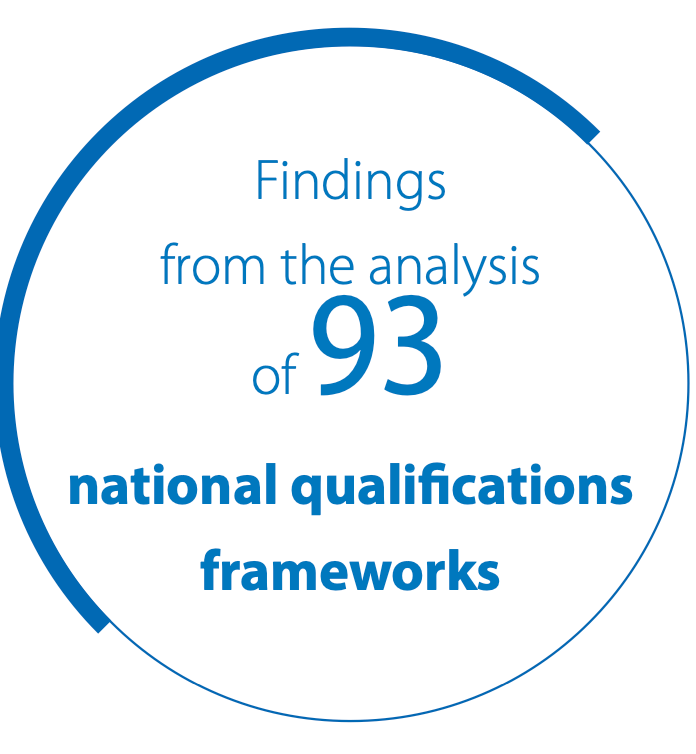
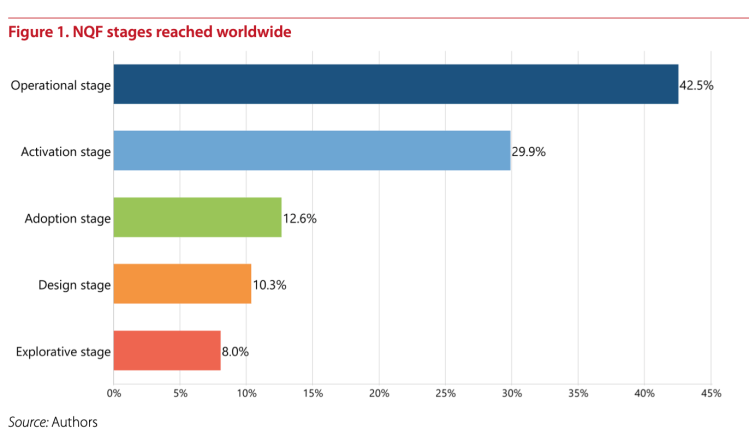
Our investigation reveals that 28 of the 93 frameworks are presently at one of the three early stages, namely explorative, design, and adoption. 8% are at the explorative stage, meaning initial discussions on policy challenges and the possible ways to address these problems are ongoing; working groups at this stage typically look internationally for examples of good practice. 10% are at the design stage. Here, typically, a formal working group has been established. Rationale, scope, and objectives of the NQF have been agreed. Work has commenced on the architecture of the frameworks and its level descriptors. 12% are at the adoption stage, in which countries formally adopt the NQF, most commonly via legislation. Usually, too, at this stage, roles and responsibilities are assigned to stakeholders, sometimes in the legislation or in other official documentation. An implementation strategy has been adopted.
The majority of the NQFs surveyed, 65 of the 93, are now at one of the two more advanced stages, namely activation and operational. 30% are at the activation stage, signifying that stable governance structures and day- to-day administrative capacities are in place; QA arrangements have been developed; and some outcomes-based qualifications are being allocated to levels and are available for use via registers. During this stage, we see the gradual but distinct shift from an internal focus on the design and adoption of the framework, to an external focus where end users such as learners, providers, workers, and employers are addressed. 43% have reached the operational stage. By operational, we mean that they have adopted the NQF; they include outcomes-based qualifications; their governance arrangements are settled and functioning; they place qualifications in a register or database; and the certificates and diplomas bear NQF levels. Here, the NQF is fulfilling one of its key intended functions, improving transparency and comparability.
Such figures say that frameworks are either already delivering on their intended functions and contributions, or just beginning to do so. We can therefore say that they are being implemented.
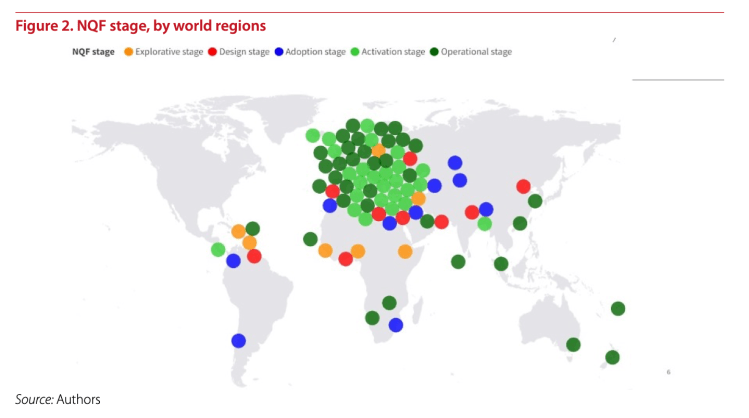
Europe has higher numbers and proportions of countries at the activation and operational stages (see Figure 2) than other continents. The Asia-Pacific region is second highest against this measurement. However, as indicated earlier, due to the data available for these analyses, European countries are disproportionately represented. A second
factor is that, from 2008 onwards especially, with the establishment of the regional EQF, there was a flourishing of European NQFs before significant numbers of NQFs were established in the Arab states, Africa, and Latin America.
Chosen excerpts by Job Market Monitor. Read the whole story @ Global inventory of national and regional qualifications frameworks 2022 | CEDEFOP
Related Posts
National Qualifications Frameworks (NQF) and the European Qualifications Framework (EQF) – The inclusion of non-formal qualifications
National Qualifications Frameworks (NQF) referenced to the European Qualifications Framework (EQF) are important policy instruments to promote mobility and lifelong learning at the national as well as the European level. The NQF can play a decisive role not only to improve the transparency of a national qualifications system, but also as a policy reform driver … Continue reading
Qualifications frameworks in Europe, 2017 – A total of 39 European countries
As countries across Europe are pushing ahead with their national qualifications frameworks (NQFs), the question of the frameworks’ added value and contribution to policies and practices is taking centre stage. While every NQF is unique, being organically woven into the fabric of a country’s education and training system, the frameworks share many features. They are … Continue reading
Qualifications Frameworks – A global inventory
This two-volume publication gives an update on the national qualification frameworks around the world. It provides information on national and regional developments as well as selected themes. It is the result of collaborative work between Cedefop, ETF, UNESCO and the UNESCO Institute for Lifelong Learning. The 2017 Global Inventory provides some important insights into the … Continue reading
Qualifications Frameworks – The labour market impact, a report by ILO
Qualifications frameworks are widely described as policies that are introduced The research did identify some evidence of impact, including possible indirect effects, such as ways in which qualifications frameworks have improved general understanding of education and training systems, or contributed to standardizing provision, which might in the long-term improve how qualifications are used in labour … Continue reading
National Qualifications Frameworks (NQFs) – A toolkit
Most of the ETF’s 29 partner countries have national qualifications frameworks (NQFs) but these mainly exist only on paper or are only partially implemented. This toolkit examines why countries are blocked and proposes solutions to speed up implementation. We go wider than the NQFs themselves. It is not about NQFs per se, but about qualification … Continue reading
National Qualifications Framework (NQF) – The six stages of development
The following six stages describe the development of national qualifications frameworks (1): (a) explorative stage; (b) design stage; (c) adoption stage; (d) activating stage; (e) operational stage; (f) review stage. Figure 1.The cyclical character of NQF developments To be able to deliver according to expectations, frameworks continuously need to adapt to changing context and requirements … Continue reading
European Qualifications Framework (EQF) – A success story ?
In May 2017, Marianne Thyssen, the European Commissioner for Employment, Social Affairs, Skills and Labour Mobility, stated that ‘The EQF is a success story. In the almost ten years since it was established, it has helped to make qualifications more transparent – and therefore more comparable – across Europe’. More than 10 years after its … Continue reading
European Qualifications Framework for Lifelong Learning (EQF) – 39 European countries are currently developing 43 NQFs
39 European countries are currently developing 43 national qualifications frameworks (NQFs) which have reached different stages of implementation. Some countries have been or are revising their frameworks. Comprehensive frameworks gaining ground European countries tend to use their frameworks to create comprehensive maps of qualifications in all sectors (VET, higher education, general education, adult learning). Many … Continue reading
Australia – Review of the Qualifications Framework
The AQF The AQF puts senior secondary school, vocational education and training (VET) and higher education qualifications into a single, national framework. Ithas played an important role in the quality assurance of Australia’s well-regarded tertiary education system and sets out the nature and purpose of senior secondary education. The AQF is used to assist recognition … Continue reading
The Finnish National Qualifications Framework (NQF) – A comprehensive and concise description
The Finnish National Framework for Qualifications and Other Competence Modules (FiNQF) was formally adopted on 1 March 2017. On this date, the Law and the Decree governing the FiNQF entered force, which marked a formal culmination of the work towards a national qualifications framework. In fact, much had been done before; the Government committed to … Continue reading
The European Qualifications Framework for lifelong learning (EQF) – To improve the transparency, comparability and portability
The European Qualifications Framework for lifelong learning (EQF) aims to improve the transparency, comparability and portability of people’s qualifications. The EQF was set up in 2008 as a common reference framework of qualifications, expressed as learning outcomes at increasing levels of proficiency. The framework serves as a translation device between different qualifications systems and their levels. It is … Continue reading
National Qualifications Framework in Europe – They play a key role in improving transparency and comparability of qualifications nationally and internationally but have limited visibility
During 2015-16, political commitment and technical advancement in developing and implementing national qualifications frameworks (NQFs) have continued. More frameworks have been formally adopted and have reached operational status, becoming an integrated feature of national qualification systems. This has made it possible for more countries to complete their link to the European qualifications framework (EQF); … Continue reading
Refugees in Europe – Selected practices in recognition and validation of qualifications and skills
This report explores procedures for recognition and validation of qualifications and skills for refugees in a number of European countries. Recognition and validation are important elements of qualification systems that can contribute to labour market integration of refugees, migrants and local citizens. Qualifications Frameworks can serve as a useful tool for the assessment of qualifications … Continue reading
Lifelong Learning – Making it a reality: a handbook by UNESCO
his handbook on lll is an attempt to capture the holistic, all-encom- passing vision of lll and recast it as practical guidance for education stakeholders. rather than providing an exhaustive account of lll in all its forms, the purpose of this publication is to articulate what lll is so that it may be understood, recognized, … Continue reading
Micro-credentials – The critical things to get started
Are micro-credentials set to disrupt professional and higher education to the same extent that Netflix disrupted the entertainment industry? Given the rapid acceleration of technology use and changes of work practices across many areas of employment during the [Coronavirus Disease 2019 (COVID-19)] pandemic – we are facing a world where learning, skill and knowledge agility … Continue reading
Lifelong Learning in UK – The Lifelong Loan Entitlement
The Lifelong Education Commission was launched by Chris Skidmore under his Chairmanship at ResPublica in February 2021. The Commission seeks to recommend how the multiple and varied barriers to lifelong learning can be removed, what future investment is needed to support this, and what regulatory change is needed to ensure the maximum possible flexibility that … Continue reading
Skills Transferability Across Borders in Europe – The instruments
To allow easier recognition and evaluation of foreign qualifications across Member States, the European Qualifications Framework (EQF) for lifelong learning was adopted in 2008.It enhances the transparency, comparability and portability of qualifications within the EU. As such, it fosters trust in foreign qualifications during cross-border hiring processes. The EQF serves as a ‘translation grid’ between national … Continue reading
Skills in Canada – Developing a mapping system that links skills to occupations
The skills required to succeed in today’s world of work are rapidly changing. Workers experience pressure to continuously improve their skills, and employers struggle to nd workers with the right skills to achieve their goals. • Developing a pan-Canadian mapping system that links skills to occupations is an important step towards improving our understanding of … Continue reading
Essential Digital Skills Framework for UK- What adults need to safely benefit from, participate in and contribute to the digital world
The essential digital skills framework defines the digital skills adults need to safely benefit from, participate in and contribute to the digital world. This framework has been designed to support providers, organisations and employers across the UK who offer training for adults to secure their essential digital skills. The frameworks sets out 5 categories of … Continue reading
National Qualification Framework in France – A guide
This report is the result of the many drafts produced by the Céreq project team that worked with the NQF-In partnership in order to reach a mutual understanding of the process of incorporating qualifications into National Qualifications Frameworks. As the following chapters will show, France benefits from a firmly established, centralised qualification system governance whose … Continue reading
Apprenticeship in Europe – In 24 out of the 30 countries covered by the study
This report details Cedefop’s first cross-nation study of apprenticeships in the European Union. The point of departure for the study is what countries define and offer as apprenticeship training. It then applies a purposive approach to identifying the changes that apprenticeships are undergoing in practice, based on their design characteristics. Largely based on data collected … Continue reading
Skills Recognition Systems – Filling the lack of hard, direct evidence of its contribution
Skills recognition systems are an important component of skills development, employment and migration policies. If designed and implemented properly, they bring benefits to individuals, employers and to the economy as a whole. However, this development and implementation give rise to a number of challenges, namely in the areas of stakeholder involvement, awareness raising and impact … Continue reading



 Job Market Monitor
Discussion
No comments yet.