The world is short on health-care workers. In 2016, the World Health Organization (WHO) predicted a global shortfall of 10 million health workers of all types by 2030. In 2020, the global health workforce numbered 65 million, according to the WHO’s National Health Workforce Accounts, yet these workers are no match for the demand. As the population in high-income countries gets older and lives longer, and as institutions fail to train enough new workers, the gap between demand and supply has remained. People are also exiting the health-care workforce, due to factors including aging, insufficient educational spaces, and worker burnout; physicians and nurses are retiring without a ready supply of replacements. This was a problem prior to the COVID-19 pandemic but has persisted since the global public-health crisis arrived. The American Medical Association (AMA) stated that two in five U.S. physicians surveyed in 2022 were planning to leave the profession by 2027.
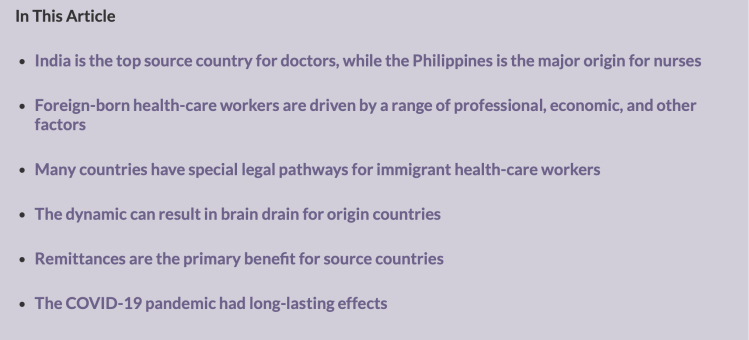
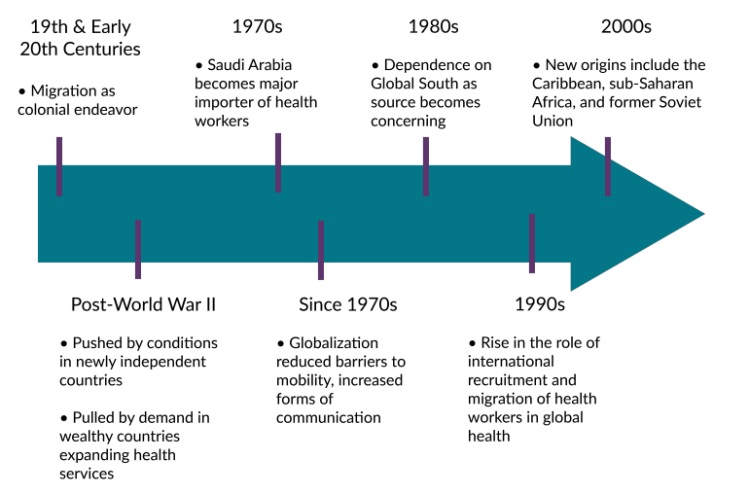
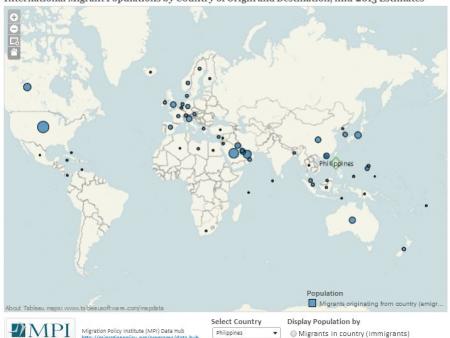
When unable to source staff at home, wealthy countries such as the United States, United Kingdom, Australia, and Saudi Arabia tend to turn abroad. The AMA, for instance, identifies better legal pathways for international medical graduates as the first way to relieve shortages, while Germany’s Triple Win program is designed to recruit thousands of foreign-born nurses. The number of migrant doctors working in mostly high-income countries of the Organization for Economic Cooperation and Development (OECD) increased by 50 percent from 2006 to 2016, to nearly 500,000, while the number of migrant nurses increased by 20 percent from 2011 to 2016, to nearly 550,000. In 2020, more than 12 percent of all nurses globally were working in a country other than that of their birth, according to the WHO. In the United States, one-quarter of practicing physicians were trained abroad as of this writing, according to the AMA.
This trend has a mix of impacts for health-care workers’ countries of origin. While emigration can advance individuals’ careers and drive economic development through the money workers send back, countries’ domestic health-care workforces may become depleted. In places such as the Philippines, training schemes have shifted to suit the needs of international markets rather than local conditions.
This article examines the trends in international migration among health-care workers. It focuses on major countries of destination and origin, factors driving migration, and global efforts to regulate the movement and prevent shortages in source countries.

Chosen excerpts by Job Market Monitor. Read the whole story @ Article: Aging Societies Rely on Immigrant Health-.. | migrationpolicy.org
Related Posts
Productivity and Aging – Aging economies are not puzzling from a theoretical perspective
Due to population aging, GDP growth per capita and GDP growth per working-age adult have become quite different among many advanced economies over the last several decades. Countries whose GDP growth per capita performance has been lackluster, like Japan, have done surprisingly well in terms of GDP growth per working-age adult. Indeed, from 1998 to … Continue reading
Aging Population – A demographic drag is coming but the consequences on growth will likely be less severe numbers suggest
As many countries complete the demographic transition, their populations age. While a growing working-age share thanks to aging has been a source for economic growth, contracting working-age shares now threaten to turn the former demographic dividend into a demographic drag. In this paper, we investigate the consequences of changes in working-age shares for economic growth. … Continue reading
Aging Baby Boomers in Canada – Their participation has surpassed earlier generations in their 60s
The large wave of baby boomers—individuals born between 1946 and 1965—accounted for 31% of the Canadian population in 2000, when they were in their prime ages of 35 to 54, and 24% of the total population in 2020, when they were older adults aged 55 to 74.1 Because of their sheer numbers, baby boomers have … Continue reading
Aging and Immigration in Europe – In addition to their integration into the labor force, the human capital of migrants is thus also a major determinant of their economic impact
This paper provides a systematic, multidimensional demographic analysis of the degree to which negative economic consequences of population aging can be mitigated by changes in migration and labor-force participation. Using a microsimulation population projection model accounting for 13 individual characteristics including education and immigration-related variables, we built scenarios of future changes in labor-force participation, migration … Continue reading
Population Aging in Canada – Would need to settle 2.85 million new Canadians immediately
If Canada was to rely solely on immigration to address the impending labour force shortage, it would need to settle 2.85 million new Canadians immediately in order to return to the 2019 OAD ratio. And arrivals would need, on average, to exceed 1.7 million people annually over the next decade to maintain that OAD ratio. … Continue reading
Aging Workforce in Canada – The ratio of younger workers to older workers declined from 2.7 in 1996 to 1.0 in 2018
Over the past two decades, the share of the employed population aged 55 and over increased significantly. This study uses Census of Population and Labour Force Survey data to examine the changing age composition of workers within the most prevalent occupations (with at least 10,000 workers), as well as the occupations that are increasing and … Continue reading
Aging – Likely a transitory phenomenon in high-income countries
Will the population of today’s high-income countries continue to age throughout the remainder of the century? We answer this question by combining two methodologies, Bayesian hierarchical probabilistic population forecasting and the use of prospective ages, which are chronological ages adjusted for changes in life expectancy. We distinguish two variants of measures of aging: those that … Continue reading
Global Aging – The trend towards higher levels of educational attainment may help to reduce economic dependency
When studying the economic consequences of changes in the age structure of the population, looking at economic dependency ratios provides us with some descriptive and intuitive initial insights. In this paper, we present two economic dependency ratios. The first ratio is based on economic activity status, and relates the number of dependent individuals to the … Continue reading
Aging Canada – The gap between the number of children and the number of seniors is growing
The gap between the number of children and the number of seniors is growing The most recent population estimates point to the continued rapid aging of the Canadian population. This trend is especially driven by fertility rates below the replacement level, which has been the situation in recent decades, and an increased life expectancy. The … Continue reading
Aging Workforce – Participation of older workers would have to rise significantly to stem the decline in aggregate participation IMF says
Population growth in advanced economies is slowing, life expectancy is rising, and the number of elderly people is soaring. Because older workers participate less in the labor market, the aging of the population could slow growth and, in many cases, threaten the sustainability of social security systems. But, as our research in Chapter 2 of … Continue reading
Global Aging Workforce – It will add further pressure to future labour market challenges
As a result of rising life expectancy and declining birth rates, global population growth has considerably decelerated and this trajectory is expected to continue over the next few decades. One immediate implication of this slowdown is that growth of the global labour force will not be suf cient to compen- sate for the rapidly expanding … Continue reading
Aging – Japan’s recent experiences
As the third largest economy in the world and a precursor of global trends in population aging, Japan’s recent experiences provide important lessons regarding how demographic shifts affect the labor market and individuals’ economic well-being. On the whole, the labor market has shown a remarkable stability during the recent financial crisis, despite decades of economic … Continue reading
Aging Workforce in US – A 10% increase in the fraction of the population ages 60+ decreases the growth rate of GDP per capita by 5.5% research finds
Population aging is widely assumed to have detrimental effects on economic growth yet there is little empirical evidence about the magnitude of its effects. This paper starts from the observation that many U.S. states have already experienced substantial growth in the size of their older population and much of this growth was predetermined by historical … Continue reading
The Aging Challenge – Two solutions
Population aging—the increase of the share of older individuals in a society due to fertility declines and rising life expectancy—is an irreversible global trend with far-reaching economic and socio-political consequences. By 2050, the number of people aged 60 and older will more than double from its current levels, reaching around 2 billion. While Europe was … Continue reading
Aging Finland – 34,000 immigrants needed instead of the current 18,000 in order to stop the decrease working-age population
Finland does not apply quotas or a points-based system to labour migration. Instead, Finland applies the determination of the availability of labour when issuing a residence permit for an employed person. However, the proportion of labour subject to the determination of the availability of labour is relatively low and the majority of labour uses other … Continue reading



 Job Market Monitor
Discussion
No comments yet.