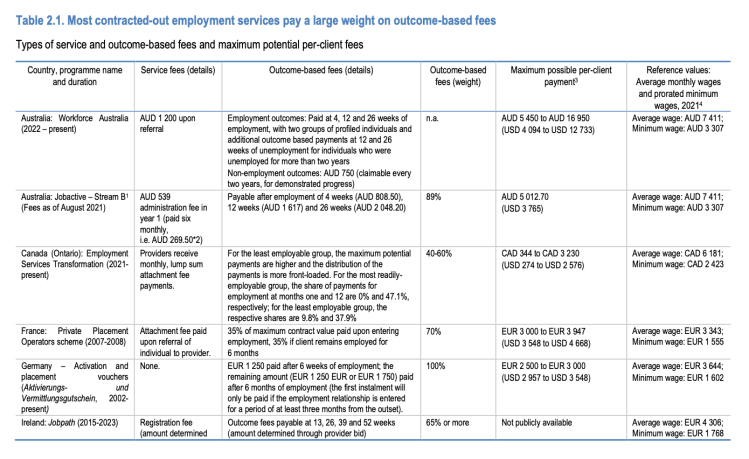
Two out of five OECD countries contract out some of the job brokerage and counselling functions of publicly financed employment services using outcome-based payment models. This paper examines several important aspects related to the design and implementation of such outsourcing. First, innovative payment models can improve incentives for external providers to offer training and more effective services for hard-to-place clients. Second, providing forward guidance to providers and accounting for contingencies can mitigate their risks, e.g. of being underpaid relative to expenses incurred, thus lowering service costs. Third, letting individuals choose a provider can result in services that are better tailored and foster ongoing competition between providers. Finally, automating data exchange can, somewhat paradoxically, improve data privacy and data protection while enabling new payment models.
These and related findings are discussed with country examples based on desk research and interviews with stakeholders in several OECD countries. The paper builds on work conducted in the project ‘Reforming the Swedish Public Employment Service’, which was carried out with funding from the European Union via the Technical Support Instrument and was implemented by the OECD in cooperation with the European Commission’s Directorate-General for Structural Reform Support.
Recommendations
• Outcome-based payment models can stimulate providers to offer better services compared to fully fee-for-service payment models. Payments should vary based on the employability of the client or – for very hard-to-place clients – include payments for soft outcomes, such as when a PES counsellor measures a client’s progress towards a set of pre-determined goals. To reap the full benefits of contracting models that incorporate outcome-based payments, the focus of monitoring should be on providers’ outcomes. Ideally, this entails embedding into the contracts an escalating ladder of consequences for poor performance, ranging from a letter of warning for poor performance to contract termination. Outcome-based payments can also be tailored to an individual’s specific employability, such as that measured by a statistical profiling tool (an approach adopted by the Reintegration voucher scheme in Italy). Experience has also shown that outcome- based payment models should include safeguards such as minimum service requirements that depend on the employability of the client. Such features can be particularly helpful to help support vulnerable jobseekers and mitigate the potential moral hazards associated with the system of contracting out.
• Ongoing competition between providers in a service area is better than having competition only during the procurement stage. The empirical evidence on the effectiveness of different contracting models in employment services is not conclusive, given the small number of such programmes and the difficulties in evaluating their relative merits. However, in several contexts that are broadly comparable to employment services, such as health and education, empirical studies have generally found a positive link between increased, ongoing competition between service providers and outcomes (although conceivably, it is also possible to have too many providers as well). Furthermore, from the perspective of the contracting authority, the presence of several different providers competing to offer their services to clients has several advantages, including a more credible threat of sanctioning underperforming providers and a lower level of systemic risk – competing providers can relatively quickly absorb clients in case a provider exits the market.
• In a market which allows client choice in principle, the system should support jobseekers to make an informed and deliberate choice in practice. This serves two purposes. First, it candirectly improve the employment outcomes of the jobseeker making the choice. Such an arrangement can provide jobseekers with more tailored support that better reflects their specific needs, thus improving the quality of the match between the provider and the jobseeker. Moreover, the act of making a choice, in itself, has been shown to improve motivation and effort in other contexts – effects that can be extremely important for individuals experiencing unemployment. Second, having jobseekers make an informed choice strengthens the competitive pressures between providers even with a given number of providers. This has indirect positive effects on the effectiveness of the employment services market, thereby improving outcomes for all clients in the private employment services market. Jobseeker choice is thus a key mechanism for unleashing the potential benefits of contracted employment services.
• Automating data exchange can, somewhat paradoxically, improve data privacy while enabling new payment models. In addition to improving the efficiency of the system by lowering administrative burdens and increasing transparency, streamlined data exchange can limit information received by providers to what is strictly necessary, such as when a client stops working, signalling to the provider that additional support may be necessary. With access to up-to-date employment and earnings data, outcome-based payments can incorporate a measure of jobseeker earnings to give employment services providers a financial incentive to place their clients into high- paying jobs. Such features have been adopted by the United Kingdom’s Restart programme, where payments to providers are triggered after their clients reach a certain earnings threshold and providers are notified of employment changes. A streamlined data exchange can also facilitate real-time monitoring and benchmarking of provider performance. In addition to facilitating monitoring, giving providers up-to-date information on their performance relative to their peers could help improve their service delivery and ensure a more consistent minimum quality of services across providers.



 Job Market Monitor
Discussion
No comments yet.