Over the last decade the English apprenticeship system has undergone a dramatic transformation. There are new apprenticeship standards developed by employers and new minimum standards for programme length and off-the-job training. Competence is tested through an end-point assessment. Apprenticeships now cover almost every sector of the economy and extend to both low- and high-skilled occupations. However, while there are some very high-quality apprenticeships and rapid growth in degree apprenticeships which are part of higher education, the apprenticeship system continues to play a relatively minor role in the area where it was traditionally strongest and where it has most to offer – the transition from school to work for young people who do not enter higher education.
Three factors obstruct the realisation of this vision for apprenticeship. First, not enough apprenticeships provide the breadth of education and training needed to provide a suitable career foundation for young people. Second, it is often unclear what apprentices can expect – not least because they often do not receive the minimum level of training required for their course – and there are high levels of dropout. Third, youth apprenticeship is a relatively small and declining part of the apprenticeship system. These are large obstacles, but they can be overcome. In response to these challenges, this report draws on international experience to propose three steps that, if taken together, would help establish a world class apprenticeship system.
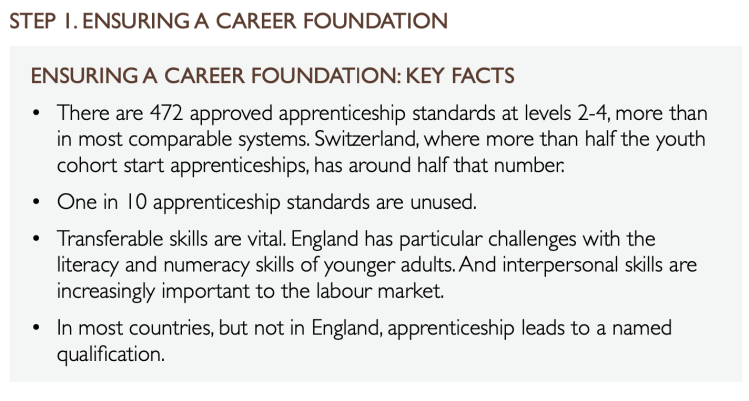
The first step is to ensure a career foundation – apprenticeship must lead to a career, not just immediate job skills; trainees must be able to adapt to changing job roles and technologies. This requires breadth of training in the target occupation, setting it above temporary job roles, alongside training in the wider and transferable skills that provide career competence. Secondly, the quality of training must be further improved and offers clarified for prospective and established apprentices and for employers. The third step is to revive youth apprenticeship, which is currently small in scale and represents unrealised potential. The wage and productivity returns gained through youth apprenticeships are greater than for older workers. There is also a lack of alternative post-16 opportunities for those with weak prior attainment. Many European countries successfully use apprenticeships to integrate young people into the labour market. But in England many employers prefer to use their levy funds to upskill their existing workforce, and/or to support degree apprenticeships and management training instead of funding the training of new recruits with limited prior attainment. The fast-increasing number of these higher level and degree apprenticeships benefit few young people.



Chosen excerpts by Job Market Monitor. Read the whole story @ Great expectations: three steps to a world class apprenticeship system



 Job Market Monitor
Discussion
No comments yet.