The world of work is getting older in advanced economies and increasingly in many emerging ones. Today, people between theages of 45 and 64 account for some 40 percent of the working-age population in OECD countries, up from 28 percent in 1990.
Two powerful and persistent trends – longer lifespans and lower birth rates – all but guarantee that the average age of theworkforce will continue to rise. The implications are profound for the labour market, government finances, healthcare and welfare systems – and the billions of individuals whose hard work underpins these societal essentials.
Are business executives, policymakers, and citizens adapting quickly enough to cope with ageing on a scale never before seen in human history? What are the structural barriers, the embedded attitudes and behaviours, that stand in the way of helping moremidcareer and older workers stay employed longer? As the world transitions to a more digital and sustainable labour market, what achievable steps could stakeholders take now to support midcareer and older workers looking to progress their careers or switch jobs when wanted or necessitated?
In search of answers, the OECD and Generation, a global employment nonprofit organisation that trains and places learners of all ages into careers previously beyond their reach, teamed up to undertake new research – which is presented
in this report. It focuses primarily on Europe that, along with parts of East Asia, sits squarely at the epicentre of ageing’seconomic impact. In early 2023, a detailed survey was conducted of 6,029 employed and unemployed people (aged 18–65) and 1,510 hiring managers in eight countries: the Czech Republic, France, Germany, Romania, Spain, Sweden, the United Kingdom, and the United States.
The results of the research are presented in three sections. The first section analyses existing data to set out the context; the second section highlights the critical findings from the survey; and the third proposes an action plan that key stakeholders may wish to consider. The focus throughout is on what companies and workers could do voluntarily,with helpful nudges, where appropriate, from government, to ensure business success, employee well-being, and continued prosperity in times of rapid population ageing.
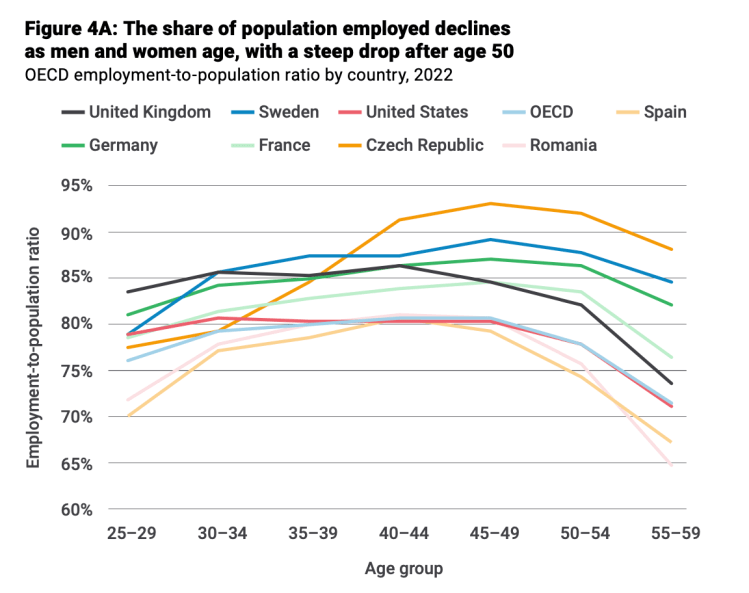
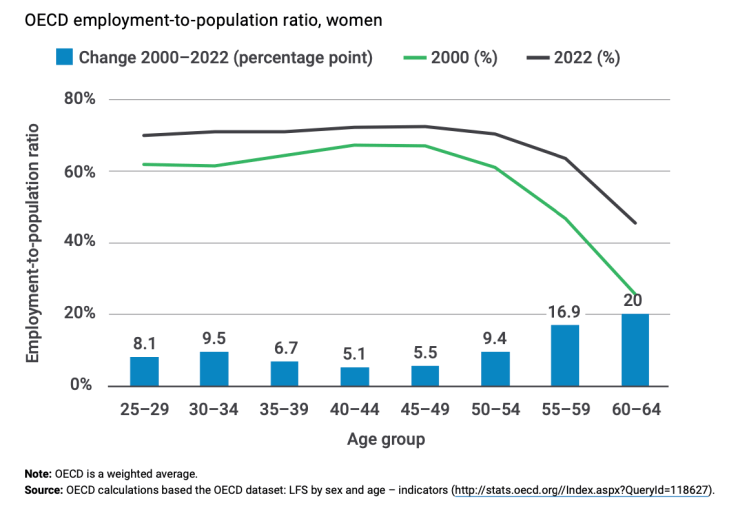
The message is clear. “Business as usual” is not an option. Across countries, the employment age profile follows an inverted-U shape; employment rises and peaks around age 45 and then declines sharply after age 50. This is more accentuated for women, but being male and highly educated pushes the inevitable downturn out only by a few years. Already, workers aged over 45 account for an outsized share of the long-term unemployed – 44 percent on average in the countries surveyed. With more ageing in store everywhere, until societies begin to bend this curve, a bad situation will only get worse.
The study, however, found strong grounds for optimism.On the one hand, the stereotype against older workers is still very present: hiring managers cling to a deeply held perception bias against job candidates over the age of 45 – they believe members of this age cohort are less able to adapt to new technologies or learn new skills. On the other hand, those very same managers also acknowledge that when they do hire people over 45, those workers perform on the job just as well as or even better than their younger counterparts. As prior OECD research has suggested, companies with thriving intergenerational workforces tend to see higher productivity than those skewed too heavily toward just one end of the age spectrum. Moreover, midcareer and older workers who switched jobs declared themselves significantly more satisfied with all dimensions
of their work compared to same-age peers who have yet to land on a new career track.
Despite the clear links to improved job performance and satisfaction, however, opportunities for midcareer job switches remain limited. Age is of course the greatest barrier, but it is not the only one. Location and physical wellness, among other things, constrain midcareer and older workers seeking new opportunities for career progression. These barriers do not inhibit younger age cohorts to the same extent, thus reinforcing biases against midcareer workers that persist despite contradicting evidence. Removing such barriers widens the talent pool employers can draw from and unlocks the undervalued benefits of an inter-generational workforce.
How can these barriers be removed, and how can the powerful “age-performance paradox” – the gap between negative perceptions about the performance of older workers and their actual performance – be reconciled? Empowering workers to extend their workspan alongside their lifespan demands a host of smart micro-interventions. Older workers will need to reassess their own biases. For example, many older workers overvalue experience, whereas employers put a premium on candidates who have engaged in relevant training and upskilling. Since engagement with training tends to decrease with age for multiple reasons, employers and policymakers should consider more targeted interventions, aimed at making training more engaging – and in some cases more affordable – for workers around that critical midcareer moment of age 45 and older.
Governments will need to rethink support for increasingly outmoded early-retirement incentive schemes that harm both sides of the labour market. Finally, employers should consider altering their recruiting processes to remove the pervasive biases that currently exist against midcareer and older job candidates.
Lasting change happens fast and slow. The steady shifts in demography at the core of this report have been visible and predictable for decades. Their consequences are now upon us. By contrast, the sudden acceleration in technology, especially the capability of artificial intelligence (AI), which promises to change almost every aspect of the workplace, caught much of the world off guard. How AI will play out is still unclear, but two things are certain. First, midcareer and older workers will need to keep building their skills, particularly digital ones, and be included as employers embrace AI. Second, leaders and citizens need not – and should not – wait a moment longer to start seizing the opportunities that an ageing workforce presents in tandem with other megatrends. As the pace of change increases, our response must be similarly swift.
What both the AI and ageing revolutions have in common is this: the extent to which they alter our societies for good or for ill will very much depend on how we choose to respond.

Chosen excerpts by Job Market Monitor. Read the whole story @ The Midcareer Opportunity: Meeting the Challenges of an Ageing Workforce | READ online



 Job Market Monitor
Discussion
Trackbacks/Pingbacks
Pingback: AI and the Future of Skills – Healthy human adults share some basic skills that AI systems do not have | Job Market Monitor - January 24, 2024
Pingback: AI and the Future of Work – Almost 40 percent of global employment is exposed to AI, with advanced economies at greater risk | Job Market Monitor - January 25, 2024
Pingback: Artificial intelligence (AI) and Skills – High-exposure occupations comprise a third of all vacancies in OECD countries in the sample | Job Market Monitor - April 30, 2024