This analytical report presents a review of evidence regarding access to, and the process of acquiring, skills for the green economic transition across initial vocational education and training (IVET), as well as lifelong learning (LLL) opportunities for people already in the labour market. The report focuses on groups in society that may be particularly affected by the greening of the economy. The policy context for this paper is provided by the EU’s ambitions for the green transition. These are set out in a number of policy documents that highlight the importance of skills in achieving these green goals. The report focuses on three interlinked aspects: (1) it provides characteristics of green(er) jobs and skills; (2) it assesses the extent to which current education and training provisions ensure equal access to the acquisition of green(er) skills; and (3) it provides illustrative examples of practices adopted by Member States to create equal and just access to green(er) education and training opportunities.
The analysis and conclusions contained in this report are based on a targeted review of literature from international and European-level sources covering EU Member States and assessing the current and future (next decade) situation and trends in the labour market. A broad range of sources discussing green skills in general have been identified during this research project; however, a relative scarcity of sources must be noted regarding the specific topic of access to green skills across education and training provision.
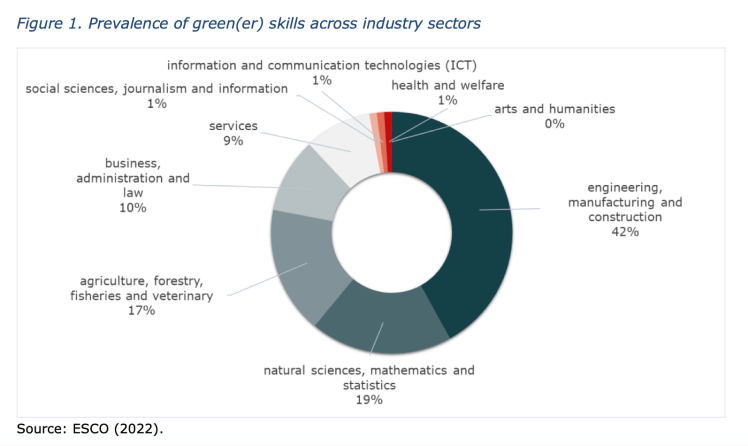
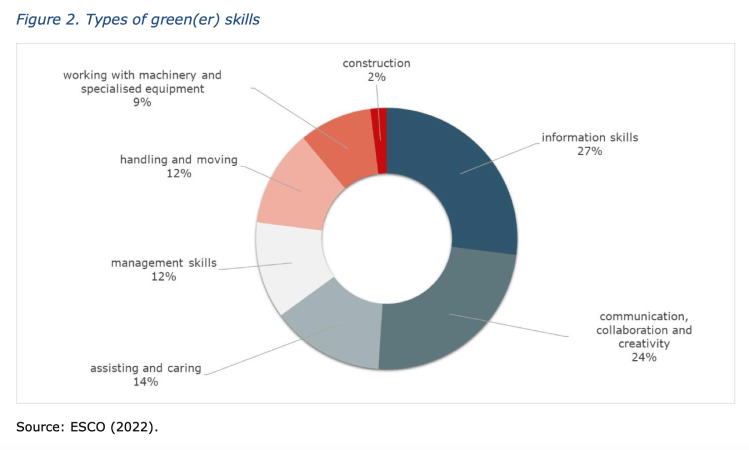
The sources reviewed provide compelling evidence that labour markets are undergoing green transitions. This comes as wider economies move towards decarbonisation, thus requiring numerous sectors to become green(er). Overall, sources suggest that green(er) jobs will require a combination of soft and technical skills, as well as cross-cutting competencies. Until autumn 2022, there was no commonly adopted approach to defining and measuring green(er) jobs and skills at international, EU or national levels. Instead, various organisations and governmental agencies formulated and adopted their own definitions and approaches. This lack of a commonly accepted definition of and approaches to measuring to green(er) jobs and skills made it challenging to form comparisons between jurisdictions. The new definition of ‘skills for the green transition’, developed jointly by the Inter-Agency Working Group on Work-based learning in autumn 2022, focuses on technical and transversal skills. The consistent adoption and application of this approach at international, EU and national levels would be a step in the direction of fostering greater definitional clarity and coherence, and would facilitate more targeted policy planning, implementation and evaluation, as well as enabling comparative analysis.
Ongoing efforts are being made to systematically record and analyse green(er) skills across the spectrum of jobs, in order to better understand trends and needs in employment and the labour market. To this end, several frameworks and taxonomies have been developed by stakeholders. However, there is limited evidence (research, and monitoring and evaluation data), on how these developments are used in practice to inform and transform the provision of education and training offers, as well as access to such provision. This is probably due to the fact that these frameworks are still very new, while updating/adopting curricula usually takes a long time.
Our review identified that greening of the labour market will lead to some groups being particularly affected (both negatively and positively). Gender, age and skills levels were found to be key determinants of potential social inequalities in securing green(er) employment opportunities. However, disaggregating the impact of each of these social dimensions is challenging, due to the intersectionality of disadvantage(s). The evidence reviewed indicates that male workers are transitioning into green(er) jobs at a faster rate than female workers, but that specific male-dominated sectors (such as fossil fuel extraction) are also particularly negatively affected by employment losses due to green economic transitions. Women are also disadvantaged, as many green(er) employment opportunities require technical and managerial / leadership skills, and women are traditionally underrepresented in STEM- related occupations and leadership roles. The evidence also suggests that younger workers will probably benefit from the increase in green(er) jobs, due to their education including green components, as well as the fact that many programmes, particularly apprenticeships, are targeted at young(er) workers. Older workers may be at a disadvantage in acquiring green skills, as they are on average provided with fewer education and training opportunities. In addition, older workers were also found to face challenges resulting from their overrepresentation in sectors experiencing the negative impact of green economic transitions, such as fossil fuel extraction (coal in particular), and due to occupational and seniority downgrading when re-skilling. The evidence reviewed provides inconclusive findings with regard to the impact of the green transition on different skill levels. This is the result of different definitions of green(er) jobs and skills being adopted in studies, and from differing perspectives in looking at short-term vs. long-term impacts. Nevertheless, an increase in overall employment levels is anticipated, with diffused impacts across all skills levels and occupations. Consequently, evidence suggests that skills training and the provision of reskilling and upskilling programmes is required at all skills levels.
As noted above, our review found that the green transition will affect all spheres of society and that everybody will be impacted, but that certain groups in society are already more negatively impacted than others (and will be in the future). However, policies that could ensure equal access to green(er) jobs and skills are still not being systematically, comprehensively and coherently applied across policy areas. This often results in disconnectedness between different policies and approaches aimed at the development of green(er) jobs and skills and addressing the impact the green transition has across society.
The report concludes by providing a set of recommendations for EU and national-level policymakers. These are contextualised within the wider policy priorities relating to COVID- 19 recovery measures and the current energy crisis. The paper includes recommendations to: (1) consistent use of a common definition of green(er) jobs and skills across the EU Member States and internationally; (2) collect relevant social and economic indicators (disaggregated along specific axes of potential inequalities) to monitor trends in employment, education and training; (3) make better use of available resources, taxonomies and frameworks; and (4) ensure coordinated and coherent policy action that takes into account the interrelationships between policy areas.

Chosen excerpts by Job Market Monitor. Read the whole story @ The green transition in the labour market: how to ensure equal access to green skills across education and training systems – EENEE



 Job Market Monitor
Discussion
Trackbacks/Pingbacks
Pingback: Green Skills and Battery Workforce in US – DOE and DOL Announce a Battery Workforce Initiative National Guideline Standards | Job Market Monitor - April 19, 2024