The Federal Reserve has a dual mandate of fostering price stability and maximum employment. Its main tool in this endeavor is the federal funds rate, which it sets based on inflation and measures of economic slack. Slack measures regarding the labor market tend to focus on the quantity of employment (e.g. the unemployment rate) and underemphasize its quality dimension. There has been a growing interest in understanding the role of employer-to-employer (EE) transitions in determining the quality of employment and what this implies for inflation dynamics. EE flows affect production costs via firm competition for workers and the productive capacity of the economy by facilitating labor reallocation between firms. Job mobility is also a key determinant of income dynamics at the individual level and thus impacts aggregate demand—all important mechanisms for the determination of inflation.
In this paper, we quantitatively analyze the positive and normative implications of EE flows for inflation and monetary policy and ask two questions: First, how much and through which channels do EE flows affect macroeconomic outcomes, particularly inflation? Second, what is the optimal monetary policy within a class of Taylor rules, taking EE flows explicitly into account?
Our paper makes three contributions.
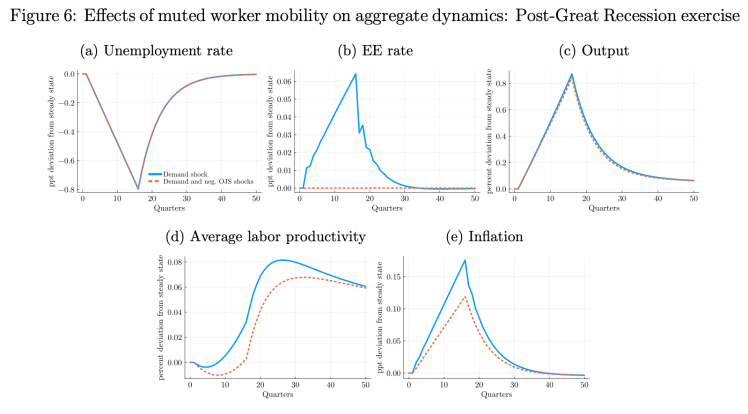
First, we develop a model that combines the Heterogeneous Agent New Keynesian (HANK) framework with a frictional labor market and on-the-job search (OJS). Second, we use the model to quantify the impact of EE fluctuations over the business cycle on inflation. The quantitative framework lends itself to analyzing a broad set of scenarios. We first show that muted worker mobility caused around 0.25 percentage points lower inflation during the 2016–2019 recovery episode, which saw “missing inflation” despite a historically large decline in unemployment.
We also find that the elevated EE rate during the “Great Resignation” of 2021–2022 generated around 0.60 percentage points additional inflation. Critically, our analysis provides a full-decomposition of the channels through which fluctuations in EE transitions affect inflation in the model not accounted for by standard demand and supply shocks.
Third, we study optimal monetary policy within a class of Taylor rules under a dual-mandate central bank objective. The optimal policy prescribes a more aggressive response to the unemployment gap than what is prescribed by the commonly used coefficient on the unem- ployment gap in the literature, and a strong positive response to the EE gap. In practice, this allows the central bank to distinguish recovery episodes where job mobility is high from those where job mobility is low, even in the face of similar unemployment dynamics.
Chosen excerpts by Job Market Monitor. Read the whole story @ Labor Market Shocks and Monetary Policy – Bank of Canada




Discussion
No comments yet.