HIGHLIGHTS
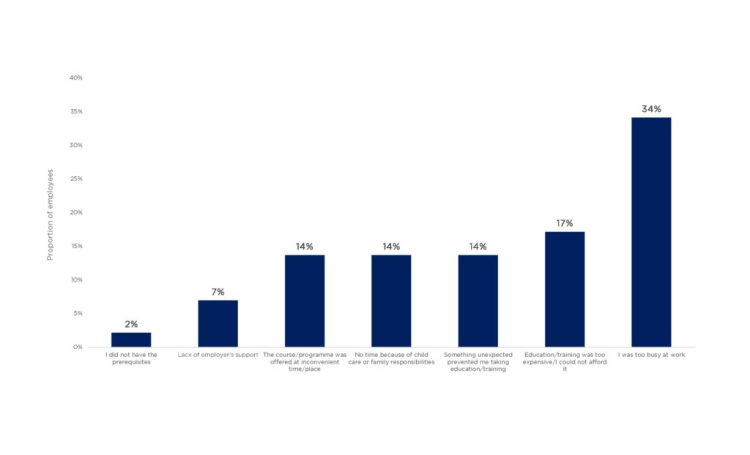
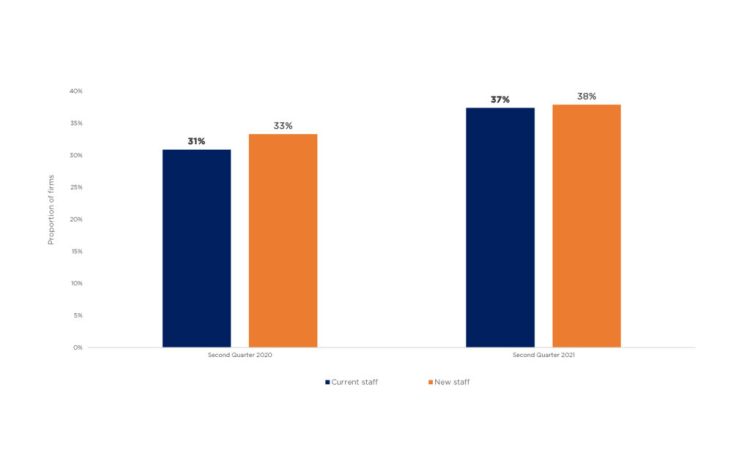
This report offers a picture of employer-sponsored skills training in Canada based the limited data currently available. It covers levels, types, and trends in firms’ training investments, discusses which firms provide (and which employees receive) training, and explores the motivations and barriers firms face in providing training as well as where gaps in the ecosystem require attention.
Data on employer-sponsored training in Canada are largely unreliable, out of date, and ill-suited for comparison across time and jurisdictions. Developing even a rough picture of the role of employers in the skills and training ecosystem is an exercise in bricolage and triangulation that requires frequent choices between using more robust but older data or more recent but unreliable data.
Examining the limited data suggests that employer-sponsored training in Canada is:
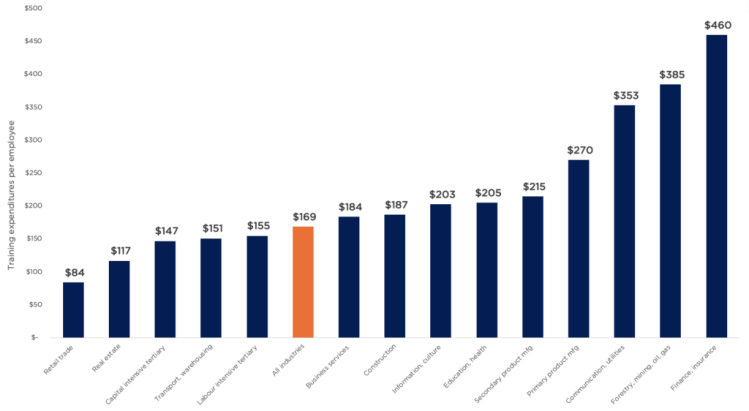
- Limited: Canadian firms invest modestly in training—an estimated $240 per employee annually—and lag their international peers in rates and hours of instruction.
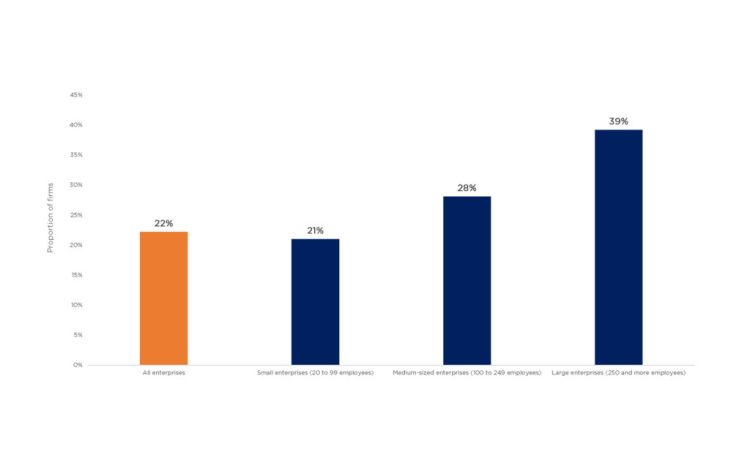
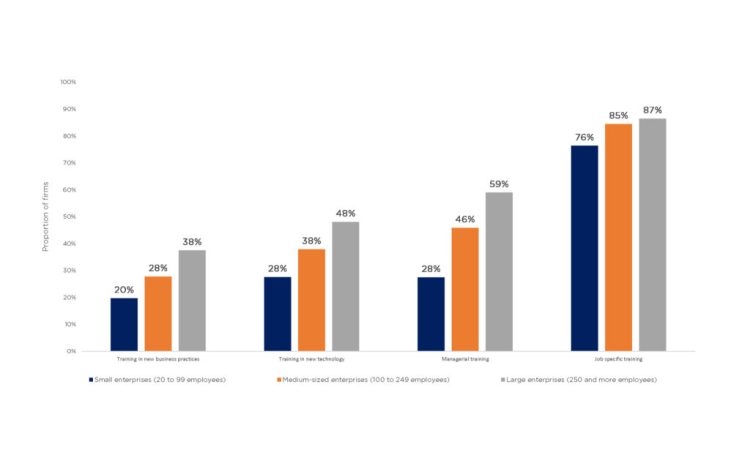
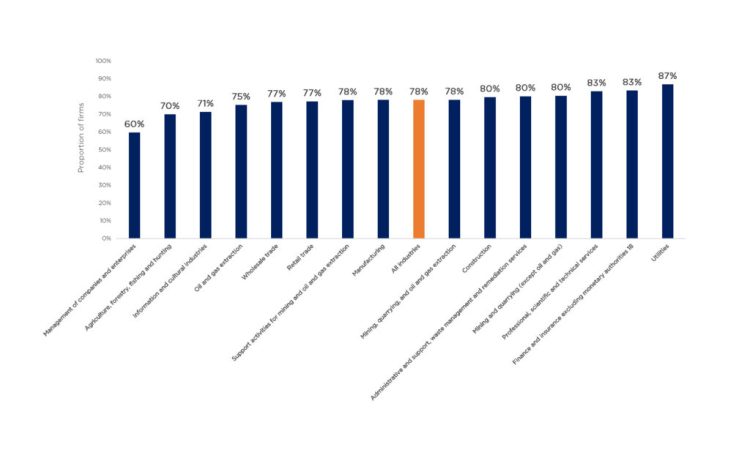
- Concentrated: Larger firms are more likely than smaller firms to provide training. Employers in utilities, finance and insurance, and other knowledge-based, technology-rich industries train at above-average rates, while firms in retail, forestry, and oil and gas extraction provide below-average levels of training. Firms in Québec and Ontario are more likely to provide training than firms in the Prairies or Atlantic provinces
- ROI and workplace-focused: Given their concern for return on investment (ROI), firms tend to invest in training for immediate needs—such as onboarding and orientation, technology adoption, addressing skills gaps, and implementing innovations—and favour on-the-job and at-workplace modes of delivery over classroom and other external options.
- Inequitably distributed: Training is more likely to be offered to employees with higher levels of education; in professional, scientific, and technology-focused roles; in their prime working ages (i.e., aged 25 to 54 years versus 16 to 24 or 55 to 64 years); and in full-time, permanent positions (versus part-time and/or precarious positions).
Gaining a clearer picture of the employer-sponsored training ecosystem and assessing whether policy interventions are achieving results requires better data. We recommend that Statistics Canada design and field an ongoing, representative, large-sample survey that asks consistent questions about training investments and activities; motives and barriers; types, modes, and distribution among employees; use and value of training-related programs and policies; and firm demographics and performance.




Related posts
Firm Investments in Skills in UK – EU Referendum and the Financial Crisis made firms less likely to increase expenditure on worker training
Investments in both human and physical capital are key drivers of economic growth and productivity gains. The United Kingdom has had a turbulent recent history, being strongly affected by the Global Financial Crisis of 2008 and more recently voting to leave the European Union, its largest trading partner. We use firm-level survey data for the … Continue reading
COVID, Reskilling and Upskilling – 42% of companies stepped up their investment while 42% of employees have pursued training on their own after the coronavirus outbreak
Employee reskilling and upskilling training is in the spotlight. Learn how and why companies reskill and upskill their workforce and what employees think. In late 2019, the World Economic Forum issued an alert. Lack of skills was keeping CEOs awake at night. The only way to bridge the skills gap is through upskilling or reskilling … Continue reading
Apprenticeship Levy and Employer Underinvestment in Training in UK – Verdict : Not yet
The UK has suffered a long-term and substantial decline in employer investment in training over past decades. Figures show declining employee participation in workplace training, and that a substantial portion of the training done is only induction or compliance-based. As part of an attempt to reverse the trend, the government introduced the Apprenticeship Levy in … Continue reading
Investment in training – Implementing a training contract reduced quitting by around 15%
Firms may hesitate to provide training which is general enough that it can be used in other jobs, if employees are likely to leave shortly after being trained. A “training contract,” which penalizes the employee for quitting quickly after being trained, may help solve this problem. Using data from a large US trucking company, we … Continue reading
Workforce Training Investments in US / A comparaison
We spend $3. billion in federal funds to prepare people for million jobs (4%) that require middle- skill training. That’s enough to train 451,000 people, a small fraction of the 16 million who could benefit from investments in access to training. We spend $ billion in federal funds to prepare people for 5million jobs (3%) … Continue reading
Skills Gap / SMEs are not confident enough right now to make big investments in training
“We’ve been able to find the types of people that we want as long we are willing to invest in them to bring them to the level of skill that we need,” says Tammy Krings who has something of a happy problem for her growing, Columbus, Ohio-based global travel business, TS24… Millions of small- and medium-sized employers, … Continue reading
The WEF’s 2023 Future of Jobs Report – Six in 10 workers will require training before 2027, but only half of workers are seen to have access to adequate training opportunities today
The Future of Jobs Report 2023 explores how jobs and skills will evolve over the next five years. This fourth edition of the series continues the analysis of employer expectations to provide new insights on how socio-economic and technology trends will shape the workplace of the future. Analytical thinking and creative thinking remain the most … Continue reading
Low Participation of Adults in Training in Europe – 28% say that they lack technical skills and 23% say they lack general skills
In 2019, Cedefop launched a pan-European opinion survey on adult learning and continuing vocational education and training (CVET). The findings show that adults of all ages and across all occupations and qualifications recognise the need for new skills. This need, however, seems insufficient to motivate adults to participate in learning and CVET at the desired … Continue reading
Individual Learning Accounts – Filling the training gaps
Individual learning accounts can make the right to training tangible for all but EU member states will need to raise their commitment. the commission proposes that member states set up personal accounts, with adequate training entitlements, for all adults of working age. Account owners could receive additional entitlements from their employer or other funders and … Continue reading
Training in Canada – Demand-driven approaches
The economic impact of the COVID-19 pandemic has heightened the need for skills development in Canada to help adult learners navigate the rapidly evolving world of work.[1] Even before the pandemic, Canada’s skills development systems were failing to keep pace with changing labour market needs. Technological and demographic changes have increased the pressure on governments … Continue reading
Skills and Credential Chaos in US – New reports find nearly one million credentials and $2t in yearly education and training expenditures
Today, Credential Engine released two reports that offer unprecedented understanding of the credential landscape. The first report, Counting U.S. Postsecondary and Secondary Credentials, offers the most accurate and robust estimate of credentials across 16 categories—including both traditional degrees, certificates, certifications, licenses and apprenticeships as well as non-traditional offerings such as badges. The report estimates that … Continue reading
Workforce Training for Job Recovery – An Opportunity Account
In this analysis, we examine the impacts of the pandemic recession across different dimensions, including employment, labor force participation, and the need to switch industries. This analysis provides texture and evidence to the emerging understanding that women and people of color, working in the service industry, have been the most negatively affected. The challenge of … Continue reading
Canada’s Training Ecosystem – A dire need to link the skills acquired through training and education programs to those sought in the job market
The recent Fall Economic Statement made it clear that the government is committed to investing in skills development to help Canadians weather the post-pandemic recovery. But how can we know what training helps to get the in-demand jobs? In a new paper published by the Institute for Research on Public Policy, Tony Bonen (Labour Market … Continue reading
Apprenticeship in Canada – Less than one-fifth complete their training within the designated time period
Less than one-fifth of people who embark upon an apprenticeship program in Canada complete their training within the designated time period. Less than one-fifth Apprentices in higher-paying apprenticeship positions are more likely to complete their program within a given period of time than those in lower-paying positions, according to a new study. Skilled trades are … Continue reading
Upskilling in US – Policies that combine investments in English language and digital literacy are vital
English is essential – especially for essential workers The Covid-19 pandemic has vividly illustrated the centrality of frontline workers to the everyday functioning of American life. Many frontline workers are immigrants and/or English language learners – not unlike the US workforce overall, in which more than one in 10 workers has limited English skills. The … Continue reading
Employer Skills Survey (ESS) in UK – Three-fifths (61%) of employers had funded or arranged training
The Employer Skills Survey (ESS) has run biennially since 2011, providing a vital source of intelligence on the skills issues employers face. ESS traditionally has an inward- looking focus assessing the current skills position and skills needs of employers. It has sat alongside the Employer Perspectives Survey, which is primarily outward-looking, covering provision of and … Continue reading
The Training System in US – Complicated, hard to navigate, and under-funded
The American job training, or human capital development, system is complicated, hard to navigate, and under-funded. Yet at the same time it has significant strengths and many best practice and effective models. The United States does not have a training system for adults if what is meant by the term “system” is a well-articulated set … Continue reading
Skills in UK – The business case for investment
We live in extremely turbulent times, with major risks and uncertainty for the country’s future and economy. Uncertainty is not just brought about by Brexit, with its challenges of having to put in place international trade deals as well as dealing with the growing likelihood of a recession. The ‘Fourth Industrial Revolution’, arising from AI … Continue reading
US – Few rigorous evaluations exist to measure the success of government-funded training programs the Council of Economic Advisers says
For the first time since the Government began tracking job openings nearly 20 years ago, there are more job openings in the United States than unemployed people looking for work. In fact, there are over 1.6 million more job openings than unemployed people. Because of the Trump Administration’s pro-growth policies, the American worker is in … Continue reading



 Job Market Monitor
Discussion
No comments yet.