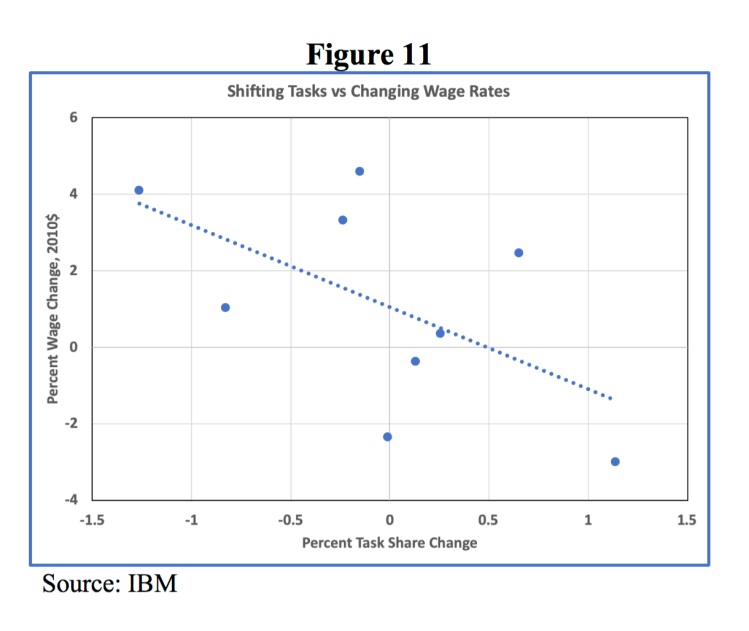
Technology has long brought change to the nature of work, and to the skills required for the most desirable, best-paying jobs. But until recently, new technology – even robotics – has tended to mean automating repetitive or arduous tasks, while often leading to new types of tasks for workers. The emergence of artificial intelligence (AI) and machine learning (ML) poses a new set of opportunities – and challenges – for work and workers. The tasks that can be done by machine learning are much broader in scope than previous generations of technology have made possible. The expanded scope will change the value employers place on tasks, and the types of skills most in demand. As AI and machine learning transform businesses and reshape industries, the innovators of these technologies must consider not only the business implications, but also the societal impact. As a result, the MIT-IBM Watson AI Lab has engaged in a first-of-a-kind research that sheds new light on the reorganization of tasks within occupations by analyzing 170 million online job postings in the US between 2010 and 2017. There is no question that AI and related technologies will affect all jobs. The research reveals how tasks are transforming and what the implications are for employment and wages.

Chosen excerpts by Job Market Monitor. Read the whole story at The Future of Work: How New Technologies Are Transforming Tasks- Artificial intelligence – IBM Research



 Job Market Monitor
Discussion
Trackbacks/Pingbacks
Pingback: AI and the Future of Skills – Healthy human adults share some basic skills that AI systems do not have | Job Market Monitor - January 24, 2024
Pingback: AI and the Future of Work – Almost 40 percent of global employment is exposed to AI, with advanced economies at greater risk | Job Market Monitor - January 25, 2024
Pingback: Online Job Postings and Skills in Canada – Understanding the connection(s) between two skills | Job Market Monitor - January 28, 2025