Technological change, globalisation and the rise of knowledge intensive work are often associated with declining job quality. However, high job quality may have positive effects not only on the well-being and mental and physical health of individuals but also on society and the economy as a whole, leading to greater productivity, competitiveness and economic growth. Thus, since, the main goal of the European Union has been not only the creation of jobs and the reduction of unemployment but also the improvement of job quality. At the same time, a shift towards new welfare, i.e. a stronger emphasis on labour market participation through activation and not on income replacement, has been a major issue in labour market reforms in Europe. In this sense, a new means-tested welfare benefit has been introduced in Germany that emphasises the activation of all welfare recipients.
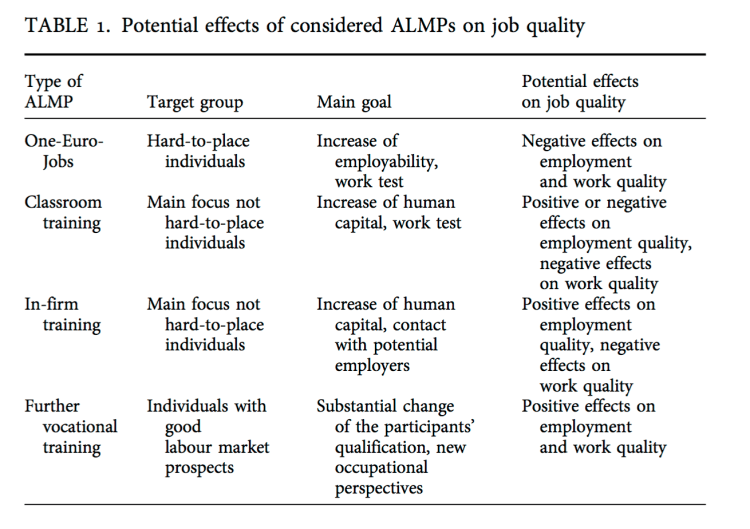
Using rich administrative data on unemployed welfare recipients in Germany and propensity score matching, the author analyses the effects of participating in four major active labour market programmes (ALMPs) on various dimensions of job quality. In Germany, welfare recipients may suffer from poor job quality because they are forced to accept any reasonable job offer. However, few studies consider the effects of participation in ALMPs on job quality. The results imply that participation in a programme not only increases the probability of taking jobs but also increases the probability of holding a high-quality job for some dimension of job quality. In particular, further vocational training is very effective in terms of job quality for West German women. Thus, job centres should focus on the activation of unemployed welfare recipients.
Chosen excerpts by Job Market Monitor. Read the whole story at Effectiveness of Active Labour Market Programmes on the Job Quality of Welfare Recipients in Germany



 Job Market Monitor
Discussion
No comments yet.