In this year’s study, 73% of executives predict significant industry disruption in the next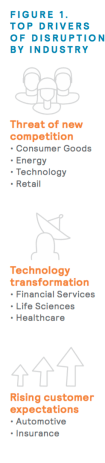 three years — up from 26% in 2018. This sharp shift in perception about the future business environment applies across geographies and industries, although it is most pronounced in the Life Sciences, Consumer Goods, and Energy sectors (Figure 1). More than half of executives expect AI and automation to replace one in five of their organization’s current jobs. But this is only half the story, as AI and automation will also create 58 million net new jobs by 2022, according to estimates from the World Economic Forum. This unprecedented shake- up demands new workforce strategies to stay ahead.
Amid the prediction of disruption lies confidence: Four out of five executives believe their company can lead disruption in their industry, and nearly all are taking action to prepare for the future of work. As organizations ready themselves, there are significant human capital risks — from the inability to close the skills gap to low engagement — that can slow the progress of transformation (Figure 2).
ECONOMIC PRESSURES MOUNTING
There are mixed opinions about this year’s business climate. Buoyed by pro-business policies, some predict the world is on the cusp of significant economic opportunity — with technological advances and innovation promising greater productivity and more balanced lives. At the same time, there is mounting concern that unresolved geopolitical tensions will dampen global growth.
Business leaders worry most about the relentless march of competitors (traditional and new) and the shifting opportunities offered by technology. Concerns around talent migration and corporate responsibility to address societal issues have increased significantly since last year. Add to thatcybersecurity risks and changing business regulations, and companies are facing pressure on multiple fronts.
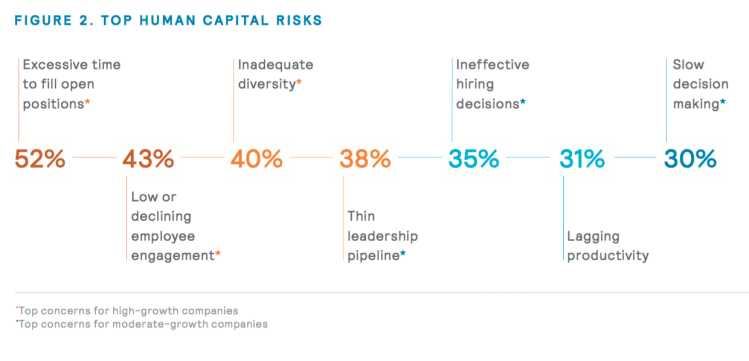
HUMAN CAPITAL RISKS LOOMING
In the Human Age, the most significant threats to successful organizational transformations are rooted in human capital risk, including the stress triggered by individuals feeling a lack of control in the face of uncertainty. Yet only one in three executives rates their company’s ability to mitigate people risks as “very effective.” This perception may be based on a lack of focus — only 29% of HR leaders strongly agree that their business executives prioritize human capital risks.
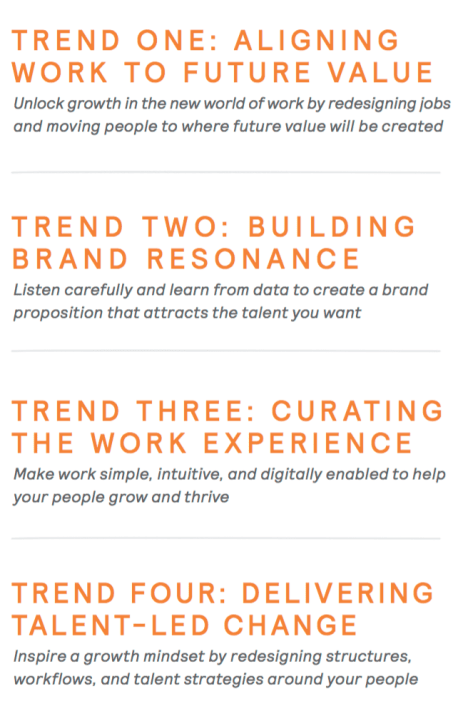
FOUR KEY TRENDS FOR 2019
Chosen excerpts by Job Market Monitor. Read the whole story at Global Talent Trends Study | Mercer 2019



 Job Market Monitor
Discussion
Trackbacks/Pingbacks
Pingback: The Future of Work and Skills Acquisition – A shift in mindset is needed | Job Market Monitor - August 21, 2019
Pingback: The Geography of the Future of Work in US – A mosaic of local economies on diverging trajectories | Job Market Monitor - August 31, 2019
Pingback: Future of Work – Initiatives at O*NET Resource Center | Job Market Monitor - March 22, 2022