This report aims to demonstrate that the time we spend in work is neither natural nor inevitable. Instead, the amount of time we spend in work is a political question. One of the central aims of this report is to establish time itself as a site of political contestation – in the same vein as housing, healthcare, income, and national defence.
The time people spend in the workplace has varied dramatically throughout history, and still today varies widely between countries. What today we consider to be a ‘natural’ amount of time to spend at work is a relatively recent invention. The nine-to- ve, ve-days- a-week model for full-time work has been dominant for just 50 years, and even that is rapidly beginning to change. This report is contemporary with a number of innovative models of work-time reduction currently in practice within the UK and internationally.
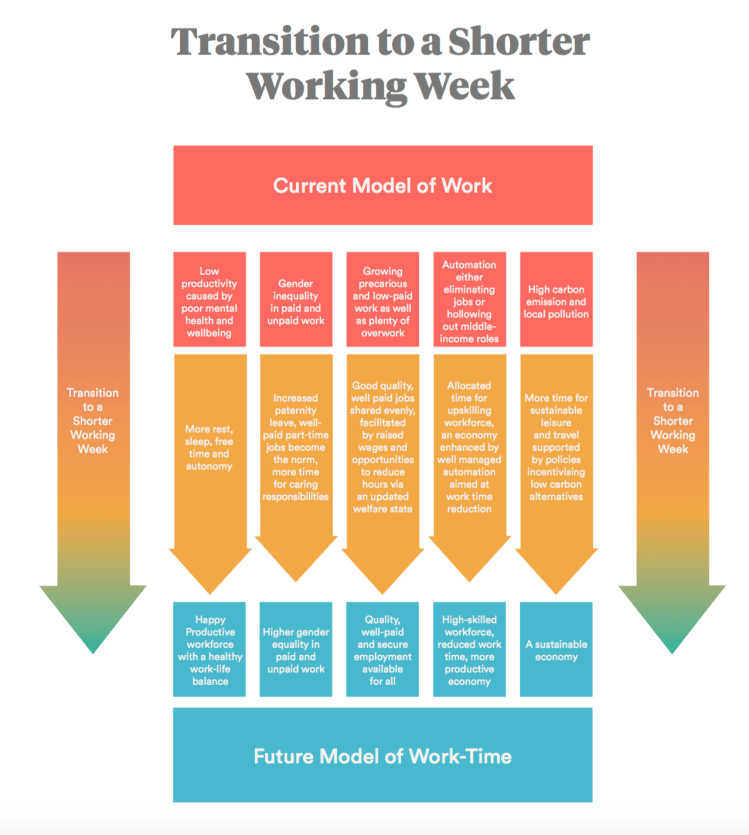
- We note the worrying trends of job polarisation, the explosion of precarious forms of work, gendered inequalities, stagnating productivity growth, the threat (and promise) of automation and the substantial inequality that exists in our society.
- Throughout the report, we make the case that the shorter working week is a powerful and practical response to some of these trends. Importantly, it should be understood that the transition towards a shorter working week is possible now and is not an abstract utopia.
- We show that there is no positive correlation between productivity and the amount of hours worked per day: working to the bone does not make ‘business sense’.
- There are strong indications that reducing the working week can help reduce air pollution and our overall carbon footprint.
- We consider research concerning the importance of non-work time for our mental and physical health and for our sense of wellbeing in general.
- Waged work and unwaged work – such as that which is carried out in the home – should be considered as two sides of one ensemble.
- We make the case that productivity should not be the burden of workers alone.
- Sector-wide trade union coverage is an appropriate component of the decision-making around automation.
- We consider various case studies where a shorter working week was implemented with varying degrees of success.
- We argue that ultimately, a more universal approach to working time reduction is the best way to prevent a ‘new dualism’ between those who can afford free time and those who cannot.
via The Shorter Working Week: a report from Autonomy – Autonomy



 Job Market Monitor
Discussion
No comments yet.