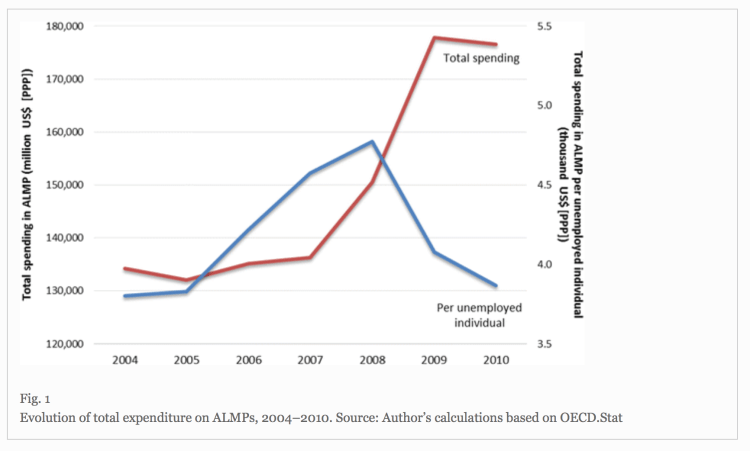
Since the 1990s, there has been a growing interest in ALMPs. Today, expenditure in ALMPs is sizeable in most advanced economies and continues to increase. Between 2004 and 2009, ALMP expenditure grew continuously at an average annual rate of 5.8%, reaching an accumulated growth of 32.5% and a total spending of US$176.5 billion (PPP) in the 5 years to 2009. Only in 2010, this expansion was interrupted and ALMP spending fell by close to 0.7% (Fig. 1). ALMP spending per unemployed individual has also increased in a sustained manner, by an accumulated 25.5% between 2004 and 2008. In 2009 and 2010, however, this upward trend ended abruptly due to the rise in the number of unemployed as a consequence of the crisis.
This paper examines the effectiveness of active labour market policies (ALMPs) in improving labour market outcomes, especially of low-skilled individuals, by means of a pooled cross-country and time series database for 31 advanced countries during the period 1985–2010. The analysis includes aspects of the delivery system to see how the performance of ALMPs is affected by different implementation characteristics.
Among the notable results, the paper finds that ALMPs matter at the aggregate level, but mostly through an appropriate management and implementation. In this regard, sufficient allocation of resources to programme administration and policy continuity appear to be particularly important. Moreover, start-up incentives and measures aimed at vulnerable populations are more effective than other ALMPs in terms of reducing unemployment and increasing employment. Interestingly, the positive effects of these policies seem to be particularly beneficial for the low skilled.
Chosen excerpts by Job Market Monitor. Read the whole story at Are active labour market policies effective in activating and integrating low-skilled individuals? An international comparison | IZA Journal of Labor Policy | Full Text



 Job Market Monitor
Discussion
Trackbacks/Pingbacks
Pingback: COVID and Labor Market Policy – The United States as a whole lags (Canada too) | Job Market Monitor - April 17, 2020