Collective ideas on the image of vocational training not only 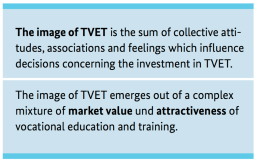 influence individual decisions, but also have a broad impact on the social investment in education and training, in the quality, acceptance in the labour market, and finally, mismatches between supply and demand in the labour market. The concept of collective images refers to:
1. More or less rational estimations of the balance between the costs and bene ts of education and training (market value) and
2. emotionalfactorsthatarecloselyrelatedtofamilialand social expectations, identity and gender concepts as well as role models (attractiveness). It is mainly in the emotional arena that image campaigns can have the biggest in uence.
This study is based on the assumption that image-promoting measures can only be successful, if trust in education and training can be established: Such measures should not, however, promote educational choices which cannot fulfil the expectations a campaign may raise. Therefore, a thorough analysis on the quality, costs and benefits of a certain training programme should be the starting point of each campaign. With regard to the design of image campaigns, this study proposes a scale with four levels for developing, emerging or industrial countries:
1. In countries with a low degree of institutionalisation of Technical and Vocational Education and Training (TVET) and labour markets, it may be advisable to promote only single projects or programmes.
2. In a situation with a low degree of institutionalisation, but where some training institutions have been well maintained, it may be advisable to present these institutions as flagships, even if at first it seems that private or civil society actors are being promoted with federal funding.
3. In countries with solid but poorly connected TVET structures and ineffective labour market structures, it could be helpful to campaign for individual sectors or certificates.
4. In the case of functioning vocational training and labour markets, but with areas of TVET that have a poor reputation, measures for social marketing should be carried out.
Here it may seem that the first levels relate to developing countries, whereas the later ones are typical for industrialised countries. This may be the case, though in our one world a great variety of parallel and overlapping social phenomena exist which can lead to very different characteristics in different branches, occupations or work activities. For this reason, the intent of this study is to suggest a range of ideas and criteria for measures which will enhance the image of vocational education and training in developing, emerging and industrial countries, but which necessarily must be adapted to the specific context of a country.


Chosen excerpts by Job Market Monitor. Read the whole story at Improving the image of technical and vocational education and training



 Job Market Monitor
Discussion
No comments yet.