The reality faced by Europe’s next generation still falls short of what it takes to age in prosperity.
First, many EU countries suffer from surprisingly large foundational skills gaps. Across half of the EU a fifth or more of 15-year-olds performed below proficiency in reading and mathematics in the 2015 Program for International Student Assessment (PISA). In reading, the share varies from around 1 in 10 students in Estonia to a third and more of 15-year-old students in the Bulgaria, Cyprus, Malta, Romania, and the Slovak Republic (see figure). Graduates who struggle with text and numbers are unprepared for learning technical skills later in life in vocational training, university, or in lifelong learning. This matters a lot as machines take over human tasks: Given the growing prominence of cognitive and non-routine tasks in Europe’s labor markets and declining shares of manual jobs, young people with poor foundation skills look towards a highly uncertain job future.
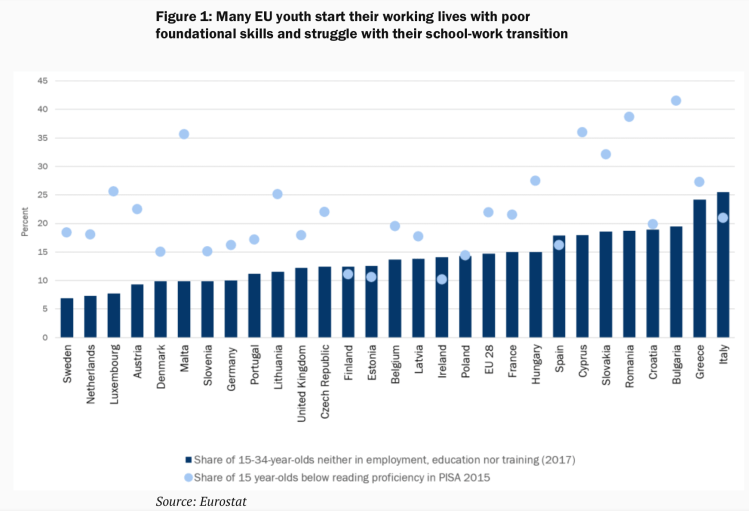
Second, too many young people in the EU struggle with the transition from school to work. Students in several EU countries drop out of school early: in Malta, Spain, and Romania, close to 20 percent of 18-24-year-olds who are out of school have achieved no more than lower secondary education qualifications. Youth idleness is also a challenge: On average, 15 percent of Europeans aged 15-34 are neither in employment, education nor training (NEET). In Italy and Greece, the number is as high as a quarter of the age cohort and in Croatia, Romania, Slovak Republic, and Bulgaria close to a fifth. Poor skills and long spells of idleness and joblessness undermine individual’s productivity potential.
Third, EU countries are increasingly seeing signs of a segmentation of labor markets between younger and older workers. Labor market entrants are much more likely to be in temporary employment than older workers. While temporary employment can facilitate entry into the labor market by reducing the risk to employers, the duration of temporary employment of young people has been increasing and the transition to permanent employment remains limited. Continuous and repeated temporary employment carries long-term productivity risks, as employers and employees are less likely to invest in skills upgrading.
Lastly, averages mask substantial variation by region and family background. For example, NEET rates in Italy vary between 13 percent in Bolzano and 41 percent in Sicily, and variations in performance in the PISA reading test mirror these regional disparities. Most importantly, family background is a key driver of opportunity for youth. Relative to averages, more than twice as many 15 year-olds from the poorest 20 percent of Europe’s student population struggle with text and numbers, according to PISA data. Education in the EU is often not an engine of social mobility, as children’s education pathways and outcomes are often highly correlated with the educational attainment of parents. And children in the EU are much more at risk of poverty than citizens above the age of 65.
Chosen excerpts by Job Market Monitor. Read the whole story at Europe is aging—it’s high time to invest in youth




Discussion
No comments yet.