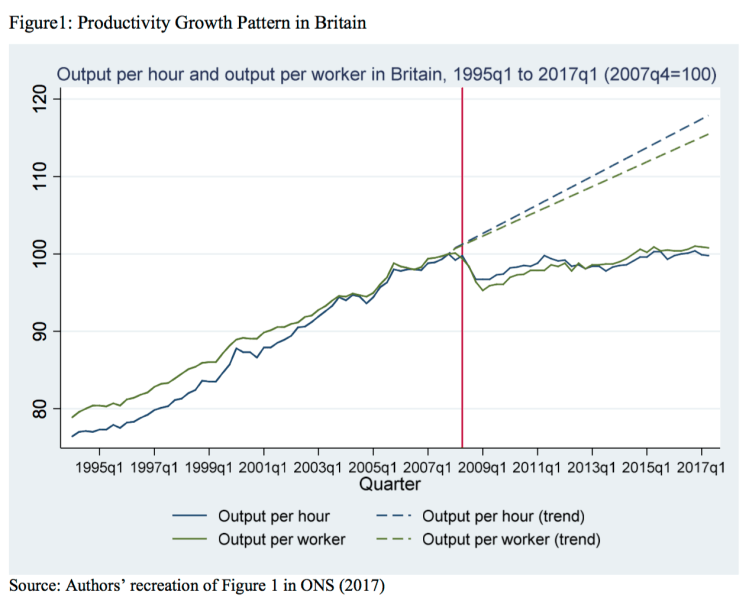
Britain has lagged behind the G7 countries in labour productivity in recent years. There is also an emerging concern about a potential post-Brexit skills deficit. Upskilling the existing workforce via on-the-job training may be a vital policy tool available.
This paper empirically examines the upskilling impact of a UK government-backed accreditation scheme, Investors in People (IiP hereinafter), which has worker training and development at its core. IiP is broadly regarded as providing a benchmark for good organisational training practice. As a result, successive governments in Britain have encouraged the scheme to promote on-the-job training. The evidence on whether the scheme achieves its objective is at best mixed however. At the same time, the current productivity malaise has put the scheme on the spotlight. Notwithstanding the diverse causes behind the productivity slack allude to earlier; it does not bode well for the scheme, which is meant to increase productivity and organisational competitiveness, that there has been a notable slack in productivity in Britain. This calls for firmly established whether the scheme achieves its main objective of worker upskilling.
Using a panel of organisations and their ‘Investors in People’ accreditation status, this paper empirically examines if accreditation promotes upskilling.
Fixed effects estimates reveal that accreditation enhances on-the-job training but only in private sector organisations. Difference-in-differences estimates using unaccredited and di-accredited organisations as alternative matched comparators reinforce the FE findings. Policy may have to further engender accreditation schemes that boost worker upskilling to address the productivity concerns and to cope with the rapid technological changes better.
Chosen excerpts by Job Market Monitor. Read the whole story at Organisational Accreditation and Worker Upskilling in Britain | IZA – Institute of Labor Economics



 Job Market Monitor
Discussion
No comments yet.