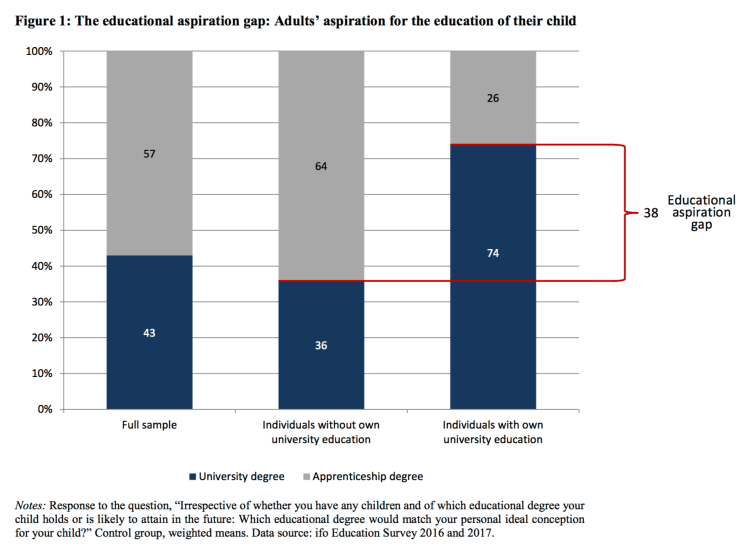
The gap in university enrollment by parental education is large and persistent in many countries. In our representative survey, 74 percent of German university graduates, but only 36 percent of those without a university degree favor a university education for their children. The latter are more likely to underestimate returns and overestimate costs of university. Experimental provision of return and cost information significantly increases educational aspirations. However, it does not close the aspiration gap as university graduates respond even more strongly to the information treatment. Persistent effects in a follow-up survey indicate that participants indeed process and remember the information. Differences in economic preference parameters also cannot account for the educational aspiration gap. Our results cast doubt that ignorance of economic returns and costs explains educational inequality in Germany.
Our results indicate that consideration of the standard parameters of the traditional economic model of educational choices – returns, costs, time preferences, and other traits relevant for intertemporal choices – does not seem to add to an understanding of the educational aspiration gap in Germany. Consequently, there appears limited scope for policy interventions aimed at alleviating imperfect information such as information campaigns to close the gap in educational aspirations. Several other studies have shown that informing (prospective) students about returns and costs can raise educational aspirations and choices in specific subgroups of the population such as low-income students or students who self- selected into an academic track. While these information effects on marginal students clearly carry policy relevance (and are in line with our results), they are uninformative about how information affects overall educational inequality in society.
Independent of the exact reasons for why information provision does not close the educational aspirations gap in our representative German sample, our results have important implications for understanding the mechanisms of the intergenerational persistence of educational attainment. They show that providing information on university returns and costs is not sufficient for aligning the aspirations of those with and without university backgrounds. Thus, the large and persistent inequalities in university access by parental education in Germany do not seem to be due to a market failure induced by asymmetric information regarding pecuniary consequences of educational choices. This is consistent with the literature emphasizing the importance of non-pecuniary reasons for educational choices. One such non-pecuniary reason might be the identity of parents and their children: Parents without a university degree might not aspire to university education for their children because university studies might lead to an alienation of the children from family identities. Similarly, educational aspiration gaps might emerge from differences in the expected consumption value of university education or its cognitive costs . We consider investigation of the empirical relevance of these non-pecuniary explanations for the educational aspiration gap an important area for future research.



 Job Market Monitor
Discussion
No comments yet.