Is automation a labor-displacing force? This possibility is both an age-old concern and at the heart of a new theoretical literature considering how labor immiseration may result from a wave of “brilliant machines,” which is in part motivated by declining labor shares in many developed countries. Comprehensive evidence on this labor-displacing channel is at present limited.
Harnessing a model from Acemoglu and Restrepo (2018), we first outline the various channels through which automation impacts labor’s share of output. We then turn to empirically estimating the employment and labor share impacts of productivity growth—an omnibus measure of technological change—using data on 28 industries for 18 OECD countries since 1970.
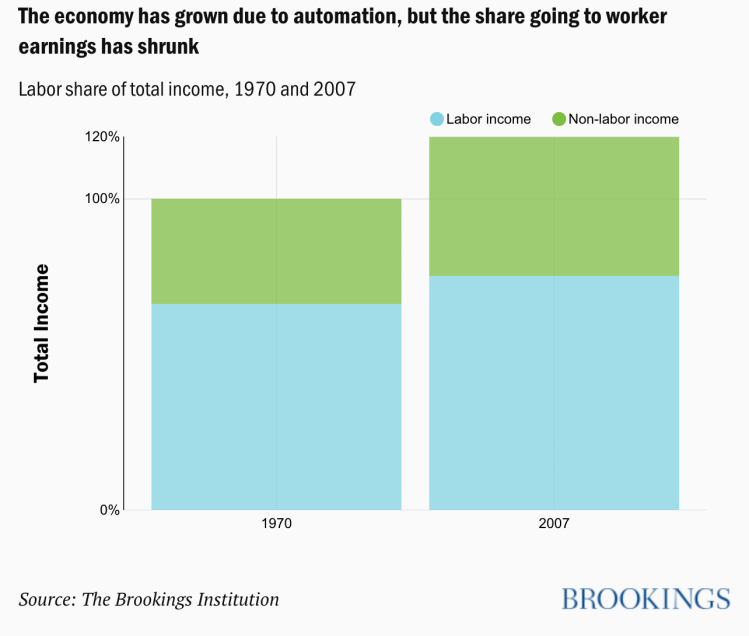
Our main findings are that although automation has not been employment-displacing, it has reduced labor’s share in value added. We disentangle the channels through which these impacts come about by considering both the effects occurring within the advancing industry and spillovers onto the industry’s suppliers and customers, and by separately estimating the wage, output, and price responses to automation. Our estimates highlight that the labor share-displacing effects of productivity growth, which were absent in the 1970s, have become more pronounced over time, largely because of a weakening wage response. This finding is consistent with automation having become less labor-augmenting over time.
Chosen excerpts by Job Market Monitor. Read the whole story at Is automation labor-displacing? Productivity growth, employment, and the labor share



 Job Market Monitor
Discussion
Trackbacks/Pingbacks
Pingback: The Future of work in US – How to rebuild the links among work, opportunity, and economic security for all Americans in the face of accelerating change | Job Market Monitor - April 20, 2018
Pingback: Job Market Monitor - April 26, 2018
Pingback: Future of Work and the Skills Gap – A net positive outlook for jobs, while no less than 54% of all employees will require significant re- and upskilling by 2022, | Job Market Monitor - October 24, 2018
Pingback: The Impact of Automation on Inequality – Increasing it says St. Louis Fed’s study | Job Market Monitor - November 27, 2018
Pingback: The Future of Work – Five policies to help the middle class from displacement | Job Market Monitor - December 15, 2018
Pingback: Future of Work – Fostering the benefits of new technologies requires good measures of their impact | Job Market Monitor - January 23, 2019
Pingback: The Future of Work in US – Five policy strategies for adjusting to automation | Job Market Monitor - March 4, 2019
Pingback: The Future of Work – Artificial Intelligence (AI) impacts on learning, teaching, and education | Job Market Monitor - April 1, 2019
Pingback: The Future of Work and Skills Acquisition – A shift in mindset is needed | Job Market Monitor - August 21, 2019
Pingback: The Geography of the Future of Work in US – A mosaic of local economies on diverging trajectories | Job Market Monitor - September 14, 2019