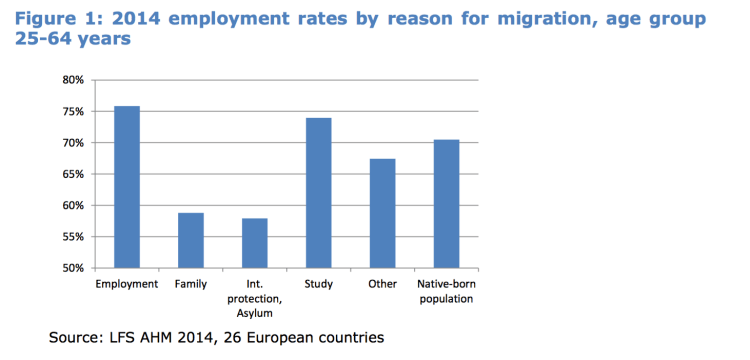
This paper analyses the individual driving factors of refugees’ and family migrants’ labour market performance, using an ordinal logistic regression model. In a basic model, their employment rate is being regressed against the main socio-demographic characteristics (sex, age, education), before a supplementary model includes other information (years of residence, language skills and information about parents) available through the 2014 ad hoc module of the Labour Force Survey dedicated to migration. A second model extends the analysis towards employment dynamics, i.e., refugees’ chances to find employment and their risk to move into unemployment.
The analysis finds evidence that good education helps improve the employment rate of refugees (and family migrants) and their chances of finding a job if unemployed or inactive. However, the improvement is much less significant than it is for native-born workers. Tertiary education, in particular, seems to pay out much less. The analysis concludes that labour market access barriers reduce migrants’ performance on the labour market. There are a number of labour market barriers that are beyond control of the migrants themselves, but rather attributed to ‘being a migrant’: legal obstacles, low acceptance of qualifications acquired abroad as well as discrimination lower the return on education on the labour market. In addition, insufficient language skills are shown to have a large negative effect on the employment rate of refugees and family migrants even after controlling for personal characteristics such as education. Investment into closing the language gap promises a high return to both the newcomers themselves and the economy.
Chosen excerpts by Job Market Monitor. Read the whole story at Publications catalogue – Employment, Social Affairs & Inclusion – European Commission



 Job Market Monitor
Discussion
No comments yet.