The increasing age of the working population is creating unprecedented challenges for organizations and governments. Coupled with economic and demographic changes, these challenges call for effective and efficient ways to manage an increasingly older workforce.
So far, policy on developing sustainable work and retaining an increasingly ageing workforce has focused on raising the retirement age and reducing retirement benefits. Although such measures can make an impact, they ignore the nature of work. The importance of the workplace for supporting sustainable and productive work for UK businesses as a whole and the ageing workforce has been neglected.
Workplace innovation practices
The interventions focused on workplace innovation (WI) practices. WI is defined as “strategically induced and participatory adopted changes in an organization’s practice of managing, organizing, and deploying human and non-human resources that lead to simultaneously improved organizational performance and improved quality of working life” (EU-OSHA, p. 8; Pot, Dhondt & Oeij, 2012). The interplay between workplace practices and participative process is central for workplace innovation and its dual aim of promoting productivity and quality of working life.
Rich research evidence exists to show that WI is important for a range of work outcomes such as engagement, job satisfaction, turnover, and productivity. With this project we also examine the evidence that WI can impact retirement. Specifically, we developed interventions around four elements of WI practices: jobs and teams; organizational structures, management and procedures;employee-driven improvement and innovation; and co-created leadership and employee voice.
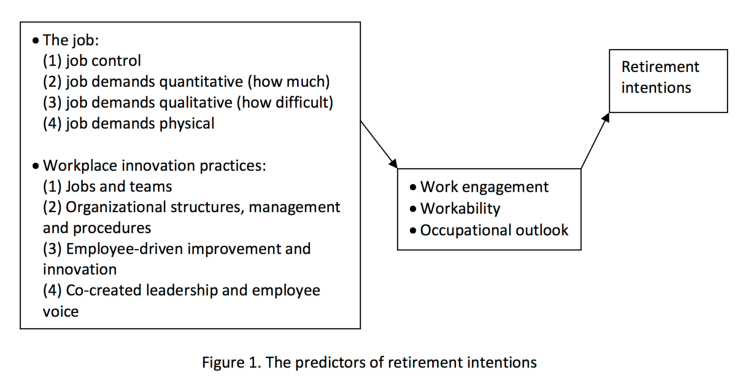
Source: project findings



 Job Market Monitor
Discussion
Trackbacks/Pingbacks
Pingback: Retirement Security: It’s Not Just About the Money – League of Greying Panthers - May 24, 2017
Pingback: Strive Consulting Named Best and Brightest Company to Work For in Atlanta - Atlanta Small Business Journal - June 1, 2017