In Norway, all young people completing compulsory school have a statutory right to three years of upper secondary education. Half of them choose between eight VET programmes.
At upper secondary level, Norway has a long-standing tradition of national and regional cooperation between educational authorities and the social partners. At national level, cooperation is organised in the National Council for VET (Samarbeidsrådet for yrkesopplæring – SRY), nine vocational training councils (Faglige råd), one for each programme area, and national appeal boards (Klagenemnder). Regional cooperation involves county vocational training boards (Yrkesopplærignsnemnder) and examination boards (Prøvenemnder).
Tripartite cooperation aims to ensure training provided to Norwegian VET students meets labour market and skill needs. It informs changes in the VET structure, curriculum development, regional structure and volume of VET provision, the framework of examinations leading to trade or journeyman’s certificates and quality control at all levels. At ISCED level 4, the social partners participate in the National Council for Vocational Colleges. In higher education, institutions are requested to set up a consultative council for cooperation with social partners.
Norway has a unified education structure, with VET integrated as an equal to general education in upper secondary education. Most education at this level is provided by public schools. Since pupils have a right to attend upper secondary education, most choose to do so. Pupils are entitled to select upper secondary VET programmes of their choice.
More than half of trade and journeyman’s certificates are awarded to people over 23.
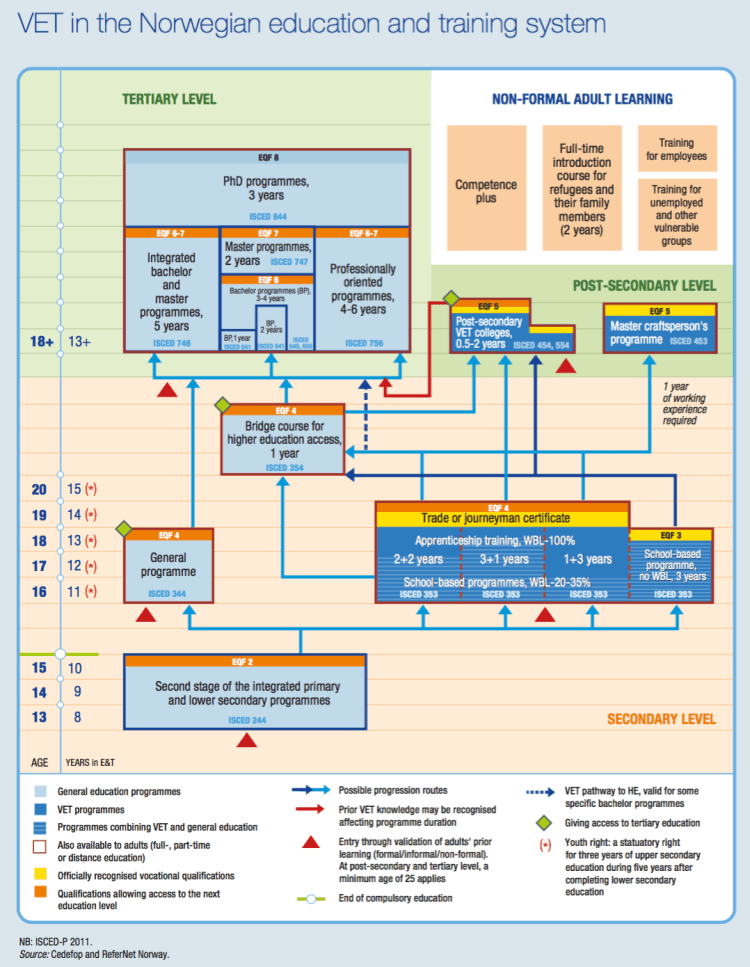
Chosen excerpts by Job Market Monitor. Read the whole story at Spotlight on VET Norway | Cedefop



 Job Market Monitor
Discussion
No comments yet.