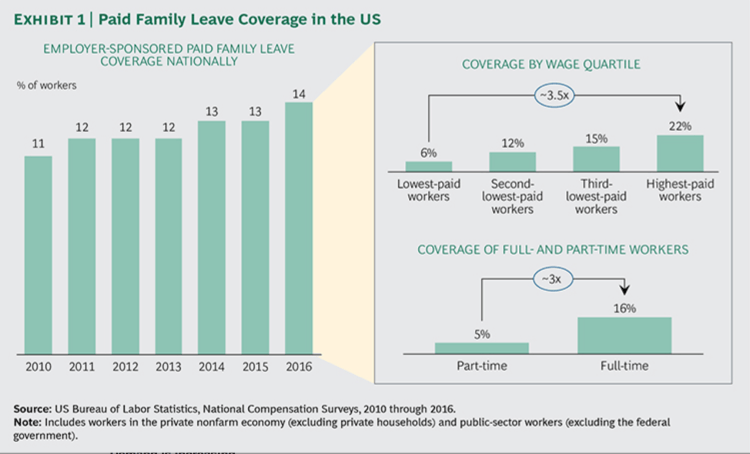
A growing number of companies are moving to provide paid family leave for their US employees—and they’re not all in industries you might expect. In addition to technology, financial services, and professional services firms, such organizations include food and beverage manufacturers, retail and food services companies, and even the US Department of Defense. And while paid family leave has traditionally been available only to birth mothers, companies are now making their policies much more expansive (covering all types of employees) and inclusive (covering all parents, all types of families, and a variety of personal events, such as the illness of a family member).
Why the shift? To answer this question BCG reviewed the policies of more than 250 companies and interviewed 25 HR leaders at large organizations. Our finding: , including benefits such as improved talent retention and attraction and their own ability to manage the costs of the program through thoughtful policy design.
Chosen excerpts by Job Market Monitor. Read the whole story at bcg.perspectives – Why Paid Family Leave Is Good Business
Related Posts
Parental Leave around the World – Which Countries Have the Most (Infographic)
Most leave policies around the world offer fully paid or partially paid time off. This pay is financed in a variety of ways including by individual employers and by the government. In addition to maternity leave and paternity leave, many countries allow for parental leave. This is extra leave that parents can take after the … Continue reading
Work-Life Balance around the World
Global management consulting firm Hay Group has delved into its database of employee surveys to explore how people feel about their work/life balance as well as the support they receive from employers. More than two-thirds (39%) of respondents don’t believe they have a good balance between their work and personal lives. Above: Responses to the … Continue reading
Canada – The majority of parents are satisfied with their work-life balance
Overall, most parents who work full-time are satisfied with their work-life balance. In 2012, 3 out of 4 parents said they were satisfied or very satisfied with this balance (75%). The others were “neither satisfied nor dissatisfied” (15%), “dissatisfied” (8%) or “very dissatisfied” (1%). Of the parents who said that they were not satisfied, the most frequently mentioned … Continue reading
Paid Parental Leave in US – What are the true economic effects ?
What are the true economic effects of paid leave? Real-life experiments are underway in three states that already have operational paid leave programs: California, New Jersey and Rhode Island. Their experiences — particularly California’s, where the policy is a decade old — offer some answers. (New Jersey’s started in 2009 and Rhode Island’s last year.) … Continue reading
Shared Parental Leave in UK- One in five HR directors not ready
More than one in five (21%) HR directors admit they are not ready for the requirements of the shared parental leave legislation that comes into effect on 1 December, according to research by HCM solutions provider ADP. The Workforce View 2014/15 is the latest annual barometer of the views and attitudes of UK workers. It … Continue reading
Shared Parental Leaves in UK – 63% said they were either interested or very interested
Employee interest in shared parental leave (SPL) will be much higher than originally forecast by the government, according to research by law firm Linklaters. Linklaters surveyed 250 recent parents and parents-to-be working in FTSE 100 companies about SPL, which comes into force on 1 December 2014. Almost two-thirds (63%) said they were either interested or … Continue reading
UK – 54,000 new mothers may be forced out of their jobs each year report says
New research suggests that around 54,000 new mothers may be forced out of their jobs in Britain each year. These findings are based on a survey of over 3,200 women by the Equality and Human Rights Commission, in which 11% of the women interviewed reported having been dismissed, made compulsorily redundant where others in their … Continue reading
Labor force participation among young moms and dads in US – Mothers are working a greater portion of the year
Over the past four decades, the labor force has changed dramatically. Women’s labor market participation rates have risen, and women are increasingly working throughout their adult lives. One consequence of these changes is that men’s and women’s roles have been converging, with men taking a more active role at home, doing a greater share of … Continue reading
UK / 67% of working mothers believed having children has hindered their progress at work
Employers are being warned they are wasting talent after research highlighted career progress is being hindered for more than two-thirds of women who return to work after having a child. Women who return to work after having children feel they are being held back in their careers. Research by banking group Santander has found 67% … Continue reading
Retaining Workers – Three actions employers are taking
Based on interviews with Express franchise owners in regions across Canada and the United States, Express has identified three actions employers are increasingly taking to improve employee retention. Raising Pay “It’s a wage war right now,” said Jeff Rey, Express franchise owner in Howell, Michigan. “Even small increases in wages can be enough to entice … Continue reading



 Job Market Monitor
Discussion
No comments yet.