The SAT provides a measure of academic inequality at the end of secondary schooling. Moreover, insofar as SAT scores predict student success in college, inequalities in the SAT score distribution reflect and reinforce racial inequalities across generations.
In this paper, we analyze racial differences in the math section of the general SAT test, using publicly available College Board population data for all of the nearly 1.7 million college-bound seniors in 2015 who took the SAT. (We do not use the newest data released for the class of 2016, because the SAT transitioned mid-year to a new test format, and data has so far only been released for students who took the older test.) Our analysis uses both the College Board’s descriptive statistics for the entire test-taking class, as well as percentile ranks by gender and race. (The College Board has separate categories for “Mexican or Mexican American” and “Other Hispanic, Latino, or Latin American.” We have combined them under the term Latino.)
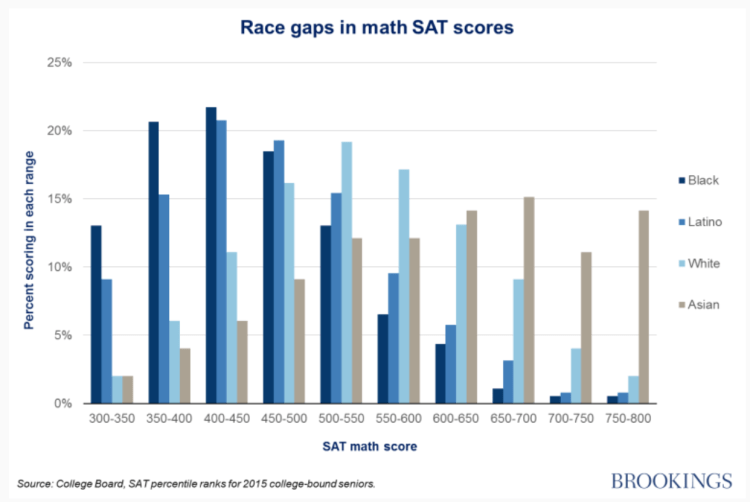
The mean score on the math section of the SAT for all test-takers is 511 out of 800, the average scores for blacks (428) and Latinos (457) are significantly below those of whites (534) and Asians (598). The scores of black and Latino students are clustered towards the bottom of the distribution, while white scores are relatively normally distributed, and Asians are clustered at the top:
Chosen excerpts by Job Market Monitor. Read the whole story at Race gaps in SAT scores highlight inequality and hinder upward mobility | Brookings Institution




Discussion
No comments yet.