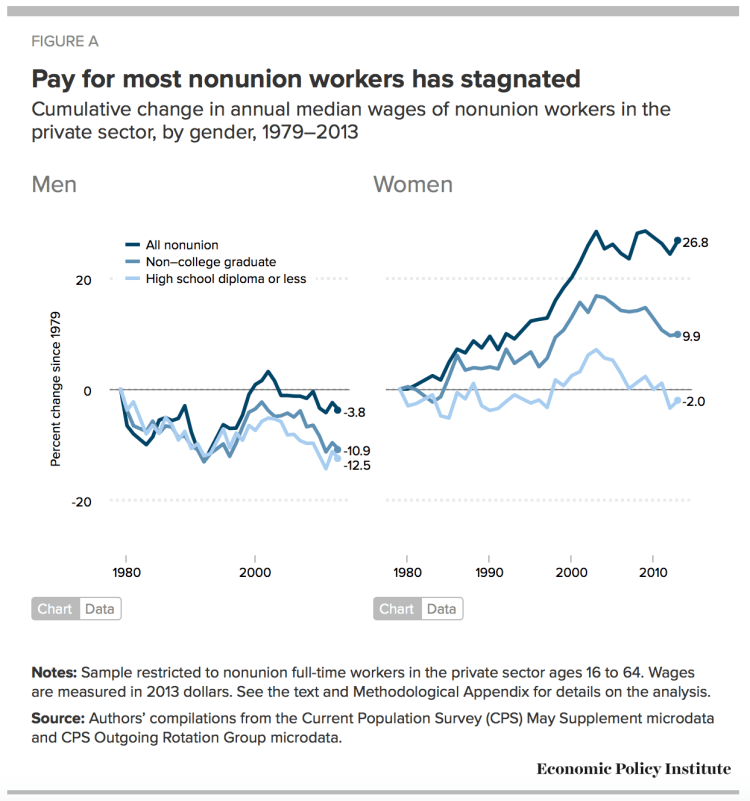
Pay for private-sector workers has barely budged over the past three and a half decades. In fact, for men in the private sector who lack a college degree and do not belong to a labor union, real wages today are substantially lower than they were in the late 1970s.
In the debates over the causes of wage stagnation, the decline in union power has not received nearly as much attention as globalization, technological change, and the slowdown in Americans’ educational attainment. Unions, especially in industries and regions where they are strong, help boost the wages of all workers by establishing pay and benefit standards that many nonunion firms adopt. But this union boost to nonunion pay has weakened as the share of private-sector workers in a union has fallen from 1 in 3 in the 1950s to about 1 in 20 today.
While we avoid strict causal claims about wage determination, the analytical approaches summarized in this report enable us to assess the independent effects of union decline on wages and lend confidence to our core contention that private-sector union decline since the late 1970s has contributed to substantial wage losses among workers who do not belong to a union. This is especially true for men. And most hurt by the decades-long decline in the nation’s labor movement are those nonunion men who did not complete college, or go beyond high school—groups with the largest erosion of union membership over the last few decades.
Chosen excerpts by Job Market Monitor. Read the whole story at Union decline lowers wages of nonunion workers: The overlooked reason why wages are stuck and inequality is growing | Economic Policy Institute



 Job Market Monitor
Discussion
No comments yet.