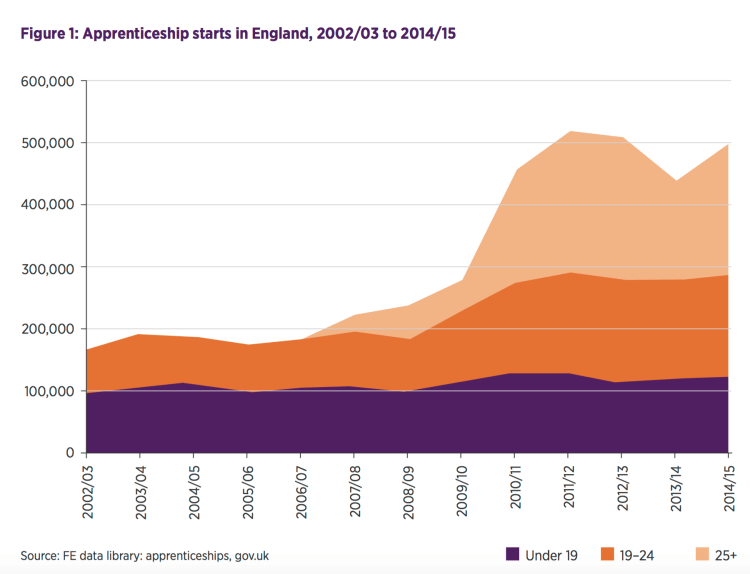
The number of apprenticeships started in England each year has almost tripled over the past decade. The Conservative Government sees apprenticeships as a tool to increase national productivity and improve the wage and employment prospects of individuals. It has launched an ambitious reform agenda to deliver 3 million apprenticeships by 2020 – up from 2.4 million in the last parliament – and at the same time raise the standards of training and assessment.
What has driven the growth in apprenticeships?
The growth in apprenticeships has been driven by a series of ambitious government targets. Grants and wage subsidies have been provided, with money channelled through training providers tasked with recruiting employers. However, the drive for more apprenticeships has taken place in the context of a sharp fall in employers’ investment in training. The average volume of training delivered by employers fell by up to 50% between 1997 and 2012 – with the fall most pronounced for young people. Pressure to deliver, combined with the increasingly loose definition of what counts as an apprenticeship, appears to have led to a focus on learners that are easier and cheaper to qualify…
These trends have raised concerns that the recent growth in apprenticeships largely reflects the rebadging of existing, low- level job-related training as apprenticeships, rather than genuine attempts to build new high-quality routes into work for young people. In October 2015, an unusually acerbic Ousted report highlighted the ‘excessive’ growth of apprenticeships in the service sector that do not reflect the needs of the local economy and in some cases add very little value to either the apprentice or the employer. The report argued that it has become accepted practice for training providers
to accredit the existing skills of people who have already been doing their job for a long time. It highlighted apprentices in the food production, retail and care sector ‘who were simply completing
their apprenticeship by having low level skills, such as making coffee, serving sandwiches or cleaning floors, accredited’ and cases where workers were completely unaware that they were on an apprenticeship (Ofsted 2015a).
Chosen excerpts by Job Market Monitor. Read the whole story at Where next for apprenticeships?



 Job Market Monitor
Discussion
No comments yet.