This article provides information on women aged 25 to 64 in natural and applied sciences occupations in Canada (i.e. scientific occupations), using data from the 1991 and 2001 censuses and the 2011 National Household Survey (NHS). The employment conditions of men and women in these occupations are also examined, based on data from the Labour Force Survey (LFS).
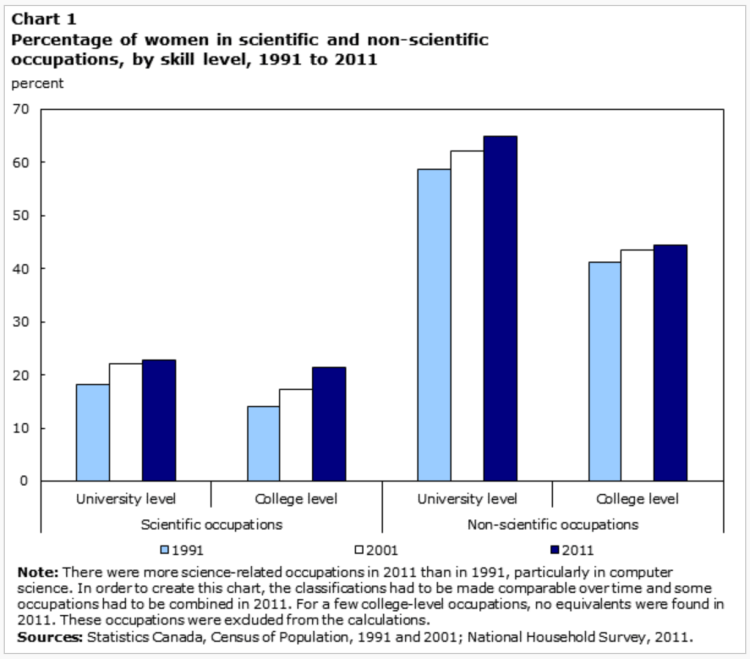
- From 1991 to 2011, the proportion of women in scientific occupations requiring a university education rose from 18% to 23%, and from 14% to 21% in scientific occupations requiring a college education.
- During the same period, the proportion of women in non-scientific occupations requiring a university education increased from 59% to 65%, and from 41% to 44% in non-scientific occupations requiring a college education.
- Between 1991 and 2011, women accounted for 27% of the growth in the number of workers in university-level scientific occupations, but for 75% of the growth in the number of workers in university-level non-scientific occupations.
- Computer science accounted for 60% of the increase in the number of workers in scientific occupations requiring a university education. The smaller contribution of women to the overall increase in the number of scientific workers is related to the fact that they accounted for a smaller share of workers in computer science occupations.
- Workers in scientific occupations generally have better employment conditions. On average, men working full-time earned 9% more than their female counterparts in both scientific and non-scientific occupations.
Chosen excerpts by Job Market Monitor. Read the whole story at Women in scientific occupations in Canada



 Job Market Monitor
Discussion
No comments yet.