Automatic stabilizers are praised since they are rule based and thus operate swiftly and symmetrically across the cycle. However, automatic stabilizers are not a result of macro design but the structure of the social safety net and the taxation system. The participation tax is a key determinant of the strength of the automatic stabilizers. Paradoxically, the disincentive effects of high participation taxes are often discussed at the same time as automatic stabilizers are praised.
The paper considers the sources of automatic stabilizers and whether they (un)intentionally have been weakened via structural reforms to strengthen work incentives. It is considered whether it is possible to maintain strong automatic stabilizers without jeopardizing incentives via the design of the social safety net (workfare) or business cycle-dependent unemployment insurance.
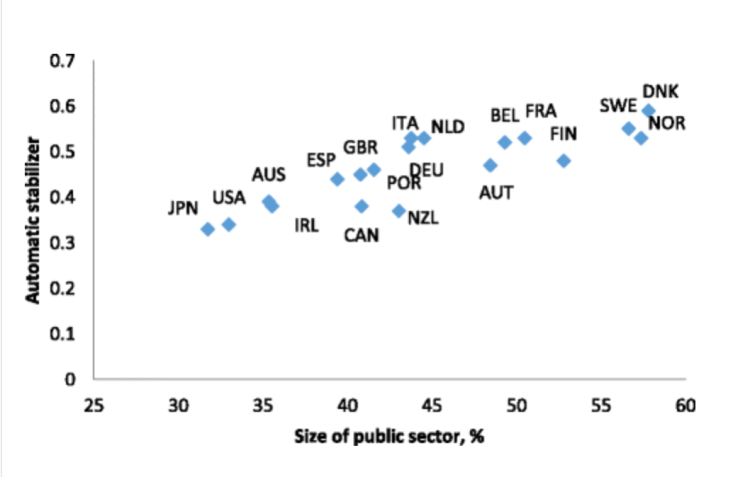
The size/strength of automatic stabilizers is closely related to the extent of welfare arrangements, cf. Fig. 1, i.e. countries with more extended tax-financed welfare states tend to have large automatic stabilizers.
From a policy perspective, it is important that it is possible to strengthen automatic stabilizers without necessarily harming the underlying incentive structure for work and job search. Two such possibilities are workfare elements in the social safety net and explicit business cycle contingencies in the unemployment insurance scheme.
Chosen excerpts by Job Market Monitor. Read the whole story at Automatic stabilizers—the intersection of labour market and fiscal policies | IZA Journal of European Labor Studies | Full Text



 Job Market Monitor
Discussion
Trackbacks/Pingbacks
Pingback: The Impact of Automation on Inequality – Increasing it says St. Louis Fed’s study | Job Market Monitor - November 27, 2018