A number of new commercial online services have emerged in recent years, each promising to reshape some aspect of the way Americans 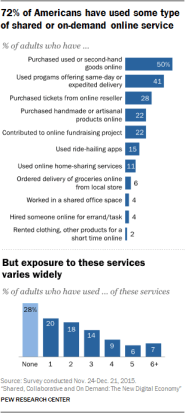 go about their lives. Some of these services offer on-demand access to goods or services with the click of a mouse or swipe of a smartphone app. Others promote the commercialized sharing of products or expertise, while still others seek to connect communities of interest and solve problems using open, collaborative platforms. These services have sparked a wide-ranging cultural and political debate on issues such as how they should be regulated, their impact on the changing nature of jobs and their overall influence on users’ day-to-day lives.
A national Pew Research Center survey of 4,787 American adults – its first-ever comprehensive study of the scope and impact of the shared, collaborative and on-demand economy – finds that usage of these platforms varies widely across the population. In total, 72% of American adults have used at least one of 11 different shared and on-demand services. And some incorporate a relatively wide variety of these services into their daily lives: Around one-in-five Americans have used four or more of these services, and 7% have used six or more.
Chosen excerpts by Job Market Monitor. Read the whole story at The New Digital Economy: Shared, Collaborative and On Demand | Pew Research Center
Related Posts
The Gig Economy in US – About 1% of adults having tried one at some point
One of the most-hyped changes to the U.S. labor market has been “the rise of Uber and its ilk”—companies that use smartphone apps to connect workers to gig jobs. The most prominent example of this phenomenon is, of course, Uber, the ride-hailing service that allows people to summon drivers with an app and pay by the … Continue reading
The Uberization of the economy
The tidal wave sweeping through the American economy has already reshaped the political landscape — from the rise of an anti-Wall Street movement on the left to the Tea Party on the right — and is sowing frustration among a large mass of voters. “Whether America will be America or not hinges on whether we … Continue reading
The Digital Economy – Dislocations in labor markets, with old industries and jobs disappearing Don Tapscott says
In the book, I warned that technology might actually destroy more jobs than it was creating. I asked, “How will we manage the transition to new types of work and a new knowledge base for the economy? ”Now, for the first time in modern history, economic growth in OECD countries is not generating a commensurate … Continue reading
Freelance economy and the future of work
Are these types of platforms an economic boon to workers who want a flexible way togenerate income? Or are they the latest sign of worsening income inequality and a fraying safety net for workers? The answer is a little bit of both. Recent research from the McKinsey Global Institute examined the economic potential associated with … Continue reading
Skills Gap and Talent – Digital platforms could reduce employee-related costs by up to 7 percent
Businesses deploying digital labor platforms to their full potential could increase output by up to 9 percent, reduce employee-related costs by up to 7 percent, and add an average of 275 basis points to profit margins. Chosen excerpts by Job Market Monitor. Read the whole story at Managing talent in a digital age | McKinsey & … Continue reading



 Job Market Monitor
Discussion
Trackbacks/Pingbacks
Pingback: Which Digital Skills Count – Measuring only overall demand can be misleading | Job Market Monitor - November 26, 2018