What is the size of the overall immigrant population, and how does its share of the total U.S. population compare with earlier eras? How many people immigrate to the United States? How many become U.S. citizens? What is the size of the unauthorized population? What jobs do immigrants hold? How do today’s top source countries compare to those in earlier decades?
Some interesting facts:
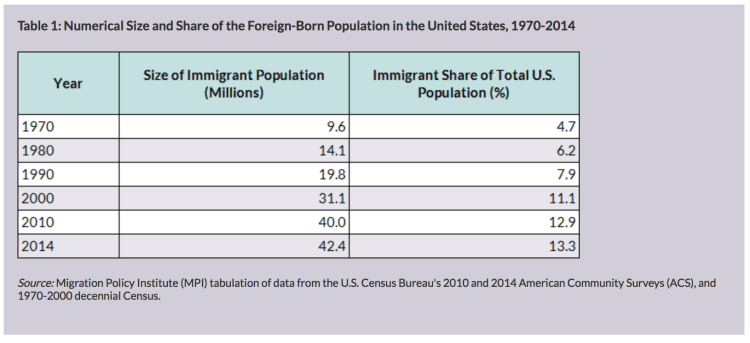
- The overall immigrant population is at a numerical high, reaching 42.4 million people in 2014. However, the immigrant share of the total U.S. population of 319 million, which stood at 13.3 percent in 2014, remains below the 14.8 percent high recorded in 1890.
- 1.3 million immigrants moved to the United States in 2014, an 11 percent increase from the 1.2 million who did so in 2013. India was the leading country of origin (147,500 immigrants), followed by China (131,800), Mexico (130,000), Canada (41,200) and the Philippines (40,500).
- Most immigrants (59 percent) entered the United States prior to 2000, with 29 percent arriving between 2000-2009 and 12 percent entering since 2010.
- In 2014, 46 percent of immigrants (19.4 million people) reported having Hispanic or Latino origins. Of the 55 million people in 2014 who identified themselves as of Hispanic or Latino origin, 35 percent were immigrants.
- Between 2000 and 2014, the five states with the largest percent immigrant population growth were Tennessee and Kentucky (102 percent each), Wyoming (101 percent), North Dakota (99 percent) and South Carolina (97 percent).
- In 2014, approximately 53 percent of all immigrants in the United States had private health insurance (compared to 68 percent of the native born), and 27 percent had public health insurance coverage (compared to 34 percent of the native born).



 Job Market Monitor
Discussion
No comments yet.